The Federal Government has described the criticisms trailing the approval of one billion dollars for the fight against insurgency and other violent crimes in the country as unnecessary and unhelpful.
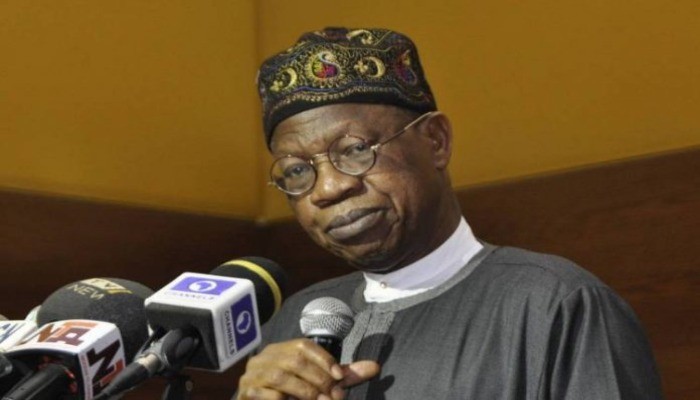
The Minister of Information, Culture and Tourism, Lai Mohammed, expressed this position at a news conference in Lagos.
READ ALSO: Boko Haram Militants Leave 70 Dead in Northeast Nigeria Attack
Further justifying the approval, the Mohammed said military operations in the North East cost the country a lot of money.

He said the aircraft being used for the war, including fighter jets and helicopters, altogether consumed 64,021.08 litres of fuel per day amounting to N15.153million daily to fuel the aircraft.
The minister said that spares for the aircraft from January to November 2017 cost a total of N20,019 million while consumables for the aircraft, and here I am talking of engine oil, plugs etc, amounted to N3.86million monthly
Mohammed said that between November 5th to December 17th, the amount spent on ammunition was over five million dollars.
” Since we are using the Air Force as a reference point here, what about the cost of acquiring air force platforms? For example, the 12 Super Tuscano aircraft recently approved for sale to Nigeria by the US Government costs a whopping $490 million, yet this is Government to Government contract, and the costs of spares, ammunition and other consumables are not included.
READ ALSO: Why Boko Haram is seemingly inexhaustible despite military onslaught

“The costs stated above are for the Air Force alone and restricted to operations in the North East alone.
” We have not even talked of the army or the navy, which are also fully involved in tackling internal security challenges in the country. Neither have we included the operating cost of the Nigerian Air Force in the Niger Delta to curb pipeline vandalism, in the North West to contain cattle rustlers, in the North Central to curtail herdsmen and farmers clashes or kidnappings, armed robberies and separatism in other parts of the country,” the minister said.
Mohammed said there was nothing wrong in the opposition offering constructive criticism as democracy allowed freedom of expression.
He, however, said freedom of expression was not a licence for anyone to distort facts, engage in crass sensationalism or bring partisanship to every issue, especially that concerned security of the nation.
He said the Nigerian Governor’s Forum acted wisely in approving the fund from the Excess Crude Account based on the need to properly fund security operations in the country to adequately respond to threats by Boko Haram and other criminals.
Mohammed pointed out that the approved fund was not to fight Boko Haram in the North East alone but also to tackle kidnapping, cattle rustling, illegal oil bunkering and other crimes.
He expressed dismay that an action intended to make the country safer had been subjected to attacks by people with ulterior motives.
READ ALSO: How prepared are security agencies to tame renewed Boko Haram threat in Abuja?
The minister said that it was wrong to sacrifice the issue of security on the altar of politics, saying opponents of the fund were taking politics too far.
Mohammed said asymmetrical wars were very expensive to fight, adding that even though Boko Haram had been degraded, there was the need to properly fund military operations to enable it to confront insurgents’ threats.
“There has been an unnecessary, uninformed and highly-partisan criticism of the one billion dollars which was recently approved by the Nigeria Governors Forum (NGF) for the military to tackle the security challenges facing the country, including Boko Haram, illegal oil bunkering, kidnapping and cattle rustling.
“I said unnecessary and uninformed because everyone knows the role the military is playing in helping to tackle the numerous security
the crisis facing the states, much less the war against Boko Haram.
“The fact that Boko Haram has been largely degraded does not mean the war is over. As we have said times without number, asymmetric wars like the one against Boko Haram do not end with an armistice.
”It is, therefore, curious that some of those who have criticised the one-billion-dollar approval have hinged their argument on the fact that the Boko Haram has been degraded.