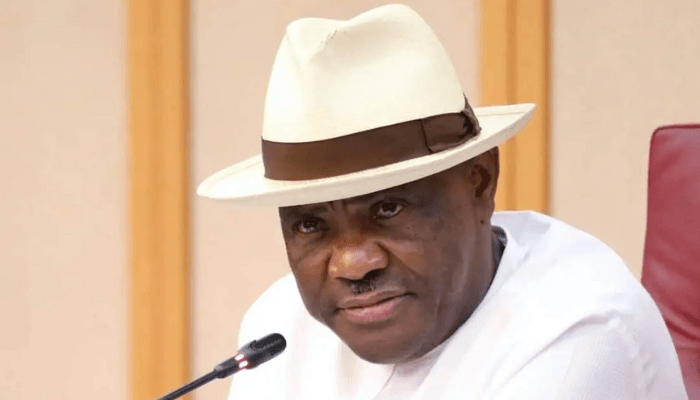
Workers of the Federal Capital Territory Administration (FCTA), under the auspices of the Joint Union Action Committee, on Monday picketed the office of the Nyesom Wike, FCT Minister.
to protest six months of unpaid salaries, non-payment of hazard allowances, the prolonged strike by FCT primary school teachers, and delayed wage awards for health workers.
They issued a three-day ultimatum to the authorities to address their demands.
The workers are also calling for the removal of Emeka Ezeh, Chairman of the FCT Civil Service Commission.
They shut down the Minister’s office, blocking access and stopping staff from entering or leaving the premises.

Rifkatu Iortyer, President of the JUAC, while addressing members during the protest, criticised the FCT administration under Nyesom Wike for failing to fulfil key financial obligations.
She pointed out that the administration had not paid overhead costs, neglected the promotion of eligible retired staff, and introduced inconsistencies in monthly salary payments.
“We’re unable to function properly without overhead funds,” Iortyer stated. “We met with a senior official who claimed that overheads are meant only for directors.
That’s a clear misunderstanding. Overhead funding is essential for daily operations —from maintaining offices to covering basic running costs. Without it, how are we supposed to work?”
She expressed deep frustration over the treatment of retired workers, especially those who were due for promotion before retirement in 2024.

“Many of our members who retired last year were due for promotion, but that never happened,” she explained. “For example, someone qualified to retire as an assistant director ended their career without that recognition. That’s a major setback to their career progression, and it’s irreversible.”
Iortyer also highlighted the irregularity in monthly salaries.
“Do you even know what you earn each month? Because I don’t. One month, it’s this amount; the next, it’s something else. There’s no consistency or clarity.”
In addition, she criticized the administration for failing to pay hazard allowance arrears owed to health workers and condemned the recent stoppage of salaries by the FCT Civil Service Commission Chairman.
“Our health workers — including mortuary staff, cemetery workers, and enforcement personnel — haven’t received their hazard pay. Then, without any proper communication, a letter dated March 10 was issued by the commission’s chairman to stop some salaries. Is that even his responsibility?”
She emphasized that salary adjustments, especially for auxiliary staff, should follow due process.
“There has to be transparency and advance notice when making such decisions. You can’t just cut off people’s pay without warning — especially not in these difficult economic times. That’s the chairman’s doing, and we believe it’s completely unjust,” she added.
Audu Akogwu, Chairman of the Trade Union Congress (TUC), FCT chapter, expressed full solidarity with the protesting workers, harshly criticizing those who opted not to participate.
He labeled them as traitors and accused them of undermining the collective struggle.
He condemned the halting of overhead funding, highlighting that staff were forced to personally purchase basic office supplies like pens and paper just to perform their duties.
Akogwu also took issue with the Minister’s apparent unwillingness to hold Area Council Chairmen accountable for failing to pay teachers and other local government workers who have been on strike.
He questioned whether any of the bailout funds reportedly distributed ever reached the councils.
“FCTA employees are suffering. There’s no overhead funding, and the system is falling apart.
Permanent Secretaries have been stripped of influence, Directors have lost their authority. Workers are funding their own work environments buying stationery from their own pockets,” he said.
“There have been no staff promotions in 2023 or 2024, and now we’re in 2025. No training has been provided either. How can you expect workers to deliver results under these conditions?”
Akogwu pointed out that public primary schools have been shut for over 100 days due to the strike, leaving children out of classrooms while the government claims it has provided bailout support to the councils.
“If those funds were truly disbursed, why is nothing being done? Back in Rivers State, he had total control over local government matters as governor. Why can’t he show that same leadership here and ensure the Area Councils use the money responsibly? I seriously doubt that the funds even got to the councils. And even if they did, are the councils stronger than the Minister himself?”
He issued a warning to the FCT administration, urging the Minister to intervene immediately on behalf of the workers. Akogwu emphasized that the current protest is only the beginning and hinted at more serious actions if their demands are not met.
“Let this message get to him — the workers need urgent help. What you’re seeing now is only the beginning a warning. After the third day of protest, we won’t just demonstrate. We’ll take action.
I will rally every union affiliated with the TUC in Abuja, and we’ll bring all FCT offices to a halt,” he warned.
Also speaking, Tabitha Akila, a Staff of the Abuja Environmental Protection Board (AEPB) expressed frustration over the silence of the minister over non payment of six months salaries to the department.
“We are here because for the past six months, we have not received our salaries,” Akila said. “We wrote letters, but we don’t know if they ever reached the Minister of the FCT. Our director has also betrayed us. We appreciate the little efforts he’s made, but it’s not enough.”
The workers, many of whom have been with the agency for over 15 to 20 years, say they are still operating without official appointment letters. According to Akila, this lack of formal employment status means many are also excluded from pension benefits and other entitlements.
“Some of us have been here for more than two decades, yet we don’t have appointment letters. No gratitude, no pension—how can that be?” she asked.
The situation is further compounded by low wages. Workers claim they are paid just ₦35,000 monthly—far below Nigeria’s current minimum wage, and not nearly enough to cover basic expenses, especially for those commuting from the outskirts of the FCT.
“Transport alone consumes all the money,” Akila said. “If someone from Gwagwalada or Kuje spends ₦2,000 a day on transport, how can ₦35,000 a month be enough?”
While the reasons behind the salary delay remain unclear, Akila said that the minister has allegedly not approved their payments, despite the board submitting the required documentation.
“There’s no explanation. Every year we sign salary registers, and they say they’ve submitted it for approvalbut nothing gets paid,” she said.