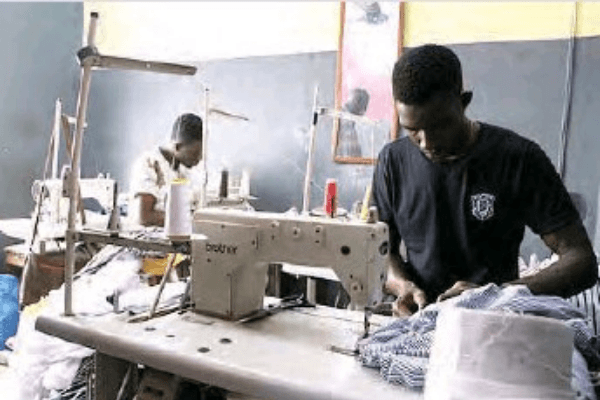
Fashion designers in Aba, the commercial hub of Abia State, have appealed to the state government to create a special cluster for them in Aba.
They argue that a cluster will facilitate conducive environment for the subsector, which is mainly made up of micro entrepreneurs.
Godwin Iheme, managing director, ICI Garments, explained that the Association of Tailors and Fashion Designers (ATFAD), an association of practicing tailors and fashion designers in Abia State, had already applied for land and hoped that the state government would respond positively.
He commended the tailors for their camaraderie disposition and enjoined their leaders to ensure that they maintained the unity that currently existed among them for the good of the association.

He noted that locally made products, although superior to most imported labels, cannot compete favourably with imported finished clothing items due to cost of production.
Read also; Lagos MoT sets up 10-member committee on abandoned vehicles
According to him, for local producers to compete favourably with their foreign counterparts, electricity and other infrastructure must be put right and urged the Federal Government not to relent in its quest to achieve constant power supply in the country.
He stressed that epileptic power supply and multiple t a x a t i o n w e re maj o r challenges faced by the manufacturing sector and urged government to support the sector, which according to him, held the key to the industrial development of the country.
“The industrial cluster system we are asking for is good for developing economies and micro, small and medium scale enterprises, which plays a key role in economic

www.businessday.ng growth,” said Onyebuchi Nwaigwe, president, ATFAD.
“It also ensures equitable development in developing economies like ours for their cont r i bution to employment generation, poverty reduction and wider distribution of wealth and opportunities.
“The potential role of our association in developing the nation’s economy is often not realised because of problems associated with our size and scattered businesses of our members.
“They have difficulty achieving economies of scale in purchasing raw materials.
“It also affects our businesses by discouraging collaborative efforts in purchasing equipment, gaining access to financing opportunities and human capacity development,” the association said.
Nwaigwe explained further that the cluster would enable it to take advantage of available market opportunities requiring large quantity of production, uniform standardisation and regular supply which would boost Nigeria’s economy.