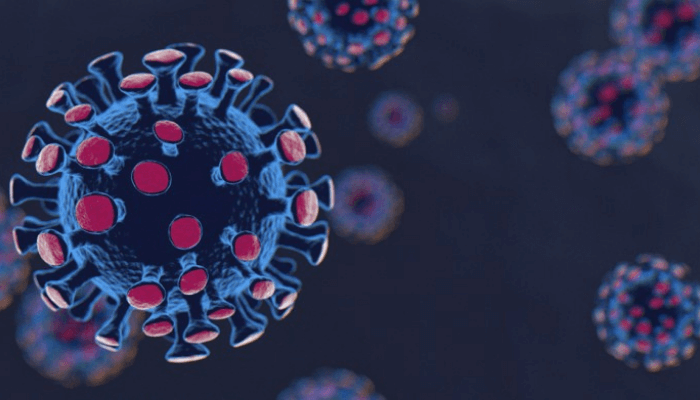
A new variant of COVID-19 has been parading through the town, pushing researchers to unravel the features that define it.
The B.1.1.7 lineage was first detected in the United Kingdom where it has been spreading rapidly from host to host over the past four weeks, at a transmissible rate 70 percent higher than the first strain, SARS-CoV-2.
In what is considered a modest rise, the presence of B.1.1.7 bumped the virus’ reproduction number by 0.4 – from 1.1 to 1.5, according to Maria Van Kerkhove, the WHO’s technical lead on the COVID-19 pandemic.
The increase means that the number of people each infected person goes on to infect rose from an average of just over 1 person to 1.5 people.

READ ALSO: Covid-19: Organisers announces postponement GOtv Boxing Night 22
The process that birthed this variant is called mutation and it has occurred many times since the pandemic was first discovered.
But this time, the lineage has an unusually large number of genetic changes, particularly in the spike protein, forcing researchers to call for enhanced genetic and epidemiological study worldwide and laboratory investigations of antigenicity and infectivity.
According to a virological report, the new variant derived from two genome samples collected on September 20 and 21, respectively, from Greater London.
As of December 15, there were 1,623 genomes in the B.1.1.7 lineage. Of these, 519 were sampled in Greater London, 555 in Kent, 545 in other regions of the UK including both Scotland and Wales, and 4 in other countries.

The same variant has been found in Nigeria but its origin comes from samples collected within the country in October, Osun State in particular, according to Christian Happi, director of the Africa Centre of Excellence for Genomics of Infectious Diseases (ACEGID), and Rosemary Audu, head of Virology at the Nigeria Institute of Medical Research (NIMR).
Out of about 250 samples genetically sequenced since the start of the prevalence of COVID-19, SARS-CoV-2 in Nigeria, scientists at the centre detected a departure in two, later discovered to be the same variant driving a storming second wave of the pandemic in the UK.
Happi, a professor of Molecular Biology and Genomics, couldn’t tell the rate of infection featured in this new Nigerian variant.
“There is no evidence of the Nigerian strain being more infectious than the first strain SARS-CoV-2. We don’t know that yet,” he said.
Will vaccines become irrelevant?
Not so fast. Researchers including Professor Happi say the variant is not expected to weaken the efficacy of the vaccine as Pfizer/BioNTech and Moderna target receptor binding domain, which can face off the new variant.
Germany BioNTech on Tuesday told the Financial Times it could use existing technology to produce a new vaccine against mutations of the coronavirus within six weeks.
Ugur Sahin, BioNTech’s chief executive, said he expects the company’s existing COVID-19 vaccine developed with Pfizer would still be effective against the new virus, “if not the beauty of the messenger mRNA technology is we can directly start to engineer a vaccine within six weeks”.
“As a scientist, you are not optimistic; you thin in likelihood it works relatively high,” Sahin said, noting that experiment still needs to be done to quantify how well it works.
He said it will take two weeks to complete the laboratory work needed to definitely prove whether or not the vaccine already approved for use in the UK, US and EU would still work as effectively.
Ozlem Tureci, BioNTech’s chief medical officer, said the breakthrough mRNA technology used to develop the vaccine would make it easier to tweak the vaccine to target the new variant if required.
Suppression very possible
According to WHO’s Kerkhove, the virus can be suppressed using exactly the same interventions and exactly the same behaviours as before.