|
Getting your Trinity Audio player ready...
|
The out-going year, 2020, was full of political activities, events and issues characterising various political judgments, decisions, defections, elections, among others.
Supreme Court declared Uzodinma Imo governor.
The year was barely two weeks old when a major political event occurred as the Supreme Court on January 14, nullified the election of Emeka Ihedioha of the People’s Democratic Party (PDP) as the governor of Imo State and declared Hope Uzodinma of the All Progressives Congress (APC) as the winner of the March 9, 2019, governorship election in the state.
In the unanimous judgment of the seven-member panel, read by Kudirat Kekere-Ekun, the apex court agreed that results in 388 polling units were unlawfully excluded during the collation of the final governorship election result in Imo State and with the results from the 388 polling units added, Uzodinma polled a majority of the lawful votes and ought to have been declared the winner of the election by the Independent National Electoral Commission (INEC).
INEC conducted 28 rerun elections

The INEC on January 25, 2020, conducted 28 outstanding court-ordered rerun elections distributed across 12 states of the federation.
They comprised, one Senatorial District out of 109; 12 Federal Constituencies out of 360 and 15 State Assembly Constituencies out of 991.
INEC de-registered 74 political parties
INEC on February 6, de-registered 74 political parties for not meeting up with the Constitutional requirements for the existence of a political party in Nigeria.
The Commission however retained 16 political parties that had fulfilled the requirements for existence based on Section 225A of the 1999 Constitution.

The de-registration of the 74 political parties according to INEC was in line with the provisions of the Constitution, which empowered INEC to de-register political parties on the grounds of breaching of any of the requirements for registration as a political party, failure to win at least 25% of the votes cast in one State of the Federation in a Presidential election or 25% of the votes cast in one Local Government Area of a State in a Governorship election, among others.
Supreme Court sacked APC’s Lyon as Bayelsa governor-elect
While APC was still basking in the euphoria of its power capture in Imo, the Supreme Court struck again, taking away the sorrows of PDP as it sacked David Lyon, the APC governor-elect for Bayelsa State on February 13.
Lyon, who was declared winner of the governorship election in the state in November 2019, had barely finished rehearsing how to inspect guard of honour at his inauguration the next day when a panel of Supreme Court Justices led by Mary Odili asked INEC to withdraw the certificate of return issued to him and re-issue another to the candidate with the second highest number of votes, which was the PDP candidate, Diri Douye.
Following the Supreme Court judgment, INEC re-issued certificate of return to Douye on February 14, and he was later inaugurated in the evening of the same date.
Emir Sanusi’s dethronement
In March, the Emir of Kano, Muhammadu Sanusi II, one of Nigeria’s most influential Muslim traditional leaders, was removed from office by Governor Abdullahi Ganduje of Kano State.
The state government attributed his dethronement to insubordination, saying his removal was necessary in order to safeguard the sanctity, culture, tradition, religion and prestige of the Kano Emirate, accusing Sanusi of total disrespect for institutions and the Governor’s office.
Obaseki dumped APC for PDP
The lingering face-off between the Edo State governor and the then national chairman of APC, Adams Oshiomhole, reached a crescendo when the governor on June 16 announced his resignation from the APC.
Obaseki, who was earlier disqualified from participating in the APC governorship primary election ahead of the Edo guber poll, later joined PDP with his deputy, Philip Shuaibu, and they later emerged the party’s governorship and deputy governorship candidates while APC nominated Osagie Ize-Iyamu as candidate for the election.
APC dissolved Oshiomhole-led NWC, appointed Buni caretaker chair
The National Executive Committee (NEC) of the APC at its virtual meeting on June 25 dissolved the Oshiomhole-led National Working Committee (NWC) and appointed a Caretaker/Extraordinary Convention Planning Committee with the Governor of Yobe State, Mai-Mala Buni as chairman.
The NEC’s decision was predicated on the leadership crisis that befell the party after Appeal Court upheld the earlier suspension of Oshiomhole, thereby creating a vacuum that led to the emergence of two parallel National chairmen, Victor Giadom and Hilliard Eta.
INEC conducted first election under COVID-19
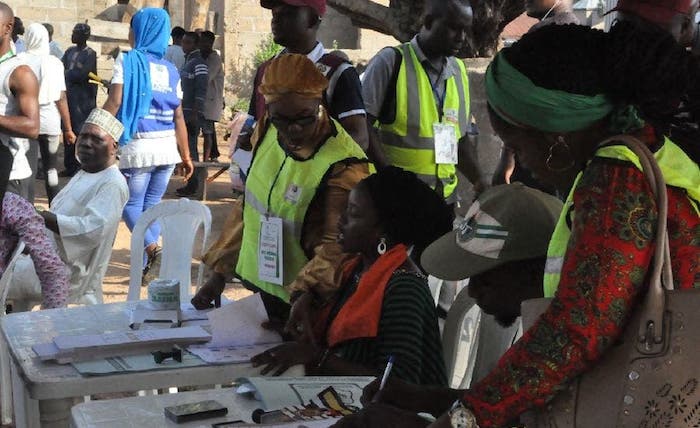
INEC conducted first election under COVID-19 in Nasarawa Central State Constituency on August 8, where the pandemic’s protocol, particularly the compulsory use of face mask, was observed. It was at this bye-election that the INEC RESULT VIEWING (IReV) that enabled Nigerians to view Polling Unit results real time as the voting ended was experimented.
Edo, Ondo governorship elections
The flagship political events in the country in the year under review were the Edo and Ondo governorship elections. First was the tension heightened Edo governorship election held on September 19. At the end of the exercise, INEC declared the incumbent, Obaseki (PDP) winner, having scored a total of 307,955 votes to defeat his closest rival, Ize-iyamu (APC) who polled 223,619 votes. The outcome of the election was accepted by both parties as well as commentators as credible.
Thereafter, the Ondo governorship election was conducted on October 10, and the present governor, Rotimi Akeredolu, candidate of the APC, was declared winner as he polled 244,842, against the PDP candidate, Tayo Jegede, who came second with 150,380 votes.
Umahi, Dogara, others defected to APC
This year witnessed several defections on the political turf, particularly from PDP and other opposition parties to the ruling APC. Prominent among the defectors include Governor of Ebonyi, Dave Umahi, former speaker of the House of Representatives, Yakubu Dogara, both of whom defected from PDP to APC, and former National chairman of PDP and senator, Barnabas Gemade, from the Social Democratic Party (SDP) to APC.
There was also gale of defections in the National Assembly such as the one of an Adamawa senator, Elisha Abbo from PDP to APC; members of the House of Representatives, Herman Hembe from APGA to APC, Ephraim Nwuzi from PDP to APC, David Abel, PDP to APC, Kolawole Lawal, Allied Peoples Movement to APC, Datti Yako, PDP to APC, Danjuma Shittu, APGA to APC, and Samuel Onuigbo, PDP to APC.
INEC conducted 12 parliamentary bye-elections
INEC on December 5, conducted 12 National and State Houses of Assembly elections in 11 states across the Federation. These included: Bayelsa Central Senatorial District, Bayelsa West Senatorial District, Nganzai State Constituency, Borno State, Bayo State Constituency, Borno State, Cross River North Senatorial District, and Obudu State Constituency, Cross River State.
Others were: Imo North Senatorial District, Lagos East Senatorial District, Kosofe II State Constituency, Lagos State, Plateau South Senatorial District, Bakura State Constituency, Zamfara State, and Ibaji State Constituency, Kogi State.
APC NEC extends Buni-led Caretaker Committee’s tenure, dissolved party organs
The NEC of APC on December 8 approved the extension of the tenure of the Governor Buni-led Caretaker/ Extraordinary Convention Planning Committee, for another six months.
The APC at emergency NEC held at the Presidential Villa also approved the dissolution of the party’s organs from polling unit, ward, local government, state, zonal to national levels.
It equally approved membership registration and revalidation, which was scheduled for December 12 but later shifted to second week of January 2021, on account of several factors, including Christmas, end-of-year celebrations and to ensure maximum participation.