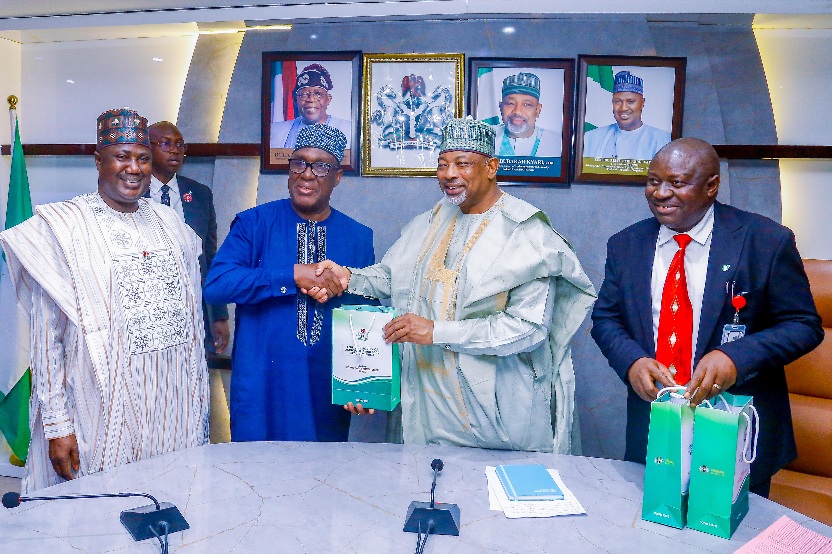
The Head of Unit, ACP and Development Issues, European Commission’s Directorate –General for Agriculture and Rural Development ,Brussels Francis Ray, stated this during a meeting with officials of the UNIDO Regional Office, in Abuja.
Ray noted that leveraging UNIDO’s global expertise to develop agro-industries would help to create jobs, and tackle the root causes of poverty and migration in Nigeria and Sub-Sahara Africa.
He said, “We are impressed with work of UNIDO in industrial and agri-business development and we see enormous potentials in collaborating with UNIDO and the Federal Ministry of Agriculture and Rural Development to develop agri-business sector in order to create jobs and help address the root causes of poverty and migration in Nigeria and Sub-Saharan Africa”.
“The EU is interested in the development of agri-business sector in Nigeria . Our special relationship and partnership with UNIDO over the years provides us with the opportunity to leverage UNIDO’s global expertise so that we can collaborate to develop agri-business sector as well as promote investment into that sector.”
The meeting was a follow up to the Joint Work Plan Agreement signed in June this year between Jerzy Bogdan Plewa, the Directorate General for Agriculture and Rural Development (DG AGRI) of the European Commission, and LI Yong, UNIDO Director General .
The Agreement is aimed at developing technical exchanges and cooperation on agro-industrial policies; fostering private sector investment in agri-business and agro-industrial value chains; encouraging business linkages, matchmaking between Africa and EU in the area of agribusiness; promoting value adding activities, including value adding schemes and increased export through capacity building, knowledge sharing, and training, and increasing interaction in the area of food quality norms and standards.
In his presentation to the European Commission’s delegation, the National Programme Officer, UNIDO Regional Office, Nigeria , Reuben Bamidele, expatiated on the organization’s work in Nigeria in the areas of agribusiness and agro-industries development (with emphasis on the Staple Crops Processing Zones) , renewable energy (small hydro power, biomass and solar) for productive uses; investment and technology promotion ; development of national quality infrastructure (NQI) (funded by the EU) ; strengthening of capacity for the implementation of the Nigerian Industrial Revolution Plan (NIRP), skills and entrepreneurship development especially for youth and women, and environmental management through Minamata Convention Initial Assessment and National Action Plan on artisanal gold mining.
UNIDO is the specialized agency of the United Nations that promotes industrial development for poverty reduction, inclusive globalization and environmental sustainability. The mission of the United Nations Industrial Development Organization (UNIDO), as described in the Lima Declaration adopted at the fifteenth session of the UNIDO General Conference in 2013, is to promote and accelerate inclusive and sustainable industrial development (ISID) in developing countries and economies in transition.
The relevance of ISID as an integrated approach to all three pillars of sustainable development is recognized by the recently adopted 2030 Agenda for Sustainable Development and the related Sustainable Development Goals (SDGs), which will frame United Nations and country efforts towards sustainable development in the next fifteen years. UNIDO’s mandate is fully recognized in SDG-9, which calls to “Build resilient infrastructure, promote inclusive and sustainable industrialization and foster innovation”. The relevance of ISID, however, applies in greater or lesser extent to all SDGs.
Accordingly, the Organization’s programmatic focus is structured in three thematic priorities, each of which represents different aspects of ISID: Creating shared prosperity; Advancing economic competitiveness and Safeguarding the environment.