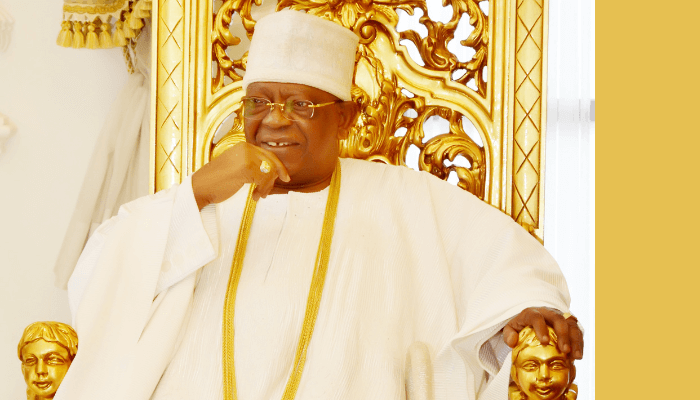
Ijebu Ode came to a solemn standstill on Monday as Oba Sikiru Kayode Adetona, the Awujale of Ijebuland and one of Nigeria’s longest-reigning traditional rulers, was laid to rest at his private residence in the historic town.
Read also: Oba Sikiru Adetona: The unyielding Awujale who reigned with modernity and defiance
The revered monarch, who died at the age of 91, was interred according to age-old traditional rites in a ceremony that balanced the gravity of ancient customs with the quiet dignity he embodied throughout his life.
Dignitaries, royal family members, and high chiefs of the Ijebu Traditional Council gathered for the final farewell. Among them were Ogun State governor Dapo Abiodun, former vice president Yemi Osinbajo, Lagos governor Babajide Sanwo-Olu, former Ogun governor Otunba Gbenga Daniel, billionaire businessman Aliko Dangote, and Fuji maestro Wasiu Ayinde, better known as K1 De Ultimate — all paying tribute to a monarch whose influence reached far beyond his domain.

Read also: Awujale of Ijebuland, Oba Sikiru Adetona, joins ancestors
Born on Thursday, May 10, 1934, to Omo Oba Rufai Adetona and Wulemot Ajibabi Adetona (née Onashile) in Ijebu Igbo, Sikiru Adetona ascended the throne as the 57th Awujale — Ogbagba II — at the remarkably young age of 26. On April 2, 1960, he was handed the staff of office by then Premier of the Western Region, Samuel Ladoke Akintola, just months before Nigeria’s independence.
Oba Adetona would go on to reign for an extraordinary 64 years, witnessing first-hand the story of modern Nigeria — from the sunset of colonial rule through independence, military dictatorships, democratic experiments, economic booms and downturns, and a society in constant flux.
Read also: A day at Awujale’s palace
He was often described as fearless and outspoken — a principled king unafraid to speak truth to power, yet unwavering in his defence of Yoruba cultural heritage and the modernisation of his domain. Many who gathered to honour him on Monday called him a “beacon of integrity” and a bridge between tradition and progress.

While the final rites were conducted with the customary privacy expected of royal burials, hundreds of Ijebu sons and daughters poured into streets, palaces and family compounds to pay their last respects to the king they fondly called the “People’s Awujale.”
His passing, for many, marks the end of an era for the Ijebu nation — an era defined by the steady hands of a monarch who combined regal authority with an open mind, ensuring Ijebuland remained one of the