For many children worldwide, particularly those from low-income backgrounds, schooling represents the primary way to escape poverty and break the intergenerational transmission of poverty. However, “in many low-income countries, aggregate income shocks often threaten children’s education, which parents view as a costly investment,” the world bank noted in a 2021 report.
Earlier this month, the Federal Government directed all Universities and Inter-University Centres as well as Polytechnics to shut down and suspend activities from February 22 to March 14 over the forthcoming February 25 and March 11, 2023 general elections.
The order is apparently to allow students, to participate in the general election in February and March.
In October 2022, the Independent National Electoral Commission (INEC) said 40% of newly registered voters are students.
“In terms of demographic distribution, 7.2 million new voters or 76.5% are young people between 18-34 years while there is a slightly higher number of female (4.8 million or 50.82%) than male (4.6 million or 49.18%) voters,” INEC Chairman, Mahmood Yakubu said.

“In terms of occupation, 3.8 million (40.8%) are students. Hard copies giving the full details of the distribution of the new voters are included in your folders for this meeting. The soft copy has already been uploaded to the Commission’s website and social media platforms,” he added.
While government’s action can be seen as an attempt to boost universal suffrage, the impact of the closure would no doubt be impactful.
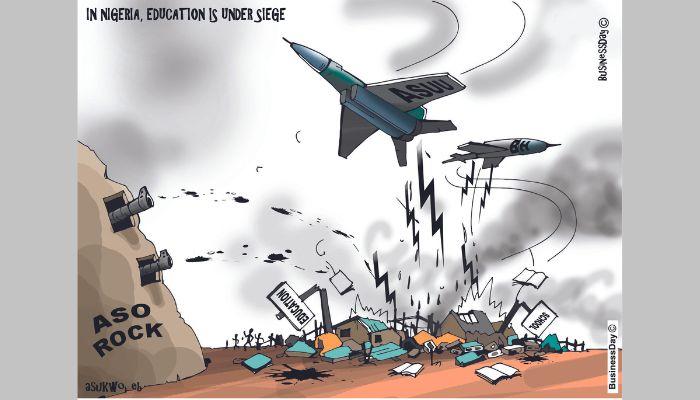
Lecturers in Nigeria’s public universities have been on strike 17 times since 1999.
In October 2022, members of the Academic Staff Union of Universities (ASUU) in Nigeria called off their eight-month-old strike on the back of rulings by the National Industrial Court and the Court of Appeal earlier that month that ordered academics to resume work, pending the determination of a substantive suit the federal government instituted against the union.
The lecturers had been striking since February over better pay. ASUU frequently strikes over pay issues halting activities at public universities attended by most university-level students in Africa’s most populous country.

The prolonged and intermittent closures of tertiary schools in Nigeria as a result of government’s action or inactions destroys only one capital – the human capital.
For Peter, a final student of the University of Benin, “the closure of school especially that long ASUU strike was really devastating. We spent a whole academic session at home and attempts to repackage that session means that we are losing knowledge and information that we would have seamlessly had if there had been no strike.
“Staying at home also created tension with parents and many of my friends said the same thing. Our parents were spending more on us and were expecting some type of responses and actions from us that generated conflicts if those responses did not come.”
In the 1960s, economists Gary Becker and Theodore Schultz pointed out that education and training were investments that could add to productivity. As the world accumulated more and more physical capital, the opportunity cost of going to school declined. Education became an increasingly important component of the workforce.
Human capital is the most likely factor to limit economic growth in countries with low levels of human capital because they are unable to effectively manage their physical capital. Physical and human capital must rise at the same time for economic growth to occur.
Thus, a central component of the economic development policies of most countries has been investment in the human capital of society. Individuals with more skills are more productive and more adaptable to technological changes in their economies.
Therefore, Education equips people with the skills that make them more productive at carrying out their work tasks, particularly in modern knowledge-based economies. Education also provides knowledge and skills that enable people to generate and apply new ideas and innovations that enable technological progress and overall economic growth.
School shutdowns create devastating academic, economic and mental consequences.
While the precise learning losses are not yet known, existing research suggests that students affected by school closures might expect some 3 percent lower income over their entire lifetimes.
There are no estimates of the benefits of school closures, says the World Bank, in contrast, the cost of keeping schools closed in terms of students’ learning, mental health, and socio-emotional development is extortionate.
Better educational achievement is reflected not only in higher individual incomes but also in higher national incomes overall.
For nations, a September 2020, OECD report noted, “the lower long-term growth related to such losses might yield an average of 1.5 percent lower annual GDP for the remainder of the century. These economic losses would grow if schools are unable to re-start quickly. The economic losses will be more deeply felt by disadvantaged students. All indications are that students whose families are less able to support out-of-school learning will face larger learning losses than their more advantaged peers, which in turn will translate into deeper losses of lifetime earnings.”
There are two related streams of long-run economic costs that are central to the closure of schools globally and Nigeria is not exempt from these costs. First, affected students whose schooling has been interrupted by the pandemic face long-term losses in income. Second, national economies that go forward with a less skilled labour force face lower economic growth which subtracts from the overall welfare of society.
These are not the only costs, notes the OECD. “In addition, the school closures can be expected to have numerous consequences for the socio-emotional and motivational development of the affected children and adolescents. Development in these areas is restricted by the lack of contact with classmates and the psychological strain on families during an extended stay in sometimes cramped housing conditions”.
A Brookings Institution research of April 2020, developed preliminary evidence to estimate projected potential losses of future earnings as a result of the school closures.
“Assuming that every additional year of schooling equates to 10 percent in additional future earnings. We then use the number of months of education closures to estimate the loss in marginal future earnings. For example, if Country X closes its schools and universities for four months, the loss in marginal future earnings would be 2.5 percent per year over a student’s working life.”
The magnitude of the long run losses associated with the disruption in schooling are truly huge. Most of the public and governmental attention has focused on short run issues of unemployment and business closures. As important as these issues are, they tend to mask the more serious long-run costs; value of GDP lost over the remainder of the century.
The magnitude of these losses requires systematic and sustained actions to improve the educational opportunities for the current and future students.
The scale of economic damage likely already stored up due to lost learning indicates the critical attention government should pay to plugging the hole of school closures in Nigeria.