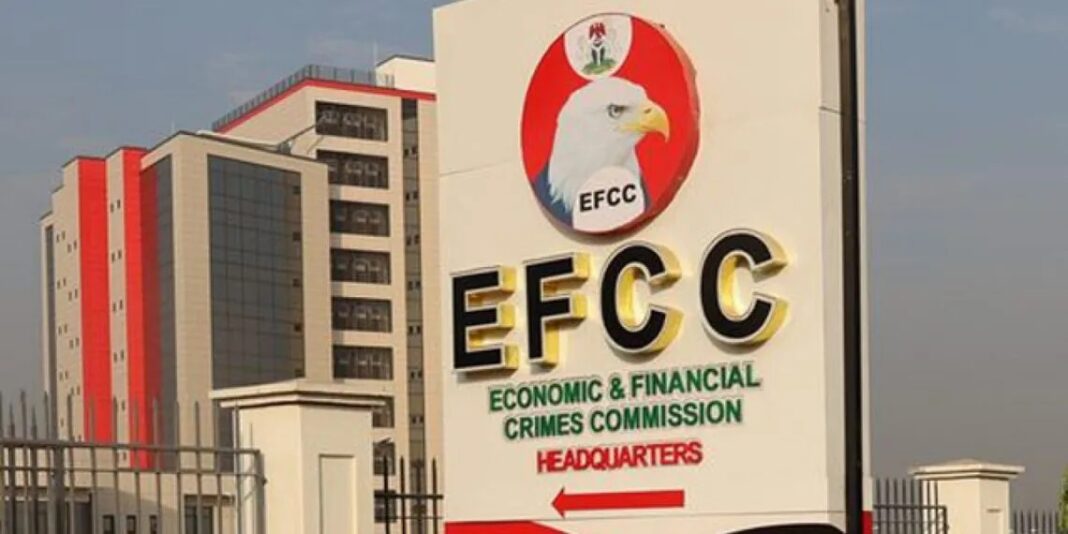
The Economic and Financial Crimes Commission (EFCC) has rejected claims by Bala Mohammed, Governor of Bauchi State that the anti-graft agency is being used by his political opponents to persecute him and some officials of his administration.
In a statement by Dele Oyewale, Head of Media and Publicity on Friday, the EFCC described the governor’s allegations as “wild, far-fetched and condemnable,” stressing that the Commission is an independent, non-partisan institution established to combat economic and financial crimes without fear or favour.
The governor had alleged that the EFCC was acting at the behest of political interests, particularly Nyesom Wike, Minister of the Federal Capital Territory.
Read also: Bala Mohammed warns against politicisation of EFCC, says democracy thrives on rule of law

However, the Commission said such claims were an attempt to malign its integrity and misrepresent its statutory mandate.
“The attempt to portray the EFCC as a pliable agency that panders to the demands of certain political interests is mischievous,” the Commission said,
It added that no political office holder has the power to influence its investigative or prosecutorial activities.
The EFCC also described it as “derogatory” for Governor Mohammed to attribute its activities in Bauchi State to the influence of the FCT Minister, insisting that its actions are guided strictly by law and evidence.
The Commission recalled that Bala Mohammed was already standing trial for money laundering before he was elected governor of Bauchi State, noting that only the constitutional immunity attached to his current office stalled the prosecution.

“If Bala Mohammed wants to be honest, he would have revealed to Nigerians that he was standing trial for money laundering at the time he won election as governor”, the EFCC said
“Who influenced the Commission to investigate him in 2016 and charge him to court?” the EFCC asked
On the ongoing cases involving some Bauchi State government officials, the EFCC stated that the facts of the matter have already been placed before a court of competent jurisdiction.
It urged members of the public to examine the charges themselves and determine whether the cases are products of vendetta or outcomes of thorough investigations.
The Commission explained that Mohammed was mentioned in the charge as the approving authority in the state, adding that this was based on the evidence uncovered during investigations.
Responding to claims that the cases amounted to an attempt to criminalise governance or frame the matter as terrorism financing, the EFCC said it was merely enforcing existing laws.
“Crying wolf over issues of terrorism financing is like clutching at straws.
“The Commission did not invent the law, and where there are offences punishable by extant laws, the EFCC will be failing in its responsibility to do otherwise”, the statement read.
The anti-graft agency also took a swipe at what it described as selective outrage by politicians, noting that allegations of persecution are often raised only when opposition figures are involved.
“It is the height of hypocrisy for opposition politicians to scream persecution whenever an opposition figure is called to account, but remain silent when a member of the ruling party faces the same ordeal,” the EFCC said.
It pointed out that it recently arraigned a senior member of the ruling party for alleged corruption without similar accusations.
The Commission urged Governor Mohammed to focus on governance in Bauchi State and allow the EFCC to carry out its mandate of sanitising Nigeria’s financial system.