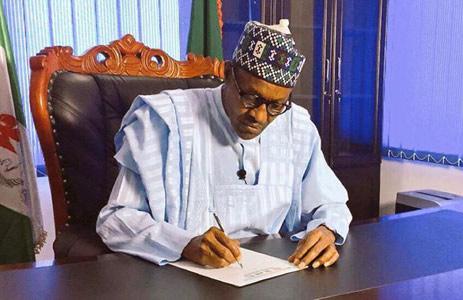
As President Muhammadu Buhari prepares to inaugurate the federal cabinet tomorrow, whoever will be asked to supervise the Ministry of Industry, Trade and Investment must drive policies capable of building virile micro economies within the Nigerian economy.
Analysts say the minister must focus on the comparative advantage of each local economy and then come up with specific policies capable of driving growth and investment in the area.
Checks show that each geographical area in the country has peculiar industries that can be grown from available local resources and only distinctive policies from the Federal Government can drive investment in the area.
Nnewi in Anambra State, known in the 1980s and 1990s as the Japan of Africa, is home to car, motorcycle and tricycle assembly. Innoson Vehicle Manufacturing Company has already unveiled IVM Fox hatchback and IVM Umu automobiles, made up of about 70 per cent locally sourced content in the area, according to the local content analysis done by the Nigerian Society of Engineers (NSE).

The foods and beverages companies boom in the north and the south-west because the areas have arable land, making the Backward Integration Policy a successful strategy.
“I think the minister must understand that each area has its peculiarity,” said Ikechukwu Ibeabuchi, managing director of chemical-making MD Services Limited, in a telephone interview.
“How will he/she ensure, for instance, that Aba becomes a hub for shoes, bags and leather? How will he/she ensure that investors tap into the agricultural potential of the north, more than we have now? How will he ensure that more confectioners leverage the cocoa potential of the south-west?” Ibeabuchi asked.
Tied to this is the development of industrial clusters, which mean areas where companies are collectively sited. In China, India and other fast-paced economies, deliberate policies are created for industrial clusters, to enable them achieve import-substitution targets and create jobs.
“The new minister will not build factories. In Lagos, we have Ikorodu, Ikeja and other industrial clusters already. All the minister needs to do is to expand these clusters and solicit for necessary infrastructure like water, power and roads, so that by the time investors in these areas finish production, the cost will have been lower and the prices, cheaper,” said Tunde Oyelola, chairman, Manufacturers Association of Nigeria Export Group (MANEG) in a chat with BusinessDay.

Analysts say the minister must take a front seat in attracting foreign investors and Nigerians in the Diaspora to come home and tap into the opportunities in the country.
But Muda Yusuf, director-general, Lagos Chamber of Commerce and Industry (LCCI), in a recent interview, told BusinessDay that one big mistake made by the country’s policy makers is to place Foreign Direct Investment (FDI) well above local investments.
“ For me, domestic investments are more important than foreign investments. You get more value from domestic investments, in terms of jobs, re-investment, profit retention, especially for small businesses,” Yusuf said recently.
However, most investors who spoke with BusinessDay suggested an equal balance between local and foreign investments.
“Let there be a balance. Investors from all sides must be wooed. Bringing capital into a new environment is not child’s play. On the other hand, investing in your country is not easy too,” said the CEO of a beverage firm, who preferred anonymity.
More so, the minister must have the capacity to understand the essence of import waivers. For sectors like iron and steel, rice and palm oil, import waivers were originally given to local investors to enable them import the gap/difference between what they could locally produce and the domestic demand.
However, the scheme turned out to give some players advantage over them. Worse still, some investors who were not producing what they claimed, exploited the process by embarking on wholesome importation.
“We tell government, ‘anything you want to do should be sectoral.’ If it is sectoral, everybody will be able to survive. But someone will go back to the same government to get a letter for the Customs. It does not work that way. If you do that, you are killing others,” Oluyinka Kufile, chairman and managing director of Qualitec Industries Limited and chairman, Iron, Steel and Fabricated Metals, of the Manufacturers Association of Nigeria (MAN) told BusinessDay recently.
Frank Udemba Jacobs, president, Manufacturers Association of Nigeria, said for the best way to actualise these lofty dreams is to create the necessary environment that will enable the real/productive sector to thrive.
Jacobs said there is no way the manufacturing sector can grow in an environment where manufacturers cannot import some raw materials on the basis of monetary restrictions, a challenge the new minister must seek solution to, if he is to be taken seriously by investors.
ODINAKA ANUDU