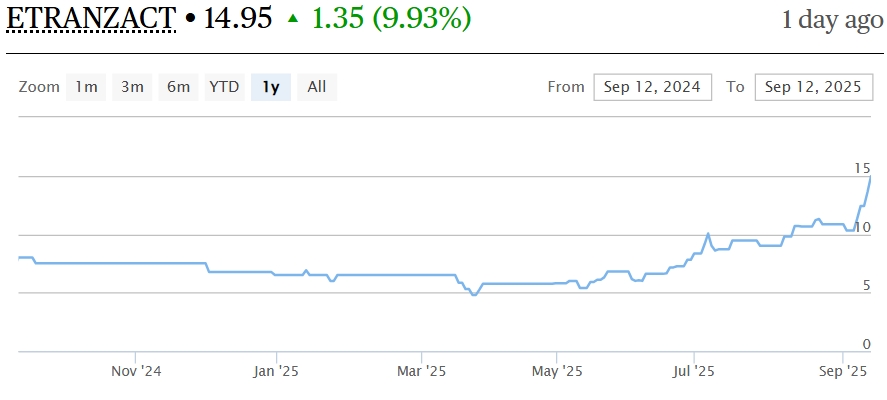
e-Tranzact International Plc surged by 45 percent on the Nigerian Exchange (NGX) within a week, rising from N10.30 on September 8 to N14.95 on September 12.
The rally followed news that the Federal Inland Revenue Service (FIRS) had approved e-Tranzact as a certified provider for its nationwide e-invoicing rollout. Under the new tax compliance system, businesses will be mandated to issue standardised digital invoices for transactions. Each invoice is directly linked to the FIRS. The move is part of Nigeria’s broader efforts to plug revenue leakages, curb tax evasion, and improve efficiency in tax administration.
Investors quickly priced in the development. On Tuesday, September 9, the stock climbed 9.74 percent immediately after the announcement, reflecting market sentiment that e-Tranzact’s earnings could be significantly boosted through the partnership. Analysts say the rollout would position the company as a key infrastructure player in Nigeria’s tax digitisation drive. It would also open a stable revenue stream tied to government-backed compliance.
Not e-Tranzact’s first public service rodeo
This is not e-Tranzact’s first foray into deploying technology solutions for public institutions. In July 2024, the company launched a digital verification system for the Military Pensions Board, helping the Ministry of Defence transition from manual verification of military retirees to an automated system. That contract underscored the firm’s growing role in digitising government processes.

Financially, e-Tranzact’s performance has been mixed. At the end of the first half of 2025, the company reported revenue of N13.3 billion, a 5.4 percent decline year-on-year from N14 billion in H1 2024. However, gross profit surged 40 percent to N6.4 billion, up from N4.6 billion in the same period last year, signaling improved efficiency and cost management.
Still, the company trades at a hefty premium. With a price-to-earnings ratio of 45.48x, e-Tranzact ranks among the most expensive stocks on the NGX. This suggests that investors are betting on strong future growth despite near-term earnings pressure