Despite overwhelming violence which have characterized elections in Nigeria since the country returned to democracy in 1999, the federal government and the Independent National Electoral Commission (INEC) have failed to establish Electoral Offences Commission observers have expressed concerns.
Experts have in recent years canvassed for the amendment of the Electoral Act to accommodate an electoral offences commission or tribunal, but little progress appears to be made so far.
Nigeria’s election have historically been fraught with violence and other abuses. In 2015, the election that brought in former President Muhammadu Buhari, the first transition of power to opposition since returned to democratic rule in 1999 was largely peaceful.
The 2019 general election was marred by violence across the country resulting in the death of several people including election officials.

Similar violence was seen in the 2023 polls, from security forces, including thugs and army acting on behalf of politicians.
A total of 238 violence and 28 deaths were recorded during the 2023 general elections, a report by the election violence monitoring and mitigation group under the aegis of Kimpact Development Initiative, a civil society organisation, said in May, shortly after the polls.
According to KDI, while a total of 98 of the total violence occurred during the February 25 presidential election, 140 were reported during the March Governorship and State House of Assembly polls.
Human Rights Watch research on the 2019 general election in Rivers State in the south and Kano in the north, both of which have a strong history of violent elections, found that pre-election tensions including clashes between supporters of major political parties and rivalry between key politicians culminated in serious violence during the elections.
Military officials indiscriminately shot and killed civilians in Rivers State, while political thugs and security officials attacked election officials, voters, journalists, and other observers in both states.

Read also: Appeal Court upholds Enos election as Akwa Ibom governor
Experts blames the situation on impunity and the failure of the Nigerian government to address accountability for past elections related abuses, killings and the lack of confident in the electoral process, empire by political actors and stakeholders.
They stated that compromised electoral officials and desperation of politicians, especially incumbent to win at all cost had fueled the situation.
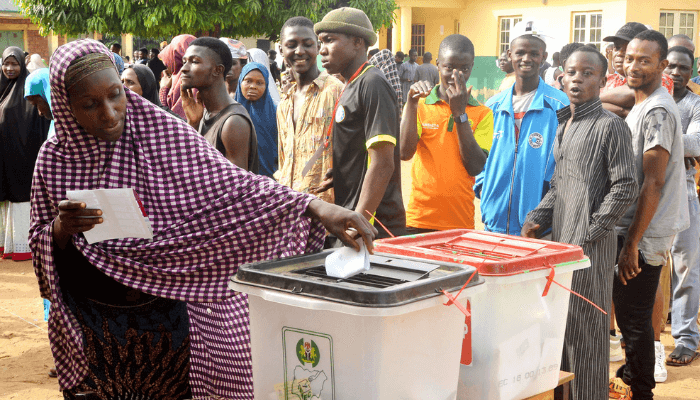
Such was seen in the just concluded off-cycle gubernatorial elections in Kogi, Imo and Bayelsa State where reports of violence and killings in the three states were widely reported.
Many people including party officials and members of rival political parties clashed on Election Day leaving many dead.
In several polling units in Kogi north and Nembe in Bayelsa eligible voters could not cast their votes due to violence and threat from thugs working for desperate politicians.
But many observers say Nigeria’s federal government, lawmakers and the electoral umpire must do more to check the trend because the country’s democracy was at risk.
“It is important for the authorities to swiftly restore public confidence in their ability to hold those responsible for electoral violence accountable and ensure the safety and security of all Nigerians. It is sad that government is not doing enough presently,” said Anietie Ewang,
Nigerian researcher at Human Rights Watch.
Stakeholders including Yiaga Africa have called on the National Assembly to accelerate the process of electoral reform, especially the establishment of the Electoral Offences Commission to promptly and diligently prosecute electoral offenders.
Samson Itodo, the executive director of Yiaga Africa, said the process should include fundamentally reforming the Independent National Electoral Commission (INEC) and the attitude of politicians to elections.
Similarly, speaking during her presentation of report about violence recorded in the 2023 polls, the Executive Director of KDI, Bukola Idowu said government need to check incumbent who stop their rivals from using public facilities for campaign, noting that it is increasingly becoming a major causative factor of electoral violence.
According to Idowu, “The CSOs and the media need to pay close attention and hugely condemn the subtle abuse of power by incumbent government who places restrictions on political groups from using public venues for their campaigns.
“INEC, the Police and Federal Ministry of Justice should ensure the prosecution of electoral offenders as this will serve as deterrence to other electoral offenders. This also underscores the urgent need for the Electoral Offences Commission.”
She added that independent Corrupt Practices and Other Related Offences Commission and the Economic and Financial Crimes Commission need to rise up to the occasion to prosecute offenders involved in vote buying and selling as this will serve as a deterrent for others.
However, recent reports indicates that INEC is yet to prosecute almost 171 people arrested for different offences in the 2023 polls, raising concerns about the commission readiness to check the trend.
In 2020, the INEC announced the prosecution of 18 people in seven states across the country for offenses during the 2019 elections, including snatching and destroying election materials, disorderly conduct, unlawful possession of ballot papers and Permanent Voters’ Cards, and vote buying at polling places on election day. It is unclear how many of these cases have concluded or led to convictions.
The commission indicated that it faces constraints in ensuring justice and accountability for electoral offenses because, while it can prosecute offenders, the authority to investigate rests with the security agencies. This has led to a lack of effectiveness in dealing with cases involving election infractions, the commission said.
Stakeholders say that security agencies should promptly and thoroughly investigate and appropriately prosecute offenses, including violence and threats against candidates, voters, election officials, and others.
Speaking recently, Femi Falana, human rights lawyer, says tribunal will continue to determine the outcome of election in Nigeria if electoral offenders are not severely sanctioned.
Falana asked the national assembly to amend the Electoral Act of 2022 for the establishment of an electoral offences commission to arrest and prosecute offenders.
But Kunle Okunade, political analyst said INEC May find it difficult to prosecute electoral offenders because their officials are sometimes differently cause of the problems.
He noted the ruling party should also share part of the blame because some key politicians aabd leaders in the party were directly responsible for electoral violence because of quest to win at all cost.
According to him, “Look at what happened in Kogi State last month it was apparently that APC was not ready to lose that election and would do everything within its power to win and you saw what happened on Election Day.
“It is not just the opposition, the ruling party should share the blame for electoral offences and lets see if INEC would be bold enough to arrest officials of the APC.
“We know what some INEC officials are doing to manipulate elections for the ruling party, in such case the other people cannot just sit and watch. How many INEC officials was prosecuted after the 2023 polls?”