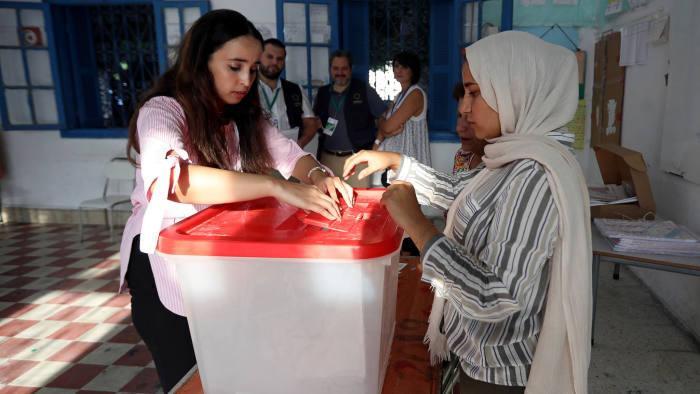
In Tunisia, the fate of the Arab world’s only democratic, secular state hangs in the balance. A parliamentary election is scheduled for October 6, and a runoff presidential election will follow. But its democratic experiment is at risk of unravelling.
In 2011, Tunisians were ecstatic about ousting dictatorial president Zein al-abidine Ben Ali and replacing him with a government that would deliver freedom, democracy and, most crucially for citizens in the neglected interior, bread. Eight years on, Tunisians have freedom and democracy — but still not enough bread. Frustrated by sluggish economic reform, voters last month rebuked the incumbents and the compromises that dominated the democracy’s first phase.
In the first round of presidential elections, two anti-establishment candidates emerged as the leading contenders: Kais Saied, an independent constitutional law professor, and Nabil Karoui, a flamboyant media tycoon running a populist campaign from prison, where he awaits trial on charges of tax evasion and money laundering.
The next round will present to the citizens of this small North African nation starkly divergent future visions. Mr Saied wants to rewrite the constitution to give greater power to local councils. He opposes recent progressive reform proposals to repeal sharia inheritance laws that punish widows and daughters, and dismantle laws that harshly punish same-sex activity.

Read Also: Democracy, security and Nigeria’s future (1)
Mr Karoui, the imprisoned businessman, is by temperament more authoritarian than socially progressive. If he won, he would be likely to consolidate greater powers into the presidency.
Tunisia’s transition into a stable, mature democracy is still possible, if the nation’s voters and leaders embrace the notion that democracy is messy, unpredictable and occasionally antagonistic. But the leading presidential candidates, who have no previous government experience, will need to acquire tolerance for uncertainty.
Back in 2010, eight of the 22 countries that make up the League of Arab States saw revolts against authoritarian regimes. Tunisia is the only one where democracy survives, with free and fair elections. But gross domestic product per capita remains shy of $3,500, the cost of living is up sharply, and unemployment rates remain unacceptably high. If forced to choose, many voters are likely to opt for the literal nourishment of economic stability over the intellectual nourishment offered by John Locke or Thomas Jefferson.
Tunisia’s authoritarian Arab neighbours, who want to see democracy contained, preferably quelled, are watching closely. After deposing Ben Ali, who died this month, Tunisians transitioned quickly toward democratic, civil institutions. This stands in contrast with Algeria and Sudan, where citizens have toppled dictators but not entrenched military institutions, and Egypt, which is ruled by a dictatorship more authoritarian than the one ousted in 2011.