Last week the African Union met in Addis Ababa, Ethiopia to discuss the latest trend of coups on the continent. A few weeks ago, Burkina Faso’s army became the latest successful coup plotters when they ousted President Roch Kabore, suspended the constitution, dissolved the government and the national assembly, and closed the country’s borders. Burkina Faso one of West Africa’s poorest despite being a gold producer, has experienced numerous coups since independence in 1960. This one that removed President Kabore was the third since the ouster of long-time leader, Blaise Compaore, in 2014.
The coup announcement cited the deterioration of the security situation and what the army described as Kabore’s inability to unite the country and effectively respond to challenges, such as an Islamist insurgency. The announcement said the takeover had been carried out without violence and that those detained were at a secure location.
The statement was made in the name of a previously unheard-of entity, the Patriotic Movement for Safeguard and Restoration, or MPSR, its French-language acronym. The MPSR said it would propose a calendar for a return to constitutional order “within a reasonable time frame, after consultations with various sections of the country.”
Africa’s latest coup epidemic, which is playing out largely in Francophone Africa, is largely driven by popular discontent with democratic ruling elites, worsening insecurity, rising cross-Sahelian anti-French sentiment, and economic stagnation
A few days later, there was a coup attempt in nearby Guinea Bissau, which failed the remove President Umaro Embalo. It was that country’s third coup attempt in the last decade.

Army putsches have toppled governments over the past 18 months in Guinea and Mali. Last year in Chad, after President Idriss Deby was killed on the battlefield, the military formed something called the Transitional Military Council and imposed Deby’s son, Mahamat Deby Itno, as the country’s leader by usurping the constitution which was clear that the President of the National Assembly of Chad, in this case, Haroun Kabadi, should take over and serve out the rest of Deby’s term. That was effectively a coup.
Africa’s latest coup epidemic, which is playing out largely in Francophone Africa, is largely driven by popular discontent with democratic ruling elites, worsening insecurity, rising cross-Sahelian anti-French sentiment, and economic stagnation among several other factors. These coups increase the risk of wider regional instability. West Africa is geographically contiguous with North and Central Africa, meaning that instability in one region is a creeping risk for the next; and as more coups see success with obvious political rewards for the perpetrators, the temptation for copycats to do the same increases.
Read also: How can the AU and ECOWAS respond to the spate of coups in Africa?
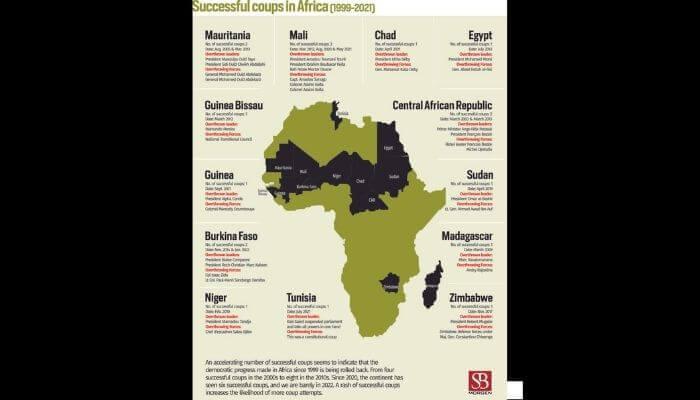
While this holds important implications for regional security and stability, the region is far from an outlier. Since Nigeria transitioned to civilian rule in 1999, there have been successful coups in Burkina Faso, the Central African Republic, Chad, Egypt, Guinea, Guinea Bissau, Madagascar, Mali, Mauritania, Niger, Sudan, Tunisia and Zimbabwe. Of these countries, only Zimbabwe and Madagascar are nowhere near the Sahel.
Zooming out and it is clear that the world is increasingly moving from liberal democracy to illiberalism at an alarming pace, and supported by local populations. The level of public support given to the coup plotters that we have seen in countries such as Guinea, Mali and now Burkina Faso is worrying, because we know how it would end. Eventually, the public in those countries would grow tired of the coup plotters when it becomes clear that nothing has changed, but even that slim chance of taking them out in the polls would not exist, cue in another coup, and more instability.

But we should not be blind to the fact that people are fed up with their “democratic” rulers. African governments have not governed in ways that would win support, and the proliferation of unconstitutional practices such as tenure elongation (Guinea’s Alpha Conde being a great example) and repressing opposition figures win few friends.
We must talk about the African regional bodies, the African Union and ECOWAS. The spate of coups in the region is evidence that coup plotters do not think the regional bodies will make their stay in power uncomfortable. This means ECOWAS has to explore effective ways to enforce its non-tolerance for non-democratic power change. It also means that beyond issuing condemnatory statements, regional bodies have to shift from a reactionary posture to a proactive approach. A good place to start will be for them to make it clear that presidents who illegally extended their tenures are not welcome. Which is why having the Ivory Coast’s Alassane Ouattara at the Addis Ababa meeting was such an epic fail.
Nwanze is a partner at SBM Intelligence