|
Getting your Trinity Audio player ready...
|
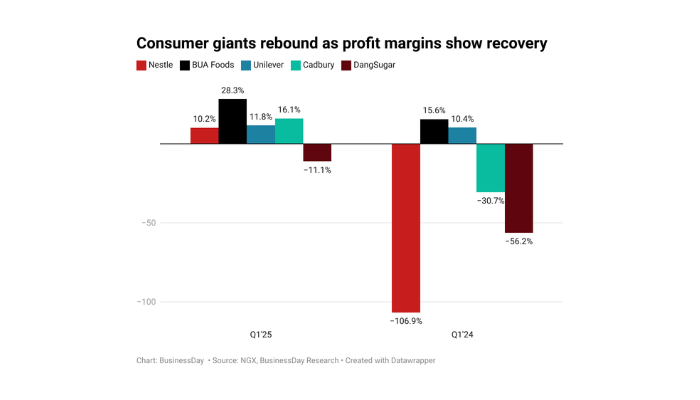
After a bruising 2024 dominated by currency devaluation, inflation, and FX-related shocks, Nigeria’s top consumer goods manufacturers posted a broad-based recovery in the first quarter of 2025.
Companies like Nestlé Nigeria, BUA Foods, Unilever, Cadbury, and Dangote Sugar Refinery showed either a return to profitability or a sharp narrowing of losses, driven by resilient sales, pricing power, and foreign exchange management.
The rally in Q1 results signals improving operational fundamentals and corporate discipline in Nigeria’s fast-moving consumer goods (FMCG) and food manufacturing space, even as macroeconomic headwinds persist.
BUA Foods led the revenue table in the reviewed period, reporting N442.1 billion, a 24 percent increase year-on-year, thanks to expanded sales in its flour and rice divisions.

The bakery flour segment led the performance with a 102.5 percent YoY increase in sales to N163.2 billion, contributing 36.9 percent to total revenue. Conversely, sales of fortified sugar declined by 16.2 percent to N165.9 billion, though it remained the largest revenue contributor at 37.5 percent.
Profit after tax surged 124 percent to N125.3 billion, up from N55.9 billion in Q1 2024, despite rising distribution and administrative costs.
Notably, BUA’s N486.7 million foreign exchange gain effectively wiped out the N27.3 billion FX loss recorded in Q1 2024, highlighting improved forex risk management. Its pre-tax margin stood at 28.3 percent, reflecting operational scale and input efficiency.
Read also: Consumer goods firms brace for recovery amid naira gains, inflation drop
“With a stabilising economy and growing emphasis on food security, we are confident that our unique and integrated business model, strong financial position, and robust execution will continue to enhance our strategic growth and create lasting value for all stakeholders throughout 2025,” Ayodele Abioye, managing director of the firm said.

Nestlé Nigeria also reported revenue of N294.9 billion, a 61 percent rise from N183.5 billion in the same period last year. Its profit after tax stood at N30.2 billion, a remarkable turnaround from a net loss of N142.7 billion in Q1 2024.
The recovery was driven by better sales volume across product lines, including Maggi, Milo, and Nescafé, and tighter cost controls.
The firm was also able to reduce its cost-to-sales ratio by 13.86ppts to 59.4 percent in the reviewed period, up from 73.3 percent, a feat that was achieved by improving energy efficiency and substituting imported inputs with local alternatives.
“Factoring Nestle’s robust pricing power, solid operational execution, and a more stable macroeconomic environment, our model estimates significant improvements in key operating margins in 2025E,” analyst at Cordros Research said in a note recently.
Unilever Nigeria posted revenue of N47 billion, a 45 percent increase from N32.3 billion. The company more than doubled its profit after tax to N5.55 billion from N3.36 billion in Q1 2024.
Gross profit rose 40 percent to N18.85 billion, while net cash flow from operating activities swung to a positive N9.56 billion—its strongest first-quarter liquidity performance in years.
Read also: Consumer goods, industrial stocks fuel market’s N182bn gain
The turnaround was also cash-driven. Operating cash flows swung from an outflow of N16.7 billion to an inflow of N9.56 billion, providing liquidity strength and support for its ongoing restructuring.
Cadbury Nigeria also returned to profitability with a net profit of N5.98 billion, after losing N7.3 billion in Q1 2024. Revenue rose 57 percent to N37.23 billion, and operating profit surged 251 percent to N9.69 billion. Finance costs fell by 91 percent to N1.14 billion, thanks to tighter currency controls and reduced debt exposure.
Earnings per share rose to 262 kobo, from a negative 321 kobo last year, reflecting the best quarterly recovery in Cadbury’s recent history.
Dangote Sugar Refinery remained in the red, but significantly reduced its loss after tax to N23.6 billion in Q1 2025, compared to N68.9 billion in the first quarter of 2024. Revenue soared by 74 percent to N213.93 billion, yet operating profit dropped to N2.75 billion from N5.30 billion.
The drag came from a steep N101.7 billion in finance costs, largely FX-related, underscoring the company’s exposure to currency fluctuations. Nevertheless, the year-on-year improvement in net position points to a possible path to recovery.
Margins improve as companies regain pricing power
Nestlé Nigeria’s gross profit margin climbed to 40.6 percent in Q1 2025 from 26.7 percent in Q1 2024, while its operating margin more than doubled to 25.1 percent. Net margin stood at 10.2 percent, recovering from negative territory last year.
BUA Foods maintained strong profitability with a pre-tax margin of 28.3 percent, thanks to cost management and economies of scale. The firm’s earnings per share rose to N6.96 from N3.10, indicating improved returns for shareholders.
Unilever’s net margin climbed to 11.8 percent, while its operating margin more than doubled from 8.6 percent to 17.6 percent. These figures show that even as input costs remain elevated, companies are passing on inflation-related price adjustments to consumers without sacrificing volume significantly.
Net profit margin of Dangote Sugar also saw a dramatic decline, slowing from -56.22 percent in the first quarter of 2024 to -11 percent in the first three months to March, highlighting a recovery path for a firm that’s exposure to FX has struck a blow to its bottom line.
Balance sheet strength supports future growth
The companies also reported improved balance sheets and cash positions, which will be critical as interest rates remain high.
Nestlé Nigeria’s equity position increased by N30 billion in the quarter, reversing impairments taken in 2024. BUA Foods saw equity rise 29.2 percent from N429 billion to N554 billion, while Unilever grew its equity to N90.7 billion, reflecting strong retained earnings. Dangote Sugar posted equity of N183.5 billion, up 14.3 percent year-on-year.
Investor confidence rebounds
The rally in Q1 earnings suggests Nigeria’s top consumer goods firms are recovering from the policy shocks of 2023 and early 2024, which included naira devaluation, petrol subsidy removal, and higher input costs.
The ability to grow revenue and margins despite tight monetary conditions points to a sector adapting quickly to economic realities.
With FX losses significantly down and cash positions stabilising, analysts expect these firms to resume dividend payouts and boost capital investment in H2 2025.
“These companies are returning to the basics—cost control, innovation, and market penetration,” said a Lagos-based portfolio manager. “The FX losses in 2024 were extraordinary, but their resilience this year is a sign of stronger corporate governance and strategic foresight.”