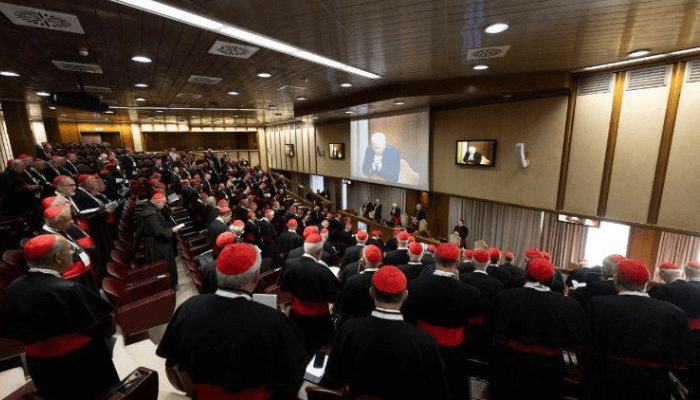
As the conclave to pick the successor to Pope Francis gets underway on Wednesday May 7, the world will be on the lookout for the emergence of a new Pope for the Catholic Church.
According to the Holy See Press Office, the secretive rite of electing the next Pope will take place inside the Sistine Chapel at the Vatican.
However, for the over 1.4 billion Catholic faithful across the globe, the choice of the new Pontiff is likely to be between the liberals and conservative Catholics.
This is so because the late Pope brought some changes to the church in line with his liberal position of a ‘Church’ open to all, which some vehemently opposed in favour of keeping to the ‘old order’ of Catholicism.

In March, the Vatican’s Central Office of Church Statistics released the 2025 Pontifical Yearbook providing details about the number of Catholics, consecrated religious, priests, and bishops throughout the world.
According to the data, the global Catholic population increased by 1.15 percent between 2022 and 2023, rising from approximately 1.39 billion to 1.406 billion, a percentage very similar to that of the previous biennium.
Africa includes 20 percent of the Catholics of the entire planet and is characterized by a highly dynamic spread of the Catholic Church. The number of Catholics increased from 272 million in 2022 to 281 million in 2023, with a relative variation of +3.31 percent.
The Democratic Republic of Congo confirms its first-place position for the number of baptized Catholics, with almost 55 million, followed by Nigeria with 35 million; Uganda, Tanzania, and Kenya also register significant figures.
With a growth of 0.9 percent over the biennium, the Americas consolidate their position as the continents to which 47.8 percent of the world’s Catholics belong. Of these, 27.4 percent reside in South America (where Brazil, with 182 million, represents 13 percent of the world total and continues to be the country with the highest concentration of Catholics), 6.6 percent in North America, and the remaining 13.8 percent in Central America.

The Asian continent records a growth of Catholics of 0.6 percent over the biennium, and its weight in 2023 is around 11 percent of the global Catholic population. In 2023, 76.7 percent of Southeast Asian Catholics were concentrated in the Philippines, with 93 million, and in India, with 23 million.
Europe, while hosting 20.4 percent of the world Catholic community, only recorded a 0.2 percent growth. The Catholics of Oceania numbered just over 11 million in 2023, an increase of 1.9 percent compared to 2022.
Backed with these data, Francis appointed more Cardinals from growth areas to strengthen the church and position it for more growth.
Read also: Conclave for 267th Pope commences May 7
As it stands, over three-quarters of the 135 Cardinal electors were appointed by Pope Francis, who reshaped the College of Cardinals, making the conclave less Eurocentric than it has ever been.
Of the 135 Cardinal electors, 108 were appointed by Pope Francis, 22 by Benedict XVI, and five by St. John Paul II. They are: French Cardinal Philippe Barbarin, Croatian Cardinal Josip Bozanić, Cardinal Vinko Puljić from Bosnia and Herzegovina, and Cardinal Peter Turkson from Ghana.
Of these 135 Cardinal electors, 53 Cardinals from Europe, 37 Cardinal electors are from the Americas (16 from North America, 4 from Central America, and 17 from South America), 23 from Asia, 18 from Africa, and four from Oceania.
However, there will be two absentees from the conclave as two of the 135 Cardinals have confirmed they will not be able to attend the conclave for health reasons bringing the total down to 133.
During the 12 years of Pope Francis’ pontificate, he significantly reshaped the College of Cardinals to reflect the growth areas of the church on what many believe to align with is personal inclination to the shift of Catholicism toward the Global South, and a broader trend that the Church of the future will likely have an increasingly non-European face.
“I will choose in between,” Esther Ikeh, a Port Harcourt based Catholic faithful said. She said her choice is backed by her conviction but would not want a Pope that is not open to change neither would she like one that is too liberal to water down the church’s doctrine.
Ikeh said that she would rather go for a conservative instead of an over liberal Pope. According to her, a Pope that would maintain and keep intact the sacredness of Catholicism would be her choice for the next Pope.
“If I say liberal; I don’t know how far he will go because in liberalism almost everything goes. I prefer that conservative because the Pope is the head of the church; so that the sacredness of many things will still be intact,” she said.
However, ultraconservatives are believed to be pushing for a conservative pope. The promotion of conservative candidates from some sections of the church started almost immediately after Francis’s death was announced.
Read also: Conclave smoke signals ready: For the world’s Catholics a step closer to a new pope
For the promoters of the move towards conservative Catholic Church, it is believed that the next pontiff will be a true conservative – someone from the ranks of what was a passionate traditionalist opposition to Pope Francis.
Raymond Burke, a staunch advocate for the traditional Latin Mass, has been favoured by some archconservatives campaigning to propel one of their own to the forefront of discussions over Francis’s successor.
Is it time for a first pope of colour?
With the Vatican announcement that the conclave to elect Pope Francis’ successor will begin May 7, intrigues surrounding the election – a secretive rite inside the Sistine Chapel has already begun.
The intrigues are further supported by the notion that the conclave being the largest in the history of the Catholic Church, could swing in any direction.
As of this moment there is no clear front-runner, which also gives credence to the unpredictability of the conclave.
And, based on the nationality of the Cardinal electors; this conclave is considered to be one of the most unpredictable in decades.
But, a possible outcome could point to the direction of the first ‘Pope of colour’ that could present a pope possibly from the Philippines or Congo.