



Commuters to the Apapa area of Lagos, which is home to Nigeria’s two most active and biggest revenue generating ports (the Tin-Can and Apapa ports), were caught in the grips of a nerve-wracking traffic gridlock for the second day running, Tuesday.
The gridlock saw the average commuter coming from eight kilometres away, spending four hours to get to Apapa, the last two hours being spent on the final two- kilometre leg, and much of that often within view of their destinations.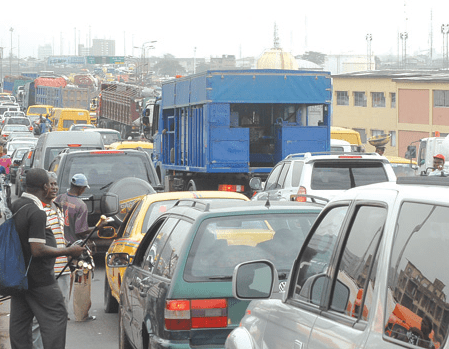
The journey typically takes two hours on weekdays and 40 minutes on weekends.
The cause of Apapa’s notorious traffic jams are the poor state of the Tin-Can Island leg of the Oshodi- Apapa Expressway and the hundreds of trailer trucks which park on the road, blocking it. This causes other drivers to divert to the alternative Ijora-Apapa route, which then becomes over burdened and is also encumbered by an overflow of parked and moving trucks.

The cost to the economy is yet unestimated but thousands of Nigerians work in the Apapa area, many of them in the ports and spin-off businesses.
Although traffic jams have become the trend in and around Apapa, yesterday’s gridlock was more intense on the Ijora-Apapa route, especially descending the Marine Bridge to connect Apapa, around the Area ‘B’ Police Command, all the way to Point Road junction and Airways Bus Stop.
For some time now, motorists have abandoned the Mile Two-Apapa axis, as it has been completely taken over by trucks and petroleum tankers.
As a result of the congestion on Monday and Tuesday, staff of companies and business organisations operating from Apapa, could not get to their offices on time, and were thus less productive.
Efforts at decongesting Apapa and its environs seem not to be yielding the desired result.

The continued loss of productive man-hours, and the pain and tension of spending long hours in the cramped enclosures of vehicles, as well as the infusion of motor exhaust fumes, medical experts say, are harmful to the health.
Presently, not less than 400 petroleum tankers and container laden trucks trucks are parked daily on a section of the Oshodi-Triinity-Apapa road, in a manner that compels motorists and other road users to spend long hours on the road. As this lasts, residents, businesses and other concerns in Apapa continue to bear the brunt.
In the last one year, the Lagos State government has issued several ultimatums to truck and tanker drivers to vacate the road, or risk having their vehicles towed.
The truck drivers have mostly turned deaf ears to the threat and suffered no consequences.
Behind the state government’s lacklustre approach to dealing with the situation is what an official said is fear of tanker drivers going on strike in the event of their trucks being towed, thereby throwing a larger proportion of the state into economic hardship.
But officials of the state government also blamed the federal government for not doing enough to deal with the situation.
A senior state official speaking on condition of anonymity, said since the May 2012 operations which saw several illegal shanties destroyed and over 85 trucks towed within the Apapa axis, by Lagos State officials, the federal government has reneged on its promise to support Lagos State in the Apapa regeneration plan, which includes creating alternative parks for trucks.
“It takes a lot of resources human and material to enforce the dislodgement of the hundreds of trucks parked on the road,” a source within the state told BusinessDay, adding that while the state government was not insensitive to the pains of motorists, it did not make money from the ports.
“All the money from the ports goes to the Federal Government, yet Lagos as a state bears the burden of fixing the Apapa environment, which ironically, is daily desecrated by the huge activities emanating from the ports,” the source added.
Remi Ogungbemi, the national president of the Association of Maritime Truck Owners (AMATO), speaking with BusinessDay, said that freeing Apapa of its encumbrances would require a far sighted and thorough approach, pointing out that towing the trucks would not bring a lasting solution to the problem.
He blamed all stakeholders, including the Federal and Lagos State governments for the menace. According to Ogungbemi, the Federal Government which owns the ports should be blamed for leasing out sections of ports meant for trucks to other businesses.
“The planners of the ports knew there would be need for trucks to park within, but unfortunately that section has been leased out to other businesses, and there are not enough parking spaces for trucks within the ports,” Ogungbemi said. He also blamed Lagos State for converting an open space near Ijora to a housing estate, where stakeholders had wanted to build parking lots for trucks.
Jobalo Oshikanlu, legal director, ARM Infrastructure, speaking on the development, suggested that the Federal Government should award a direct contract for a complete rehabilitation of the road or employ a Public-Private Partnership (PPP) option in tackling the poor state of the road.
Meanwhile, port operators and users lament continued man-hours lost to the gridlock on the road from Ijora to Apapa.
JOSHUA BASSEY, AMAKA ANAGOR, ALEX CHIEJINA & ODINAKA MBONU




