



|
Getting your Trinity Audio player ready...
|
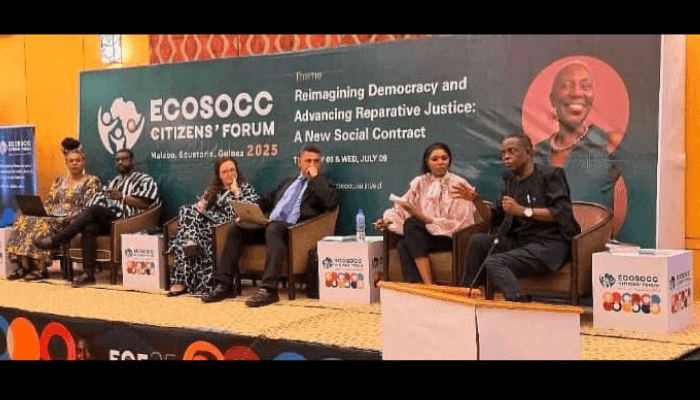
Civil society organisations across Africa and the diaspora gathered in Malabo from July 7 to 9, 2025, for the Civil Society Forum of the African Union’s Economic, Social, and Cultural Council (ECOSOCC) and the 2025 Interregional Dialogue of Civil Society Organisations.
The forum, held at the Sipopo International Conference Center, is contributing key inputs to the final communiqué of the 47th Ordinary Session of the African Union Executive Council, which will take place from July 11 to 13, 2025.
Held under the AU’s 2025 theme, “Justice for Africans and People of African Descent Through Reparations,” the forum focused on ways civil society can shape a future rooted in reparative justice. The opening panel, “The Role of Civil Society in a Future Rooted in Reparative Justice,” brought together over 200 participants to discuss mechanisms for addressing colonial injustices.
A major part of the discussion centred on models for reparations. One model involves calculating unpaid labour during the transatlantic slave trade. With an estimated 12.5 million enslaved Africans working unpaid for 10 years at $5 per day, the total reaches over $2 trillion, excluding interest and compound growth.

Another model examined resources extracted during colonial rule. Between 1880 and 1960, colonial powers extracted agricultural products, minerals, and tax revenues from Africa. Some estimates put the financial value of colonial extractions at between $4 and $6 trillion. These figures include forced labour, underinvestment, and lost development opportunities.
Participants discussed the possibility of creating a Global Reparations Fund. Proposed sources of funding include state contributions from former colonial powers, windfall taxes on corporations that benefited from colonial systems, and climate levies on Global North polluters.
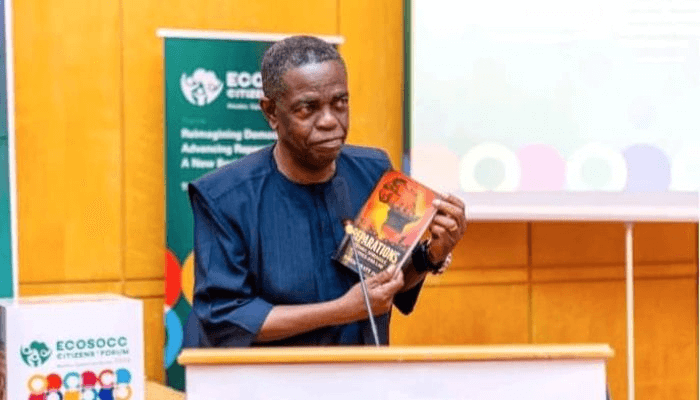
Kwesi Pratt Jr., member of the International Coordinating Committee of the Pan-African Progressive Front, presented his new book, “History, Struggle, Politics, and the Case for Reparations.” The book was published in June 2025 and includes a foreword by former Ghanaian President John Dramani Mahama.
“No amount of money can repay the millions of lives lost in the transatlantic slave trade. Reparations are about restoring our world,” Pratt said. His book traces historical events such as the Pan-African Congresses and reviews current campaigns like CARICOM’s push for reparations. It also provides guidance for civil society groups on global mobilisation strategies.
Dr Catherine Brooks from the UNDP’s African Facility for Support to Inclusive Transitions (AFSA) said transitional periods are an opportunity to renegotiate social contracts.

Ambassador Amr Aljowaily, Director of the Citizens and Diaspora Directorate (CIDO), spoke on institutional support for reparative justice. “ECOSOCC and CIDO are platforms specifically designed to enable civil society to shape the Union’s agenda. The Year’s Theme is not a one-off event but a long-term commitment,” he said, citing ongoing partnerships with CARICOM.
Makmid Kamara, Executive Director of Reform Initiatives, said reparative justice must replace conventional human rights education. “Reparative justice is not charity—it is a right. We must revive African consciousness, reconnect the continent with its diaspora, and restore stolen lands to their people,” Kamara said.
The forum closed with a call for unity and action among African civil society groups to keep reparations at the centre of the AU’s policy agenda.





