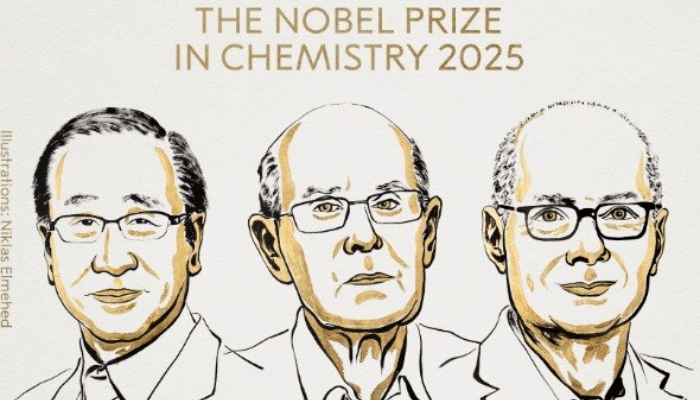
The 2025 Nobel Prize in Chemistry has been awarded to three scientists — Susumu Kitagawa of Japan, Richard Robson of Britain, and Omar M. Yaghi of Jordan, for their pioneering work in developing metal–organic frameworks, a new class of materials with extraordinary potential in tackling global challenges.
Announcing the award in Stockholm on Wednesday, the Royal Swedish Academy of Sciences said the trio’s discovery has “provided chemists with new opportunities for solving some of the challenges” the world faces, from clean water and energy storage to environmental protection.
Read also: Immune system breakthrough wins 2025 Nobel medicine prize for US, Japan scientists
“These molecular constructions, called metal-organic frameworks, can be used to harvest water from desert air, capture carbon dioxide, store toxic gases, or catalyse chemical reactions,” said Heiner Linke, chair of the Nobel Committee for Chemistry. “They have enormous potential, bringing previously unforeseen opportunities for custom-made materials with new functions.”

Turning chemistry into a tool for global good
Metal-organic frameworks, often abbreviated as MOFs, are crystalline structures made by linking metal ions with organic molecules. What makes them remarkable is their incredibly porous nature — like molecular sponges — which allows them to trap, store, and release gases or liquids with high efficiency.
In practical terms, these frameworks could help draw drinking water from dry desert air, filter pollutants from industrial emissions, or even store hydrogen for cleaner energy. Chemists say they could one day transform industries that rely on energy storage, gas separation, or catalysis.
Read also:Nobel Prize in Physics 2025 awarded to trio for quantum mechanics discoveries
The scientists behind the science
Kitagawa, a professor at Kyoto University, is recognised as one of the founders of the field, having first demonstrated how metal-organic frameworks could be built with large internal spaces. Robson of the University of Melbourne contributed to the early theoretical and experimental groundwork, while Yaghi of the University of California, Berkeley, expanded the field dramatically by designing MOFs with tunable properties, tailoring them for specific tasks such as gas storage and water harvesting.
Together, their work laid the foundation for a new branch of chemistry — one that blurs the line between molecular design and materials engineering.

The chemistry prize continues a tradition of recognising scientists whose work shapes the building blocks of modern science and technology. Last year, the Nobel went to David Baker, a biochemist at the University of Washington, and Google DeepMind researchers Demis Hassabis and John Jumper, for using artificial intelligence to decode the structures of nearly all known proteins — a feat that could revolutionise drug discovery.
In 2023, the award went to researchers who developed quantum dots, tiny particles now used in LED displays and medical imaging.
Read also: Baker, Hassabis, Jumper win Nobel Prize in Chemistry with protein research
This year’s winners, by contrast, are celebrated for opening new possibilities in materials chemistry — a field that touches everything from climate solutions to manufacturing and medicine.
The three laureates will share the 11 million Swedish kronor (£830,000) prize. Each joins a long line of scientists whose curiosity and perseverance have reshaped how humanity understands — and uses — the materials that make up the world.
As Heiner Linke of the Nobel Committee put it, “Their discovery shows that chemistry is not only about understanding nature, but also about creating new ways to make life better.”