…Move to foster peace, justice across West Africa
Catholic bishops across West Africa have appealed to policymakers in the education sector to integrate conflict resolution into the school curriculum, just as they commit to fostering peace, justice across the sub-region.
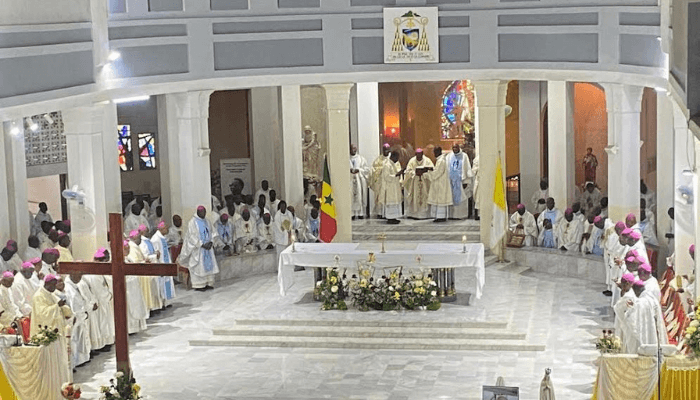
“We urgently appeal to educators to integrate civic education, mutual acceptance, and the peaceful resolution of conflicts more strongly into school curricula,” the bishops stated in a resolution issued at the end of the 5th Plenary Assembly of the Reunion of Episcopal Conferences of West Africa (RECOWA) held recently in Dakar, Senegal, with the theme, ‘For a synodal and Self-reliant Church at the service of justice and peace in West Africa.’
Read also: Tinubu to Catholic Bishops: We have a nation to build

The bishops in a resolution signed by Alexis Touabli Youlo, President of RECOWA, and Vitalis Anaehobi, the Secretary General, identified several key areas of focus for promoting peace and justice in West Africa, including educating for peace, promoting intercommunity dialogue, developing an inclusive economy, reforming the security sector, and fighting corruption and violent extremism.
The bishops, through the resolution, adopted a synodal approach to promote peace and justice in the sub-region, and emphasised the need for a synodal Church where all members walk together collaboratively.
“Walking together and carried by the Holy Spirit, the Lord calls us in this time to renew our way of being Church: not as a fixed structure, but as a people on the move, listening to the Spirit.
“May the blessing of the Lord descend abundantly upon each and every one, and may our God and Father continue to make our Churches living instruments of synodality, peace, justice, and reconciliation,” the bishops stated.
Read also: Catholic bishop urges govt to implement sustainable measures to alleviate poverty

According to the bishops, a synodal Church embodies a vision of true communion and evangelical solidarity, where gifts are shared among local Churches. “Each community, rich in its charisms, experiences, and resources, is not an isolated entity, but a living member of a single body.”
The resolution also called on governments across the sub-region to strengthen judicial institutions and oversight mechanisms to combat corruption and crime in West Africa.
It also emphasised the importance of self-reliance, stating that the Church should rely primarily on members, rather than external support. “This autonomy, which is not only financial, but also cultural and pastoral, aims to foster shared responsibility between the faithful and leaders, anchoring the Church in its local reality.”