Telecommunication has been the fastest growing industry in the Nigerian economy since 2018, hence it may not come as a surprise that it retained the spot in the first quarter of 2021.
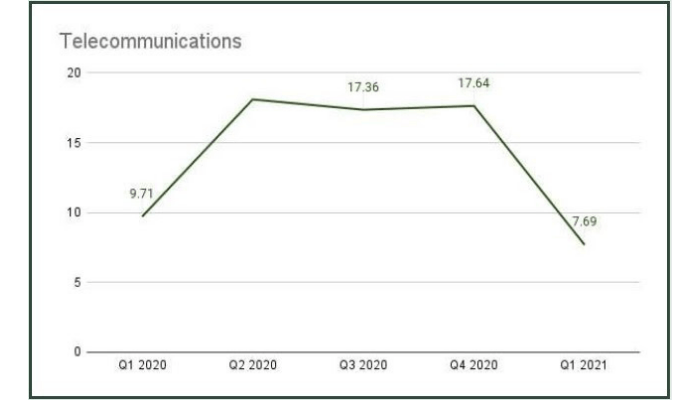
But the latest feat came by the whiskers with the industry dropping about 10 percentage points to settle at 7.69 percent from the previous quarter where it recorded 17.64 percent.
An almost 150 percent decline in three months is very significant for a sector expected to carry the burden of the country’s digital economy. It is the largest growth decline the industry has seen in many years and contributed to the wider drop the information and communication technology (ICT) sector witnessed.
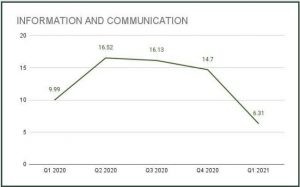

The National Bureau of Statistics (NBS) showed that in the first quarter the ICT sector recorded a growth rate of 6.47 percent in real terms, year-on-year, representing a decline of -1.18 percent from the same quarter in 2020. It is also a -8.46 percentage point lower than the rate recorded in the preceding quarter.
Read Also: We have resumed SIM card activations – Globacom
The reason for the decline is partly self-inflicted. The decision to ban SIM card sales and registration in order to conclude a nationwide National Identification Number (NIN) registration backfired spectacularly.
The entire telecom industry lost a total of 15.4 million subscribers between November 2020 and March 2021. Before now the sector has been growing double digits every quarter since the second quarter of 2020. It grew 18.1 percent, 17.36 percent and 17.64 in the second, third and fourth quarter of 2020, helping to lift the economy out of the pandemic-induced recession as other sectors contracted.
The ban was only lifted in April after it became clear that the NIN registration was not going to be ending that month. The registration deadline has now been moved to 30 June, the fourth time the Minister of Communications and Digital Economy is shifting the deadline.

There is a positive side to the suspension. Since the NIN registration, an estimated 54 million Nigerians have obtained their NINs. The NCC said this translates to 190 million mobile numbers with linked NINs. This is deducted from the empirical data that suggest that each unique NIN maps three to four phone numbers.
But while the country appears to be making progress with the national identity database, operators in the telecom industry have stacked five months of losses as a result of the SIM ban, the longest run in the industry’s history.
Arewa Telecom Operators Agents and SIM card Dealers Association (ATOASDA) estimates that 2 million young people were left unemployed as the suspension of sale, registration, and activation of SIM cards.
The country’s macroeconomic condition is also seen as a big contributor. Nigeria’s inflation in April is at 18.12 and driven by food inflation at 22.72 percent. With the increase in food prices, many people are forced to review their priority.
“We have a consumer base that is weak in terms of the pressure to spend on essential items,” Olusola Teniola, National Coordinator for Alliance for Affordable Internet (A4Ai), said in an interview. “As data are coming out we expect that (decline) to continue as a lot of people who had jobs are no longer having them.
Although Isa Ali Pantami, the Minister of Communication and Digital Economy is choosing to highlight the positive, the fact that telecom remains the fastest-growing industry, the decline as Teniola said, would not be going away any time soon, at least for as long as the economy stays weak and inflation at double digits.
Amid the economic realities, the minister can buy the operators in the sector a lifeline. Digital inequality is growing, driven mainly by widespread insecurity.
Northern Nigeria, for example, has been mostly affected by widespread incidences of terrorism, banditry, and herdsmen attacks. Telecom operators said they have been victims of infrastructure vandalism that has left whole communities disconnected.
A senior executive at the Association of Telecommunications Companies of Nigeria (ATCON) told BusinessDay in April that telecom investors are mostly staying away from the north due to the security situation in that part of the country.
One option Pantami has is pushing for the realisation of the Critical National Infrastructure (CNI) Bill which will deal with the issues of frequent fibre cuts, Infrastructure theft, and vandalisation, network congestion, community access denial amongst other sectoral issues. There is an executive order signed by President Buhari declaring telecom facilities as Critical National Infrastructure. But it would require a law for the order not to be overturned and to have the force of law. Without a law it would be difficult to punish offenders effectively.
Unfortunately, the bill has been in the National Assembly accumulating dust since it was sponsored in 2008 by Senator Enyinnaya Abaribe in the 7th Assembly. The current legislative House has yet to give it attention.
Pantami also has unfinished business with Nigerian Governors on Right of Way fees. After the intervention in 2020 in which the minister made efforts to get all the states to revert to the N140 agreed by members of the National Executive Council (NEC) in 2012, only seven governors have responded. 29 states have maintained the high fees.
Lagos States, which is among the states, have told operators it would consider revising the fees only when it finishes the Dig Once project it is currently working on.
The minister would have to make good on the promise to provide N65 billion counterpart funding for
The Nigeria Communications Commission (NCC) had said it is committed to the counterpart funding arrangement. The plan ensures that the NCC supports the infrastructure companies responsible for deploying broadband, with a subsidy of N65 billion counterpart funding. It is also part of a larger plan to raise N265 billion which falls under the State Accelerated Broadband Initiative designed to address the infrastructural deficits in the telecommunications sector. The infrastructural companies would raise the balance of N200 billion.
The Federal government was expected to release this fund by the third quarter of 2020 to infracos depending on their physical broadband rollout plan. Operators say they are yet to receive it and would likely hold off making significant investment until the money is released.