A recent report by PricewaterhouseCoopers (PwC) reveals that Africa holds 132 billion barrels of oil reserves. This is about eight percent of total world reserves and with significant new discoveries across Africa; the continent’s collective contribution to the sector is expected to reach thirteen percent of global oil production by 2015.
In spite of the enormous potential, Africa is still grappling with old and new challenges extraction of their hydrocarbon resources. Africa has experienced some of the largest oil demand gains globally in recent years. But the continent does not produce enough refined products to meet demand, resulting in imports from either US, Europe, Middle East or Far East.
In a forecast by International Energy Agency (IEA), demand for refined products across the entire Africa continent is likely to rise by up by 40 percent to 4.3mil¬lion barrels a day in 2020, from 3 million barrels a day in 2008. Africa’s substantial oil resource is still largely sent overseas to have value added by others and then
a total of 55 refineries have been built in Africa. At present, only 40 are operational; 21 of them are in North Africa while 19 are in sub Saharan Africa.

No doubt, there have been a lot of missed opportunities. For instance, Nigeria which is the leading oil producer in African has a capacity to pump over 2.5 million barrels per day (bpd), currently operates four refineries, but they can only refine less than 20 percent of its total production because of poor maintenance and corruption. Recently, a threat by workers at the Nigerian refineries to go on strike after the government mentioned their possible re-exported as refined products.
Africa’s oil-producing states are largely disengaged from the most lucrative and advanced part of the petrochemical value chain, and their economies are less dynamic as a result. By exporting most of this oil to be refined elsewhere, including for eventual domestic consumption, the con¬tinent has long missed out on a huge opportunity for economic transformation. It is, thus, imperative that Africa increase its refining capacity.
Missed opportunities
Ever since Egypt’s El Nasr refinery came on-stream in 1913,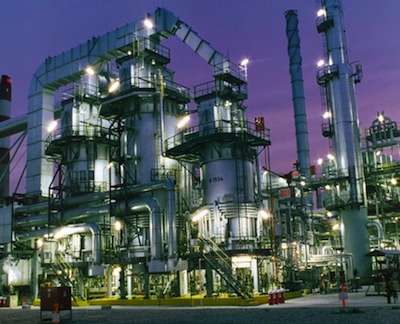 privatization forced the government to reverse itself and opt for the refineries to remain in public hands.

However, the situation in Cote d’Ivoire is different. Even though it does not have huge hydrocarbon resources, its 70,000 bpd refinery, Société Ivorienne de Rafinnage (SIR), is a key supplier to the West African region as oil consumption in Cote d’Ivoire is only 27,000 bpd.
If Africa is going to truly trans¬form its hydrocarbon wealth to economic dynamism, it must in¬crease its refining capacity and better capture the more sophisticated economic opportunities that exist along the petrochemical value
chain.
New frontiers
As new oil fields continue to be found and drilling technologies improve, analysts estimate that oil production in sub-Saharan Africa will grow from the current 7.4 million bpd to 8.8 million bpd in 2020. With only 30 percent of subSaharan Africa’s 2,900 existing oil blocks licensed, significant room for growth remains in the sector. Discovery of hydrocarbons in the traditionally under-explored West African region such as Gambia, Ghana, Senegal and Liberia are set to fundamentally alter the equations over the next decade.
More recently, Africa’s policymakers and private sector have begun to consider new plans for various refineries on the continent. Countries including Senegal, Cote d’Ivoire, Gabon, Angola and Nigeria are considering either the modernisation of their existing refineries or the building of new ones to meet growing fuel consumption.
Aliko Dangote, Africa’s richest man is currently driving Nigeria’s project for a new 400,000 b/d refinery. Kenya plans to almost double the 35,000 bpd capacity of its Mombasa refinery, currently the only major crude oil refinery in East Africa. Uganda plans to add another refinery to be constructed in collaboration with Kenya, Rwanda and South Sudan that would handle 60,000 bpd.
In Angola, Sonangol has started work on a new 200,000 b/d refinery. Cameroon’s Limbe refinery is currently
Undergoing extensive improvement works that will enable it to double its capac¬ity by 2016-17. There is a project to expand Senegal’s 27,000 b/d Dakar plant owned by Societe Africaine de Raffinage, as well as the 64,000 b/d plant in Abidjan, in Cote d’Ivoire and a new refinery could be built in Gabon.
More needs to be done
Unfortunately, these plans to upgrade refining capacities could be too modest in ambition. Mid¬dle Africa’s total installed refinery capacity stands at 860,000 bpd but analysts estimate that the region has a product supply gap of over 485,000 bpd. Oil consumption in West Africa is about 665,000 bpd but active refining capacity in the region is currently around 38% of the 620,000 installed refining capacities.
Even if Kenya’s and Uganda’s refinery plans are both success¬fully implemented, the region’s oil consumption of about 200,000 bpd will outstrip its planned refining capacity of 135,000 bpd. Similarly, with Dangote’s ambitious new refinery coming online by 2016, Nigeria will remain an importer of refined oil products.
Africa, especially the oil producing countries, should work on boosting their capacity to refine oil by investing in worldclass refineries that process a mini¬mum of 200,000 bpd (an industry standard) and design plans for smallcapacity refineries that can be upgraded to such a level in the future.