President Muhammadu Buhari on Thursday said Nigeria’s investment opportunities would continue to offer some of the highest returns globally as a result the country’s strategic initiatives.
Buhari, while presenting Nigeria’s Statement at Plenary Session Three on “Public-Private Business Dialogue” at the Seventh Tokyo International Conference on African Development (TICAD7) in Yokohama, Japan, said he was looking forward to prospective investors making inroads in priority sectors in Nigeria, including power and renewable energy, petrochemical and gas, maritime (shipping and ports), automobiles, mining, agribusiness, healthcare and pharmaceuticals, ICT and railway.
He assured participants at the event, comprising major global business moguls, of good returns as a result of ongoing reforms initiated by his administration, which include the Presidential Committee on Enabling Business Environment set up to promote ease of doing business and make Nigeria more attractive.
Buhari said his administration was “committed to removing all impediments to private sector participation in these sectors by creating policies that will ensure consistency, predictability and a level playing field for all”.

He identified power, transportation, infrastructure, maritime/shipping, agro-processing, mining, manufacturing, petro-chemicals, food processing, textiles, among others as “key drivers to the diversification” of the Nigerian economy as well as “priority areas” that will drive his administration’s economic agenda.
He said he looked forward to personally “welcoming prospective investors to Nigeria”.
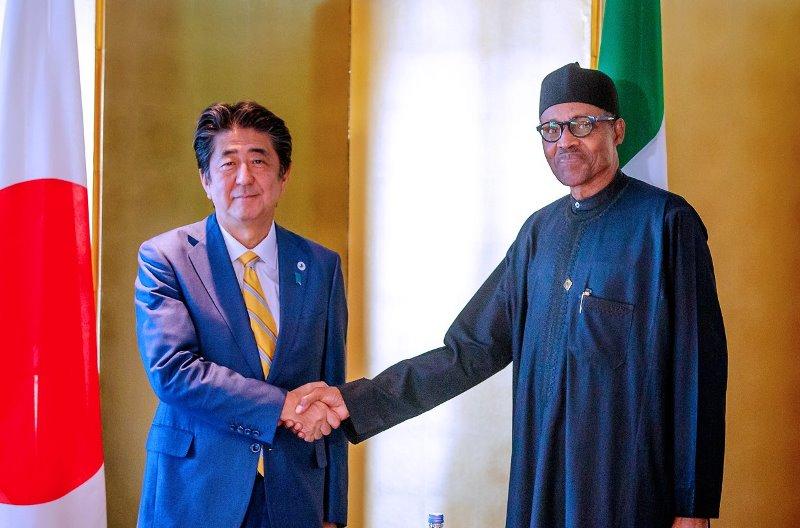
On the sidelines of the conference, Buhari also met with other world leaders. During a meeting with Japanese Prime Minister Shinzo Abe for bilateral talks, he pleaded for Japan’s assistance in tackling illegal fishing and piracy on the Gulf of Guinea.
Abe, while commending President Buhari for “taking Nigeria to the Next Level”, made a donation of $300,000 to the Nigeria Defence College and another ¥12 million in support of the public health sector in Nigeria.
Abe assured of his country’s support for Nigeria’s presidency of the 74th Session of the United Nations General Assembly currently occupied by Nigeria’s Tijjani Muhammad-Bande, who was elected to succeed María Fernanda Espinosa, whose term ends in September 2019. He in turn pleaded with Nigeria to support Japan’s bid for headship of some global organisations.
President Buhari, who also met with the European Union (EU) top officials, witnessed the signing of a €50 million Memorandum of Understanding to support humanitarian and development efforts in the war-ravaged North-East region of Nigeria.

The cooperation agreement which was signed by Nigeria’s Foreign Affairs Minister Geoffrey Onyeama and Neven Mimica of the EU is expected to bring the EU support which commenced in 2014 to €562m by 2020.
Buhari used the opportunity to commend EU for its consistent support for Nigeria, especially in the North-East ravaged by the over 10 years of Boko Haram insurgency.
He called for more assistance, especially in the areas of education, describing the situation in the Internally Displaced Persons’ camps as “pathetic”.
Mimica assured that Nigeria’s requests would be given top-priority considerations as EU is currently working on its seven-year budget.
While presenting Nigeria’s Statement at Plenary Session Three on “Public-Private Business Dialogue” earlier, Buhari commended existing bonds of friendship and economic cooperation between Nigeria and Japan, describing the Asian country as “a strategic partner for our socio-economic development”. He said Nigeria’s intention was to “further encourage relationships with key public and private sector stakeholders” in both nations.
He expressed particular delight with the level of “discussions on the establishment of the Japan-Nigeria Business Facilitation Council, an initiative of the Japanese government, which would be launched on our return to Nigeria”.
“I look forward to positive reports of increased trade and investment between Nigeria and Japan from these initiatives,” he said.
Buhari described the TICAD Forum as important to Nigeria in many respects, as it “coincides with the period when the country is faced with a number of challenges that affect our economy”.
“TICAD is coming at a time when our government is implementing home-grown and private sector-driven economic measures that are predicated on good governance, infrastructure and human capital development as well as, business climate reform,” he said.
He said the domestic measures being implemented informed his invitation to “the private sector to come and invest in Nigeria”.
“Nigeria and indeed Africa expect much from this Forum in terms of investment, considering the role of Foreign Direct Investment in all economies – developed and developing,” he said.
Buhari also expressed Nigeria’s gratitude to the Japanese Prime Minister Abe “for his unwavering commitment to strengthen trade and investment between Japan and Africa through various initiatives, partnership and support of the Japanese Government”.
He wished TICAD7 “fruitful deliberations and hope that the conclusions reached will enhance access by African countries to international capital investment as well as boost Japan-Africa exchanges by developing new and strategic public and private sector alliances”.
TONY AILEMEN, Abuja