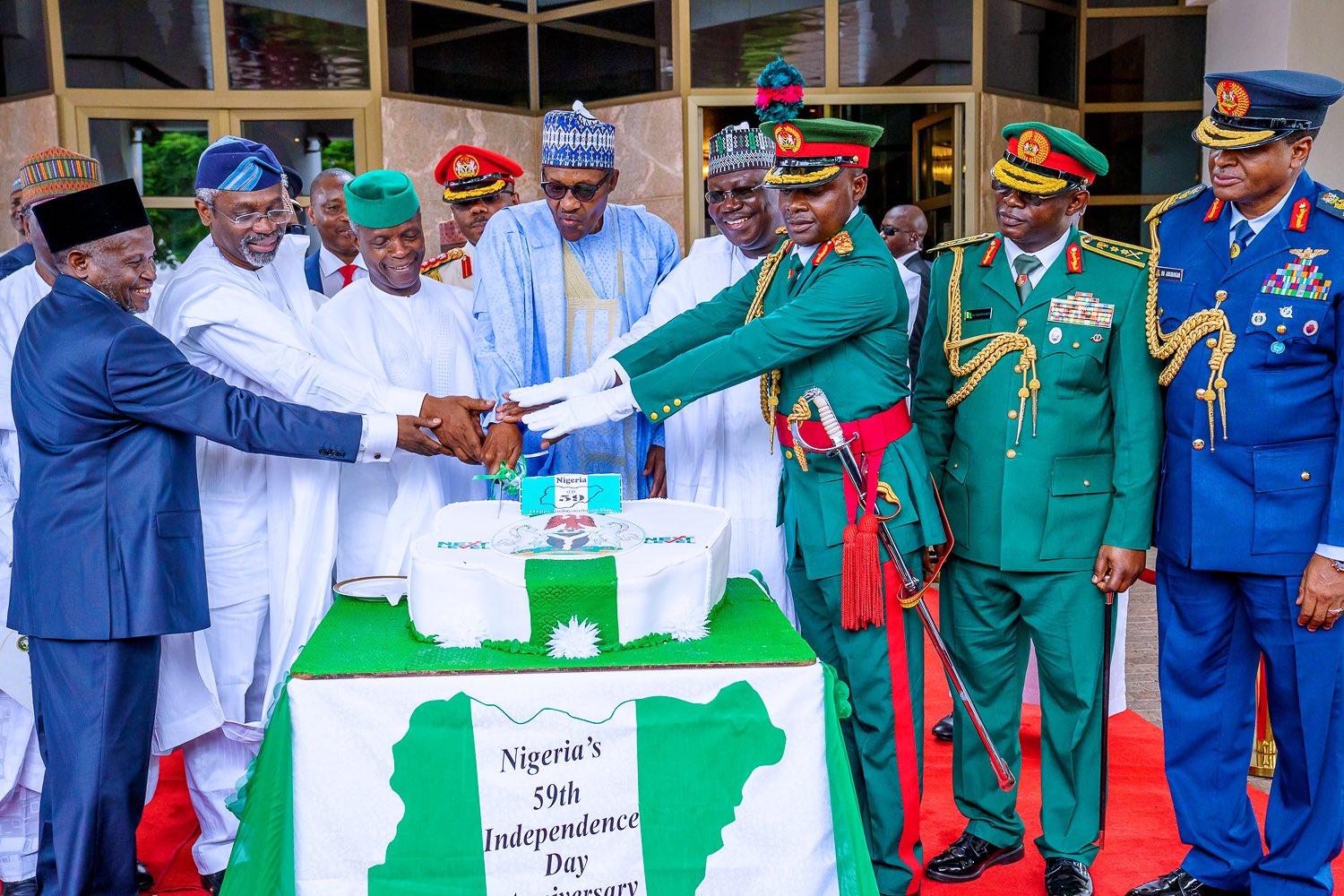
What President Muhammadu Buhari said on the economy in his Independence Day speech on Tuesday failed to impress experts who say the narrative has remained the same for Nigeria where the president remains stuck in the past.
Among other things, the president said his administration inherited a skewed economy but has learnt from past leaderships and is making headway in steering the economy in the right direction, evidenced by growth seen since the 2016 recession and other measures, but experts are not as enthusiastic.
“It is a shame that five years as president, Buhari is still blaming past administrations,” said Bongo Adi, a senior lecturer at Lagos Business School. “Five times he has said the same thing; five times things have gotten worse.”
Boniface Chizea, MD and CEO of BIC Consultancy Services, said there were challenges in the economy that could not be denied, although efforts are being made to address them.
“The president should not be talking about past administrations anymore because this is his second term,” Chizea said. “If we keep looking behind, we get stuck in the past.”

Chizea called for more effort towards implementation of the various plans the country has.
The president had in his speech said the previous governments abandoned the residual investment-driven non-oil sector which contributed 40 percent of Nigeria’s Gross Domestic Product and employed millions.
To address the imbalance, Buhari said his government launched the Economic Recovery and Growth Plan in 2017 to diversify Nigeria’s economy, which plunged into a recession when oil prices slumped in 2016.
“Pursuant to these reforms, the economy has recovered and we have had nine successive quarters of growth since our exit from recession,” Buhari said.
He also noted that Nigeria’s exchange rate in the last three years has remained stable, with robust reserves of US$42.5 billion, up from US$23 billion in October 2016.
“To a very large extent they have been able to achieve macroeconomic stability since 2016, although growth remains weak and we have not been generating enough jobs which have affected income level,” Omotola Abimbola, an analyst at Lagos-based Chapel Hill Denham, said.

Moody’s, an international ratings agency, has described the country growing slower than its population since 2016 as stuck in a low-growth cycle.
In terms of achieving diversification, Johnson Chukwu, CEO of Lagos-based Cowry Asset Management, said Nigeria has not made significant progress in years as statistics provided by the presidency have been the same in Nigeria for years.
“One is hoping that by highlighting those concerns, the president would do the needful to change the structure of oil contribution to its revenue by growing the non-oil sector and improving the value chain there,” Chukwu said.
David Oke, a senior lecturer in the Department of Economics, University of Lagos, said the move from oil to agriculture would not be enough to stimulate growth as the commodities earned less foreign exchange in the international market.
Oke said the move can, however, help Nigeria attain food security while the lack of infrastructure remains a drag for manufacturing which is critical for the country.
The experts expressed concerns about the state of insecurity in Nigeria, especially the spate of kidnapping which is affecting economic activities in the country while they called for fiscal consolidation, ease of doing business and infrastructure investment.
The president in his speech reiterated commitment to encourage private capital for infrastructural development through Public-Private Partnerships and addressing electricity challenges, a move the experts applauded.
Buhari also said his administration would soon pass the Petroleum Industry Bill and amendments to the Deep Offshore Act and Inland Basin Production Sharing Contracts Act into law, while he assured Nigerians of increasing share of funds for capital expenditure.
“Implementation of the 2019 capital budget, which was only approved in June 2019, will be accelerated to ensure that critical priority projects are completed or substantially addressed,” Buhari said.
“The Ministry of Finance, Budget and National Planning has been directed to release N600 billion for Capital Expenditure in the next three months,” he said.
While assuring Nigerians of greater scrutiny over revenue-generating agencies as well as inter-agency collaborating, Buhari said he remains mindful of the vulnerable in the country.
SEGUN ADAMS