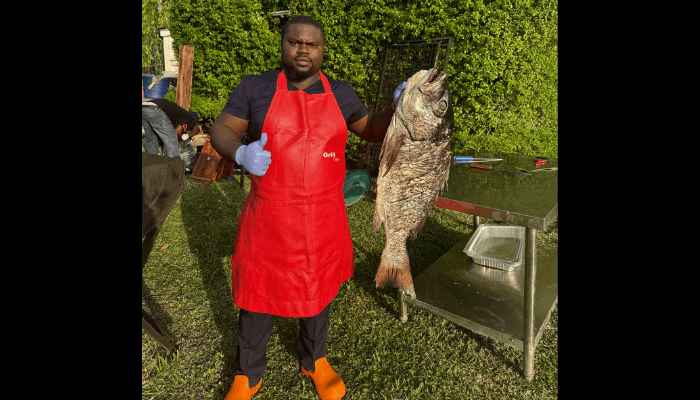
He arrived with a charcoal smell and a grin, and by the time the last rib was torn apart, an entire crowd had found a new scripture for celebration.
They call him The Grill King. In Abuja courtyards and Lagos pop-ups, at carnivals and private galas, BrightGrillzz has become a one-man cultural engine: part master butcher, part showman, part brand builder.
It’s not just that he cooks. It’s that he stages ritual, the slow choreography of fire, spice and applause, and turns ordinary meat into a narrative people want to be part of. His Instagram bio reads like a manifesto: “Multiple Awards Winning Chef, Barbecue Online Offline Training Guru, and First Chef to Grill for 5,000 People at the Ochacho Carnival.” That claim – and the crowds that back it up – is visible in clip after clip of packed grills and stacked platters. Nfon Bright Bungansa is the founder of BrightGrillzz.
From Douala streets to Abuja stages

Public traces suggest BrightGrillzz’s roots sit in Cameroon’s vibrant street-food culture, then fast-forward into Nigeria’s capital, where the brand found a new ecosystem. Short social reels show meals served “in Douala” and packed lunch rushes in Abuja; a continuity of craft that crosses borders and tastes. It’s the kind of mobility that modern West African culinary entrepreneurs need: culturally fluent, logistically mobile, and media-savvy.
Look closely at the videos, and you see the clues to his ascension. There is the ritual pour of palm oil and spices; there is the theatrical pour of flaming alcohol over fat-laden cuts to elicit hisses and cheers; there is, always, a crowd. On TikTok and Instagram, BrightGrillzz’s signature hashtags – #feedthebodythatworksthemoney and #BBQLife – appear on hundreds of posts documenting pop-ups, private shifts and celebrity cameos.
One viral clip even credits a prominent nightlife patron for bringing him to national attention. Those social moments are not accidental: they are strategic cultural currency, turning every event into both revenue and publicity.

Culinary craft as performance economics

What BrightGrillzz does well is combine two simple truths: Nigerians love spectacle, and Nigerians love flavour. But spectacle without scale is a moment; flavour without story does not sustain a brand. He has built both. Every grill is a stage, and every customer is an advocate. The metrics are visible in engagement: thousands of followers, packed events, and recurring bookings across private and public spheres. Those metrics are the modern currency of food entrepreneurship, and BrightGrillzz has them in abundance.
Behind the theatrics is a business operator who understands value capture. Videos show coordinated teams, custom branding on platters, and food presented as a lifestyle product. Some pop-ups act like product launches, new platters, new sauces, new “limited runs”, creating scarcity and hype in equal measure. That is how culinary artisans leap from the informal to the institutional: through repeatable experiences that justify higher price points and create brand loyalty.
Celebrity, community, commerce
BrightGrillzz’s feeds are littered with name-checks and endorsements, from club owners to social media micro-celebrities. One feature-length clip frames how “Obi Cubana brought me to Nigeria,” a shorthand indicating a patronage moment that transforms a vendor into a social brand overnight. These bridges to celebrity life do two things: they signal prestige to well-heeled clients and they send aspirational cues to younger cooks who see possibility in the trade. The chef’s work is curatorial: he collates social capital into economic value.
But the brand also keeps one foot in the community. Many posts show crowds of everyday workers – lunch queues, festival-goers, market stalls – suggesting that BrightGrillzz is not only a luxe name but a mass-market favourite. That combination, an aspirational brand with broad accessibility, is the sweet spot for sustainable food enterprises in West Africa.
Lessons in modern African food entrepreneurship
BrightGrillzz’s arc illuminates a pattern we see across successful culinary startups in Africa:
Performance-first product – the meal is an event. Social media amplifies events into demand.
Cross-border provenance – mobility across markets (Douala ↔ Abuja) supplies both authenticity and diversification.
Celebrity ecosystems – patronage accelerates brand growth more than traditional advertising.
Digital-first distribution – TikTok and Instagram are pre-sales platforms; bookings and buzz flow directly from social clips.
The narrative that sells
Brands that stick in people’s minds do two things: they speak to taste, and they tell a story bigger than the plate. BrightGrillzz tells a story of transnational grit, of a Cameroonian-born grill master who found his audience in the heart of Nigeria and scaled through spectacle, taste and community ties. It’s an exportable story because it ties cuisine to identity and identity to commerce.
What comes next – scale without losing the flame
The obvious next step is institutionalisation: a flagship restaurant that doubles as a training academy; packaged sauces and marinades sold through supermarkets; licensing deals for event franchises across West Africa. The challenges are those every food entrepreneur faces: food safety compliance, supply chain consistency, cold-chain logistics, and capital for formal expansion. But the brand has an advantage most startups do not: a proven social media demand model and a public personality who converts clicks into bookings.
A portrait of possibility
BrightGrillzz is at once an entertainer and an economist. He monetises ritual and reclaims texture; he packages spectacle into livelihood. In an economy where cultural products are rapidly becoming tradeable assets, chefs like him are architects of a different kind of soft power, the kind that tastes like home and sells like a dream.