Big banks may not have started feeling the pinch of stringent regulations by the Central Bank of Nigeria (CBN) as they continue to make money from short term government securities.
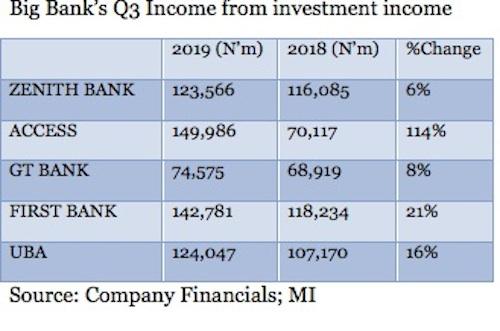
FirstBank Holdings Nigeria (FBHN) Plc, United Bank for Africa (UBA), Zenith Bank Plc, Access Bank and Guaranty Trust Bank (GTBank) realized a combined N614.95 billion from income from in investment bonds and Treasury bills, this represents a 27.98 percent increase from the N480.52 billion they made the previous year.
Between 2017/18, banks took advantage of high yields on government securities to underpin earnings. However, starting from 2018, yields began to drop thereby resulting in weak revenue.
Experts are of the view that lenders are ingenious and will always take advantage of monetary policies, but at times these policies do not favour them.

A breakdown of the figures shows Access Bank‘s interest income from investment securities surged by 113.90 percent to N149.98 billion in the period under review from N70.11 billion the previous year.
FBHN’s interest income from short term government securities was up 20.80 percent to N142.78 billion in the period under previous from N118.23 billion the previous year.
Zenith Bank’s interest income on investment securities increased by 6.40 percent to N123.56 billion in the period under review from N116.08 billion as at September 2018.
UBA’s interest income from short term securities was up 15.71 percent to N124.04 billion in the period under review from N107.17 billion as at September 2018.
However, the lender could see future profit shrink as the CBN has implemented policies that will force them to lend to the real sector of the economy.

First, the regulator has directed that banks Some of the CBN’s recent are to maintain a minimum loan-to-deposit ratio of 65 percent by 31 December 2019 and 150% weighting to be applied to loans to SME, retail, consumer and mortgage sectors for the purpose of LDR computation.
Second, a reduction in banks’ daily limit at the standing lending facility to N2.5 billion from N7.5 billion.
Last week, the Federal Government barred individuals and local non-banking firms from buying-yielding central bank bonds, a move designed to curb speculative activities and encourage more lending to the economy.
According to the Apex bank, the measures are in line with a wider policy to penalise banks that don’t boost lending.
Analysts say the new rules could expose operators in the industry to deteriorating asset quality since they are forced to extend credit to high-risk asset amid a tough macroeconomic environment.
If they lend to the sector that is strong they will make money but there will be a problem if they give money to high-risk sectors then there could be trouble,” said Ayodele Akinwunmi, equity research analyst at FSDH Merchant Bank Ltd.
“They will have to look at the economy to know the sector to lend to,” said Akinwumi,”
BALA AUGIE