Wednesday, May 28, 2025, marked the 8th edition of the National Day of Mourning (NDOM), with a report showing not less than 6,549 citizens were victims of mass atrocities, ranging from violent attacks, clashes, terrorism, kidnappings, and extrajudicial killings. Ruth Tene Natsa writes
The National Day of Mourning (NDOM), commemorated March 28th annually, is a citizen-led initiative set aside to recognise and accord dignity to victims of mass atrocities, demand justice for the dead and the missing, and insist on accountability for the deluge of mass atrocities.
The NDOM came into existence following an emergency meeting of more than 100 Nigerian civil society actors on Monday, April 30, 2018, in Abuja, to deliberate on the escalation of violence in the Middle-Belt/Benue Valley of Nigeria and other parts of Nigeria and its attendant humanitarian crisis.
The meeting quoted that from 2001 till 2018 (17 years), the African Centre for Strategic Studies had estimated that over 60,000 had been killed in the rising violence in the Middle Belt, representing a yearly average of more than 3,500 people.

In 2019, the Coalition tracked a minimum of 3188 killings; 2020 recorded 4556; 2021 recorded 6895; 2022 had 5792, while 2023 tracked 4385 killings and deaths, respectively. The coalition tracked that the loss of lives was attributed to mass atrocities, violent attacks, clashes, terrorism, kidnappings, and extrajudicial killings. A glaring spike of over 40 percent in the number of casualties in comparison to the 2019 figure of three thousand, one hundred and eighty-eight (3188).
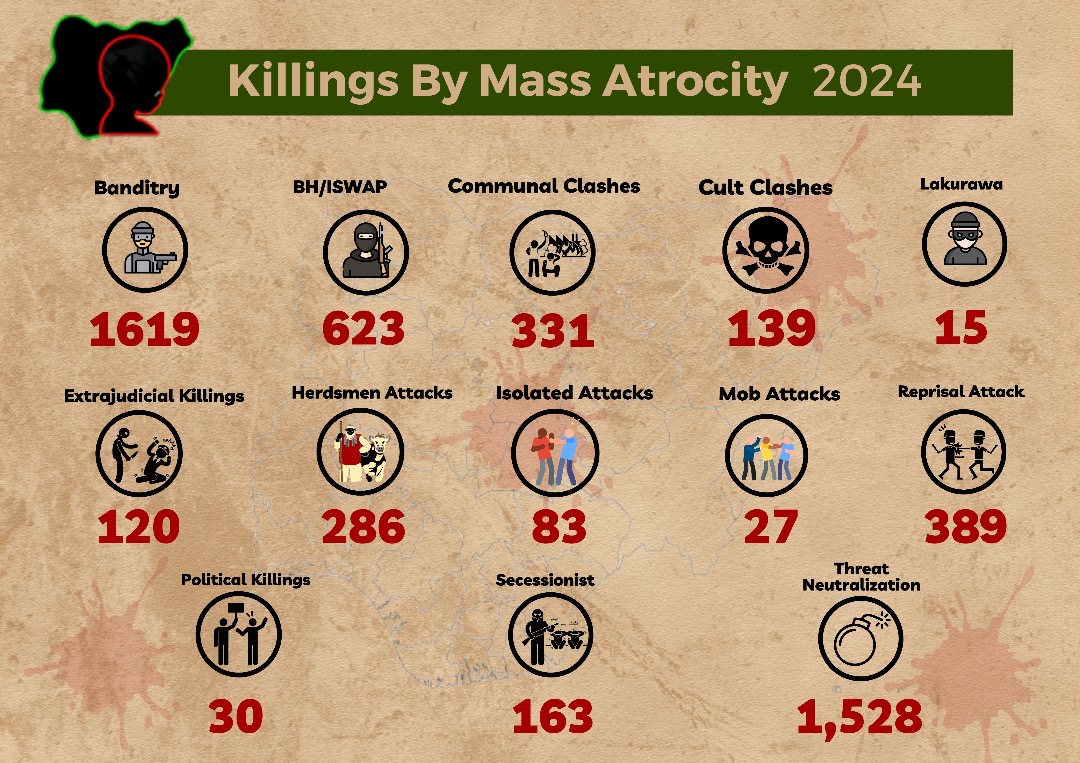
In 2024, no fewer than 5,353 people were killed and 5,171 abducted in incidents of mass atrocities nationwide. An additional 1,196 people have been killed and 1,367 kidnapped so far in 2025, bringing the numbers to at least 6,549 Nigerians killed and at least 3,804 abducted across the country since the last commemoration of the National Day of Mourning on May 28, 2024.
These numbers, unfortunately, do not account for the regular crimes of armed robbery and other forms of crime within that range.
Presenting a regional overview of atrocities since May 2024, the Coalition noted that no part of Nigeria has been spared from the onslaught of violence, however varied they were, and the devastation was national.
The North West accounted for the highest number of fatalities, with at least 1,671 people killed in terror pillages and bandit attacks, with numbers as high as 70 people killed in a single attack, as was the case in Yargoje, Kankara LGA, of Katsina State. There was a resurgence of terror activities in the North-East. Boko Haram killed at least 75 fishermen in an attack on Tunbun Rogo, Kukawa LGA, Borno State, contributing to the second-highest mass atrocity toll.

The North Central of the country, particularly the Benue Valley, continued to contend with escalating attacks from herder-militia and some faceless groups, in addition to communal clashes. In one brutal attack on the Wase community in Plateau State, at least 50 people were massacred.
The South was not spared. In the South-East, organised terror groups claiming a secessionist agenda continued to inflict violence on helpless citizens. In Orlu and Orsu LGAs of Imo State, at least 40 people were killed in coordinated attacks by the secessionist groups. Violence instigated by politicians and their cult-gang friends ensured that people in the South-South could not sleep with their eyes closed. We call to mind the upheaval in Rivers state, which has also been marked by bloodshed.
While the SouthWest was the most peaceful region, in spite of having the lowest numbers, it continued to contend with an assortment of issues. Again, herder violence spilt over to the South and claimed the highest single toll in the region, with at least 20 people killed in a single attack in Akure North LGA, Ondo State.
There have also been instances where the state was complicit in the killings of citizens. Since the last National Day of Mourning in May 2024, at least 174 civilians were killed by state security agents, including 76 lives lost in four separate “accidental” airstrikes in Kukawa, Maradun, Yauni, and Gidan Bisa communities.
The worst states to live in for Nigerians in 2024, according to the report, were Borno with 1124 killings, Katsina 694, Zamfara 624, Kaduna 538, Benue 469 and Plateau 354. It further records that the worst abductions were recorded in Zamfara (1540), Kaduna (991), Katsina (604), Sokoto (485), Niger (438) and Borno (397) (from May 28, 2024, to May 28, 2025).
In his remarks, Ken Henshaw, executive director of We the People and chairperson of the Community of Practice Against Mass Atrocities, said Nigeria has been thrown probably into the worst form of killing ogres from every part of the country. “North, South, East, and Central; mindless, ruthless murders are going on unchecked, unabated, and nobody seems to be saying anything, and it is unfortunate.”
“In 2024 alone, our data indicated there were 5,353 people killed and 5,171 people abducted, and these are just the ones we have data for; there are many more cases that we do not have data for.”
“Every single Nigerian has lost somebody; everybody feels the pain and wears the shoes. Everybody, no matter who has lost somebody to these mindless killings, everybody is touched.”
He recalled that as recently as 3 weeks ago, his colleague was abducted and dragged into a swamp, crossing 3 rivers with the police shooting at them. Fortunately, a ransom was paid, and his colleague was rescued after a week of incarceration.”
“It’s been 3 weeks, but my colleague is still very much traumatised.”
“We had hoped that with democracy and especially with the coming of President Bola Ahmed Tinubu, we would see a visible attempt to stop the killings and bring some measure of security to the country, but rather, what we have seen is an exponential increase in the killings in the country, to the extent that the killing has spread to every single part of the country.”
How can we be talking figures of up to 5000 people killed in atrocious circumstances and still claim the nation is not at war?
In her remarks, Abiodun Baiyewu, executive director of Global Rights, said, On the 8th National Day of Mourning for Victims of Mass Atrocities, we demand security, not condolences.
We start by quoting an Igbo proverb that says, ‘The blood of the innocent does not dry; it cries out for justice.’
“We, the undersigned civil society organisations, in commemoration of the 2025 Day of Mourning and in assessing President Bola Ahmed Tinubu’s second year in office, reiterate our deep concern over the nation’s descent into chaos occasioned by the failure to tame insecurity across Nigeria.”
“We demand that the President and his administration fulfil their constitutional duty of ensuring the security and welfare of all Nigerians in accordance with Section 14 2 B of the 1999 Constitution as amended.”
Baiyewu said the National Day of Mourning is a solemn citizen-led initiative that sets aside May 28th of each year to recognise and accord dignity to victims of mass atrocities, demand justice for the dead and missing and insist on accountability for the deluge of mass atrocities. Nigerians are subjected to this when the government fails in its primary role.
“It is a day to remember that our fellow citizens are not mere statistics but humans and citizens whose lives are unjustly cut short or whose identities must not be forgotten and for whom justice must be served,” she said.
Rafsanjani Musa Auwal, executive director of the Civil Society Legislative Advocacy Centre, stressed the need for citizen engagement. “We are saying condolences are not what Nigerians want; they want Nigerians to be protected.”
“We do not need to wait until it happens to start paying condolences, we have every responsibility as Nigerians to also support the efforts of the government to ensure that these wanton killings are stopped”.
“We have also seen that part of the reason for the insecurity lapses is as a result of the corruption in the security sector, and that is why we are appealing to the president to carry out thorough security reforms that will address so many gaps,” he urged.