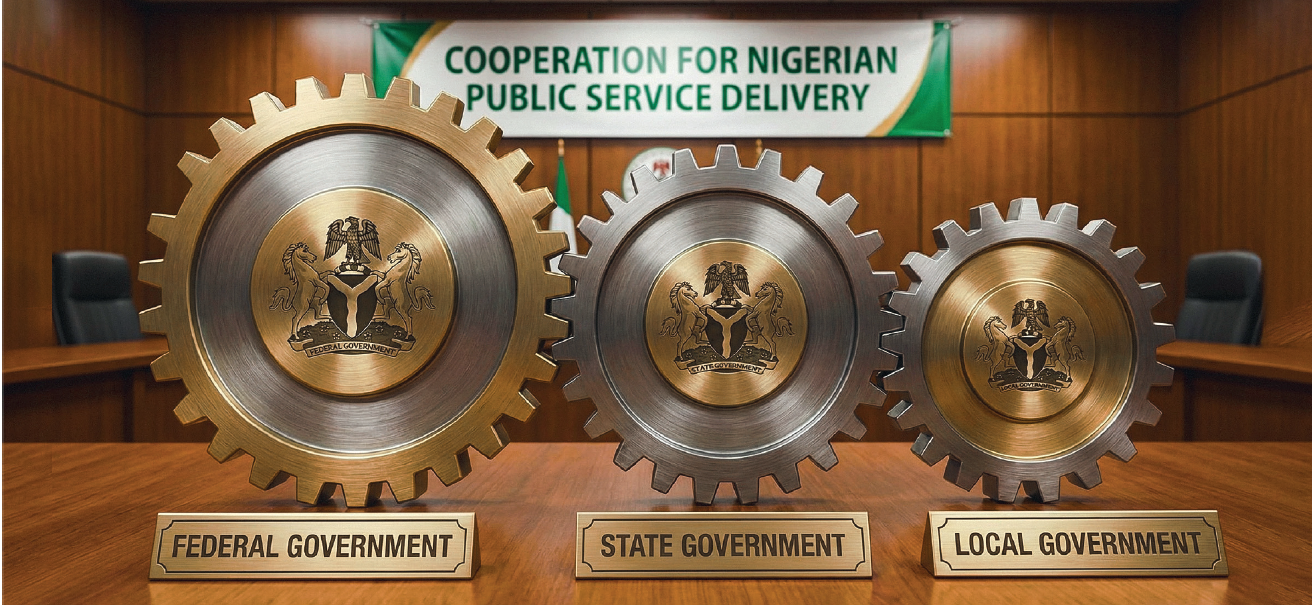
In 2020, the Attorney General of the Federation challenged the South-West governors’ Western Nigeria Security Network (Amotekun), citing exclusive federal power over security and defence. This came amid herder violence that national agencies seemed unable to contain. The eventual compromise permitted Amotekun only on a state-by-state basis, destroying its original “network” logic. An obsession with constitutional division of powers as an end has turned Nigeria’s house of 36 mansions into one where doors reinforce separation rather than create linkages.
In principle, federations share powers between tiers of government so that the level best able to internalise costs and benefits can tax, fund, and regulate defined matters. In practice, however, no division is so perfect that convergence becomes unnecessary. Populations overlap, resource disparities create spillovers, and neighbouring states can gain economies through joint initiatives. To achieve these objectives, governments must sometimes combine powers, devolve them, or share resources.
Why, then, do we show so little interest in how federalism delivers public good through cooperation? First, a doctrinaire black-letter legal training has produced a discourse that emphasises conflict over collaboration. Similarly, the long spell under military rule has somewhat fudged an understanding, blurring the lines between rules-based cooperation and command-chain conformity. The post-1999 string of AG Lagos v. AGF cases was therefore needed to reassert state autonomy.
Yet, overstating division of powers has grave consequences. It breeds policy paralysis and blinds the country to the benefits of cooperation. Without studying models and results, one cannot tell genuine collaboration from free-riding. Cooperative federalism deserves attention if institutions are to deliver efficiently. Three models of cooperation merit examination.

Devolution of power is a mechanism by which the central government consciously cedes regulatory authority. A promising Nigerian example is the framework of the new Electricity Act 2023, which empowers states to create their own regulatory frameworks for power generation and distribution. As a practical response to a national crisis, this reform allows the matching of options to local preferences, something a one-size-fits-all federal control has notoriously failed to do. Thus, Lagos could design its electricity market to support mini-grids targeting commercial clusters, a system more suited to the band-rated structure than that of states with more uniform consumer bases.
Intergovernmental fiscal transfers allow the central government, as part of its ‘distribution function,’ to make grants to the states to support equitable service delivery and to correct spillovers. Some of the funds in current operation have shown evidence of design flaws: misaligned incentives, lack of credible commitments, and poor governance safeguards. In 2024, some states’ failure to provide counterpart funding left N263 billion unaccessed, under the Universal Basic Education programme, worsening the crisis of 17.8 million out-of-school children. The National Ecological Fund, requiring no matching contribution, has been plagued by mismanagement; a former governor was convicted in 2018 for diverting over N1 billion. A level of poly-centric governance is required to keep states honest to their bargains while addressing the regional peculiarities in the problems with these funds. The new Regional Development Commissions (RDCs) could serve this dual purpose.
The third tool is the interstate compact. It enables states to collaborate in developing and regulating common resources and contiguous assets. The US constitution explicitly allows this, with congressional approval, even for matters within unused federal powers. Nigeria lacks such a provision, but no constitutional barrier prevents states from collaborating on matters within their explicit or residual powers.
Opportunities for interstate compacts abound, including to complement devolution. For example, neighbouring states with compatible consumer bases could create a joint electricity market under the 2023 Act. Similarly, security compacts could lay the groundwork for regional policing. President Tinubu’s recent pronouncement signals eased federal hostilities to state policing, clearing the path to devolution or constitutional reforms. This could allow Amotekun and similar initiatives to regain efficiencies of scale, joint training, and intelligence sharing under a single compact.
Borderlands between states tend to be zones of neglect, with developments gravitating towards state capitals. Regional infrastructure linked to last-mile feeder services could unlock growth in these zones. A Lagos-Ogun joint-development pact that has outlined plans for infrastructural projects to ease unplanned development pressure that has produced urban blight between the states, is still awaiting a legislative framework. Similar neglects in more rural pairings such as Niger-Kwara have created ungoverned spaces prone to insecurity. Infrastructure and security compacts could transform these areas, a part of the country’s food basket. For nationality groups demanding regionalism, interstate compacts offer a practical halfway house to test viability without immediate constitutional rupture.

State obligations to deliver public goods arise from Chapter II of the 1999 constitution. There are equally international obligations under the UN Sustainable Development Goals. Duties pertaining to security, education, healthcare, housing, and ecological protection cannot be neatly severed along the lines drawn by the constitutional division of powers. Working together by creatively fusing and trading some of those powers, the tiers of government can design programmes and initiatives that better fulfil those obligations. That way, they can convert today’s zones of conflict into terrains of genuine partnership for service delivery to the people.