There are moments when politics sheds its noisy garments and appears in plain clothes, stripped of protocols, sirens, and choreographed praise-singers. In such moments, truth does not issue a press statement; it clears its throat in the human chest and speaks in applause or in silence. One such moment occurred, unscripted and unbudgeted, within the solemn architecture of worship, where incense rose, bells tolled, and history briefly leaned forward to listen to itself. The official dedication of the Nnewi Catholic Cathedral should have been remembered chiefly for its liturgy, its sacrament, its prayers ascending like cautious birds into the high ceiling of faith. Instead, it has entered public memory as a parable enacted by clapping hands. Herein lie legacy, integrity, applause and the arithmetic of public trust.
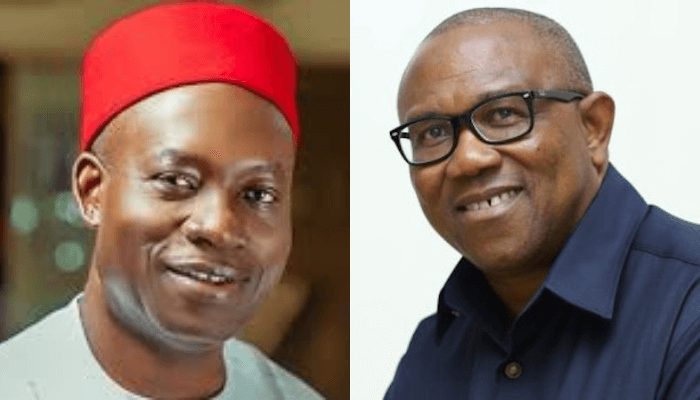
When the presiding bishop acknowledged the Governor of Anambra State, Prof. Chukwuma Soludo, seated, by the geometry of office, at the strategic front pew, the congregation responded with courtesy, thin and procedural applause. When he acknowledged a former governor, Mr. Peter Obi, seated without choreography, hidden among ordinary worshippers, the church convolved with disruptive ovation. Applause did not merely occur; it multiplied. It became a force, a weather system, a temporary insurrection of gratitude so volcanic that the Bishop was compelled to intervene almost unsuccessfully, to domesticate the storm, to rescue the Mass from turning into a referendum. In that interval between muted claps and uncontrollable elation, a political philosophy announced itself without footnotes.
First, it is the two acoustics of power. Power has two acoustics. One is loud but hollow and perfunctory, produced by microphones, convoys, and the grammar of office. The other is quieter in origin but thunderous in effect, generated by memory, private judgment, and the long arithmetic of trust. The first acoustic follows position. The second follows reputation. Office commands recognition; legacy commands affection. It is easy to mistake the first for the second, especially in political cultures where protocol is confused with popularity, and seating arrangements are mistaken for seating in the heart. However, the cathedral episode reveals a cruel but accurate distinction: authority can allocate seats, but it cannot allocate love. The front pew is architectural; the ovation is anthropological.
Second, it is the politics of afterlife. Every public office has an afterlife. There is life in office, conducted in sirens and signatures; and life after office, conducted in memory. The first is governed by law; the second by conscience. During the years of power, a leader speaks. After power, the people speak. And the people are harsher editors than any newspaper. Peter Obi’s tenure has been audited not by committees but by time, that incorruptible accountant, who adds nothing and forgets nothing. Long after budgets have dissolved into archives and policies into footnotes, something remains: a moral residue, an emotional balance sheet. That residue explains applause. For applause is not noise; it is judgment translated into sound. It is history clearing its throat.

Third, it is the handwriting of power. History, it is often said, is an open book of blank pages. Power hands the pen to whoever occupies the seat. But the ink is optional. Some write with gold – slow, difficult, accountable strokes that outlast weather and fashion. Others write with charcoal – fast, theatrical, dark, easily erased by rain. Gold demands restraint. Charcoal enjoys display. Gold is heavy. Charcoal is loud. The tragedy of governance is that charcoal looks like confidence in the short term. It stains quickly. It photographs well. It announces itself. Gold, on the other hand, is shy. It glows quietly. It does not shout. It survives fires. The congregation in Nnewi did not applaud a man. They applauded a handwriting style.
Fourth, it underscores integrity as political capital. Integrity is the only political asset that appreciates after exit from office. Everything else depreciates. Convoys rust. Security details retire. Letterheads expire. The choreography of aides dissolves into private life. What remains is reputation, that invisible monument built daily by small decisions that never make the news. Integrity is slow architecture. It is built from boring virtues: restraint in procurement, modesty in personal lifestyle, predictability in principle, aversion to vulgar displays of filthy wealth. These virtues excite no crowd while in practice. They attract no carnival of praise. But they compound.
And compound interest is the most powerful force in politics. Thus, years later, when the microphones are gone and the protocols asleep, integrity returns as applause.
Fifth, it is the burden of incumbency. This reflection is not an indictment of the present occupant of office as much as it is a diagnosis of the burden of incumbency. The sitting governor lives inside unfinished sentences. His story is still being edited. His policies are still negotiating with reality. His mistakes are fresh, his successes contested, his motives interrogated. He is judged daily, loudly, prematurely. The former governor, by contrast, has crossed into a quieter court: the court of completed narrative. His errors have been folded into context; his virtues distilled into symbols. Memory has sanded down his rough edges and preserved what the public found useful.
Time is unfair in this manner. It is harsher to the living than to the finished. Yet, even within this asymmetry, the scale of the Nnewi ovation suggests something more than nostalgia. It suggests moral credit. Not perfection, but credibility.

Sixth, it is democracy’s unsponsored referendum. The most honest elections are those not organized by electoral commissions. They occur in markets, in buses, in church aisles. They have no ballot boxes. Their ballot is the hand. Their counting system is noise. No court can nullify them.
What happened in Nnewi was a referendum without INEC, without ‘go to court’ litigation, without party logos. It was the people’s subconscious speaking out loud. Such moments are dangerous to power because they cannot be managed. They expose the difference between legitimacy conferred by law and legitimacy earned from memory. The first installs a leader. The second enthrones a symbol.
Seventh, it is the paradox of development without affection. A leader may build roads and still fail to build emotional infrastructure. Concrete does not automatically translate into confidence. Budgets do not necessarily become belonging. Policies may improve statistics while leaving the soul untouched. Public service is not only about measurable outputs but also about moral tone: how power sits on a man, how wealth rearranges his humility, how access negotiates his accent, how victory re-engineers his face. People forgive inefficiency more easily than they forgive contempt. They forgive slow progress more readily than they forgive visible arrogance. They endure poverty longer than humiliation.
Eight, it is the theology of applause in a sacred space. That the drama unfolded inside a cathedral is not accidental. Religious spaces are theatres of ultimate values. They are houses where the language of eternity silences the noise of propaganda. Inside them, political titles shrink; mortality expands. Applause inside such a space is not casual. It is a theological statement disguised as emotion: a confession that certain virtues are still sacred, that restraint is still legible, that modesty still has witnesses. When applause disrupts a Mass, it means politics has accidentally confessed its sins in the presence of God.
Ninth, it is the arithmetic of legacy. Legacy is not additive; it is subtractive. It is what remains after ambition is removed after security is withdrawn; after power forgets your number; after relevance changes address. What remains is how you treated money that was not yours, power that was temporary, and people who were permanent. Legacy is the remainder after history performs its long division.
Finally, it is the lesson for all who hold pens. Every office holder is a temporary author. The book is permanent. Ink choices are daily. To write with gold is to accept obscurity while alive and applause after departure. To write with charcoal is to enjoy fireworks now and silence later. The cathedral has offered a footnote to political science: that reputation is governance extended into eternity; that integrity is a delayed election; that the people never forget, they only postpone their verdict.
Then, here comes my closing meditation. Between the front pew and the hidden aisle lies the entire philosophy of leadership. One is constructed by protocol. The other by conscience. One is purchased with power. The other is earned with restraint. And when history finally organizes its liturgy and calls names, it is not seating arrangement that answers, but the echo in the human chest. Some names produce courtesy. Others produce earthquakes. In the end, every leader will be recognized. The only uncertainty is the sound that will follow.