Beta Glass Plc, a member of the Frigoglass Group, aims to export its product in a push for a share in other African countries, especially the Francophone African market. It projects to produce 650 million bottles per year.
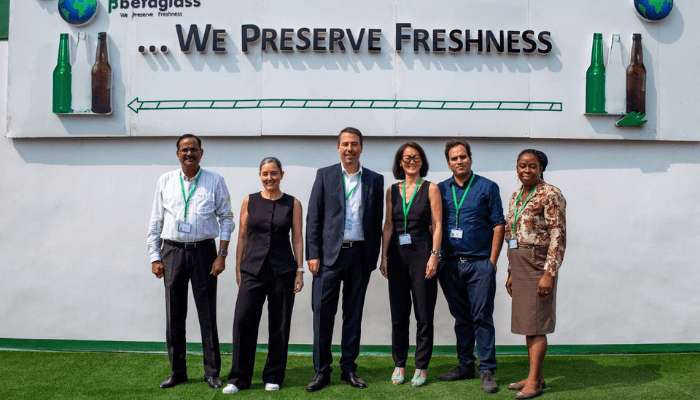
Alexander Gendis, CEO of Beta Glass, said during a factory tour at the Agbara industrial hub of Ogun State that the manufacturing processes of the glasses are to ensure commitment to sustainability.
“Beta Glass’ focus on sustainability has been a key differentiator and an edge, as more of our customers seek partners committed to reducing environmental impact. As the leading glass container manufacturer in West and Central Africa, Beta Glass drives sustainable growth while expanding into neighboring countries, especially Francophone Africa,” Sharin Sweet, head of sales at Beta Glass Plc said.
“With innovation and sustainability at the forefront, Beta Glass is shaping the future of the industry across the continent,” he stated.

The CEO of Beta Glass said Beta Glass integrates advanced technology, sustainability, and efficiency in its operations and they are pushing for export because we want to be a hub for West Africa.
“We can also do 650 million bottles per year,” the CEO of Beta Glass said.
This firm caters to major customers including Nigerian Breweries (Heineken), AB InBev, and Guinness Nigeria Plc. (Diageo), Nigerian Bottling Company (Coca-Cola), Nigerian Distilleries Ltd., Pharmaceuticals & perfumes, Intercontinental Distillers Ltd, Wines & Spirits.
The use of bottled drinks dates back to ages when an opener was used to open the bottles and consumers enjoyed the content from diverse consumer brands.
The truth is the majority of these consumer goods brands outsource their bottles from manufacturing companies whose occupation is to solely manufacture glass bottles for wines, soda drinks, and hard liquor and also glass containers used for the packaging of cosmetics and pharmaceutical products.

Beta Glass Plc is one of them which holds 70 percent market share; it is a Nigerian industrial goods company headquartered in Lagos but has production plants in the Agbara industrial hub of Ogun State, as well as Ughelli which is located in the Southern Nigerian state of Delta.
Read also: NNFM, Beta Glass push NGX higher as earnings season spurs buy actions
Jagdish Agarwal, chief operations officer of Beta Glass Plc said Beta Glass’ commitment to operational excellence is evident in the advanced technologies and sustainable practices they employ at the firm’s manufacturing plants located in Agbara, Ogun state and Ughelli, Delta state.
“With these innovative technologies, we are shaping the future of glass container manufacturing while ensuring minimal environmental impact. We are pleased for the media to experience this firsthand while amplifying our strides with key stakeholders,” he stated.
How bottles for drinks are made
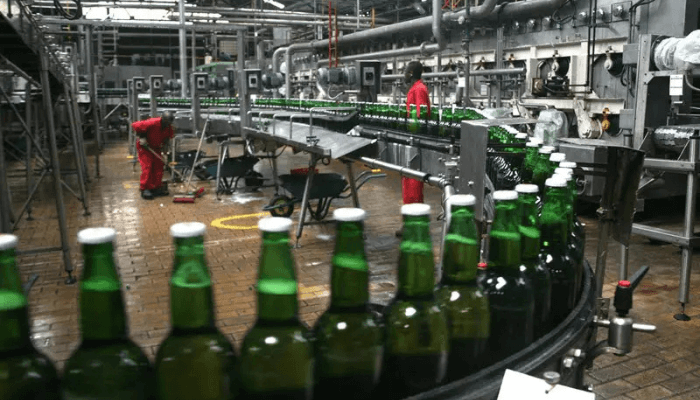
Prasad Govind, plant manager at Beta Glass said during the factory tour that the process of making the glass includes raw materials, batching, furnace(melting, refining, and conditioning), then the forming of glass stage, hot end surface treatment, cold end surface treatment, cold end inspection equipment and packaging.
According to him, the process of melting the raw materials starts with the highest heat of 1450 degrees Celsius at the furnace level then the process of heating reduces gradually depending on the levels till it reaches 50 degrees Celsius which is the cold end inception equipment.
At the furnace level, the personal protective equipment that must be worn include a hard net, safety glass, coverall, safety boot, ear muff, and hand glove due to the level of heat.
The raw materials used for glass include Cobalt, Selenium, Silica sand, Soda ash, Sodium sulphate, Limestone, Feldspar, and Cullet.
As of February 7, 2025, Beta Glass safety performance board reveals that there was no fatality year-to-date(YTD), no first aid cases, no lost time incident, 1 near miss, 103 unsafe conditions reported, 39 unsafe acts reported and the last accident date was May 17, 2024 which was a finger accident by a worker.
”No child labor – persons below 18 years of age are prohibited to work in this factory, according to a written statement at the factory.
The firm has a quality policy that states that individual jobs are carried out in line with clients’ requirements which ensures customer satisfaction and total commitment to continual improvement of the Quality Management System (ISO 9001:2015).
Hence, to achieve the quality policy it stated that the quality objectives include achieving customer satisfaction by on-time delivery of quality products which is measured by comparing total dispatch to market requirements.
It also includes ensuring that the number of justified customer complaints is not above the yearly set target of three maximum.
To ensure quality assurance, Sunday Olagbende, supervisor/chemical lab manager at Beta Glass said the chemical laboratory is responsible for ensuring that Beta Glass’s composition is stable.
“We achieve a stable composition of all our glass by ensuring that all incoming raw materials are checked properly to ensure that they meet specifications that will give a quality glass material,” he said.