|
Getting your Trinity Audio player ready...
|
Managing director of Benin Owena River Basin Development Authority (BORBDA), Ahmed Saliu, has appealed to the leadership of the eighth National Assembly to pass the National Water Bill currently before it.
Saliu, who made the call at the celebration of the World Water Day in Benin City with the theme, “Leaving No One Behind,” said history would be kind to the lawmakers if the bill was passed before the closure of the Assembly.
He called on the state and local governments to redouble efforts in their primary responsibilities in the provision of potable water, adequate sanitation and hygiene.
He said the BORBDA had over the years implemented several projects aimed at providing safe water in most communities in its catchment states of Edo, Delta, Ekiti and Ondo.
He also said the agency had in the last two years provided boreholes fitted with hand pumps and motorised pumps powered by either generators or solar power.
“In this regard, we have paid particular attention to quality and yield of water from such boreholes. Where quality was uncertain, package treatment plants have been provided.
“In semi-urban and urban communities, we have built dams at various levels of completion. Our current effort in Otuo to build a dam for water supply to Otuo and the surrounding districts in Owan East Local Government Area shall see us providing safe pipe-borne water to a population of over 200,000 persons.
“All these complement our efforts to provide water for irrigation and for all year round agricultural production,” he said.
While noting that Nigeria cannot be described as a water stressed country like Bahrain, Israel, Saudi Arabia and even Morocco, he said the nation’s water management practices leave a lot to be desired.
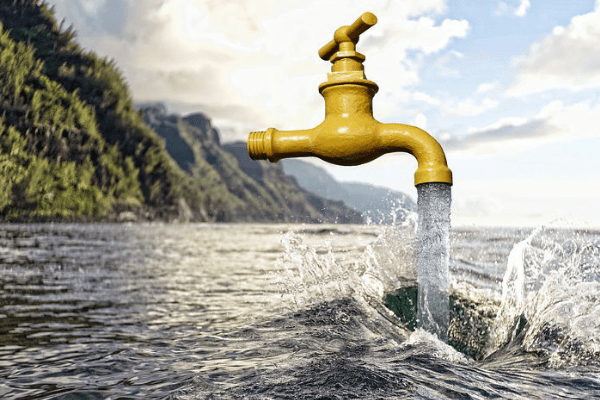
Nigerians may not be lacking of adequate rainfall in most parts of the country, but the water situation in the country can best be described as akin to “water, water everywhere, but not a drop to drink,” he said.
He said the plethora of packaging water, whether in sachets or bottles, for safe water with its concomitant economic strains demand that we seek better ways to make water more available in the right quality and amount.
In his presentation, the guest lecturer, Gabriel Ebosele Oteze, a professor of Geology/Hydrogeology, said in 2017, 68 percent of Nigerians bought or sourced water from locations outside their homes.
Oteze, who was the former general manager/chief executive of BORBDA, said most of the water they drank from sachet, bottle water, taps, wells and boreholes depended on their location.
He said 40 percent of the people who go out looking for water were women, and that the situation was worst in the North-East region, South-South was next with 71 percent followed by North-Central with 70 percent.
He also said 83 percent of homes had no drinking water within their premises.
Also speaking, Edo State commissioner of energy and water resources, Yekini Idiaye, represented by Akongie Oboh, permanent secretary of the ministry, expressed the state’s commitment to providing potable and safe drinking water for the use of all, irrespective of where they live.