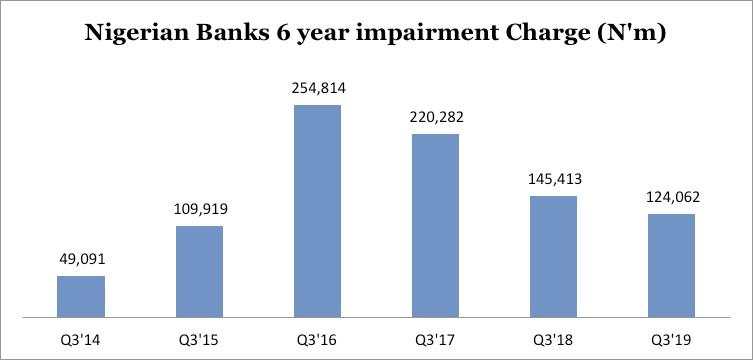
Nigerian largest banks have seen impairment charges for loans to the oil and gas and other sectors fall to a five-year low as they have resolved to strengthen their balance sheet.
The cumulative impairment charge on financial asset fell by 14.64 percent to N124.06 billion in September 2019 from N145.41 billion recorded in 2018.
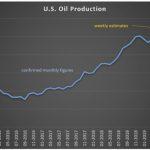
A cursory examination of the books of lenders showed charges were at an all-time high of N254.81 billion in 2016, when a sharp drop in crude oil price paralyzed economic activities, and valued customers were unable to pay interest on loans borrowed from financial intuitions.
However, the introduction of a new foreign exchange policy in 2017 by the Central Bank of Nigeria (CBN) that eased the flow of foreign exchange in the system and a rebound in oil price helped the country exit recession that year.

That gave companies the leeway to pay back interest on money borrowed, and banks have strengthened their risk management strategies as they slowed down on credit extension to the oil and gas sector.
The negative outlook brought about by the oil and gas exposure is out of the way, while a lot of them have written back some of the provision in the period under review,” according to Kayode Tinuoye, head of porfolio management at United Capital Research Ltd
“We haven’t seen serious downtrend in oil and gas, and l think we may see more improvement in bad loans,” said Tinuoye.
First Bank Holdings Plc’s impairment charges dipped by 62.64 percent to N28.46 billion as at September 2019, while Non-Performing Loans (NPLs) ratio fell to 12.60 percent in September 2019 from 25.90 percent as at December 2018.
The oldest financial institution in the country attributes the improvement in asset quality to its risk management practice, as it resolves to significantly close challenged legacy exposures.

Zenith Bank’s robust risk management framework has ensured that NPL ratio declined from to 4.95 percent in September 2019 from 4.98 percent as at September 2018.
The largest lender by profit saw a 27.34 percent drop in impairment charge in financial assets by 27.34 percent to N18.25 billion in the period under review from N14.33 billion the previous year.
However, Access Bank’s increased by 27.02 percent to N10.61 billion as at September 2019, on account of lender’s business combination with Diamond Bank.
It acquired Diamond bank in 2018 to emerge as the largest lender by total assets, but Diamond had a pile of debt on its books before it was acquired.
Access Bank’s NPL ratio fell to 6.30 percent in September 2019, as net loans and advances was up 38 percent to N2.94 trillion, reflecting the impact of merger.
Going forward, Banks NPLs could rise as CBN is forcing them to extend credit to the real sector under the current weak current macroeconomic environment.
Analysts say that without complementary fiscal policy that will create the enabling environment for businesses to thrive, it will be difficult for financial institutions to record double digit growth in earnings.
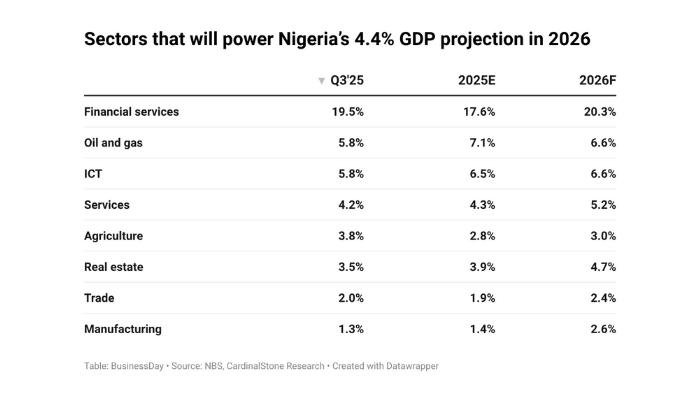
The Nigeria economy has been growing sluggishly as GDP expanded by 1.94 percent in the second quarter of 2019, this compares with 2.10 expansions in the first quarter, according to data from the Statistics body.
“It is already affecting the outlook of the banking industry because it reduces the ability to earn income, and that money will not earn interest,” said Ayodeji Ebo, managing director/CEO of Afrinvest Securities Ltd.