



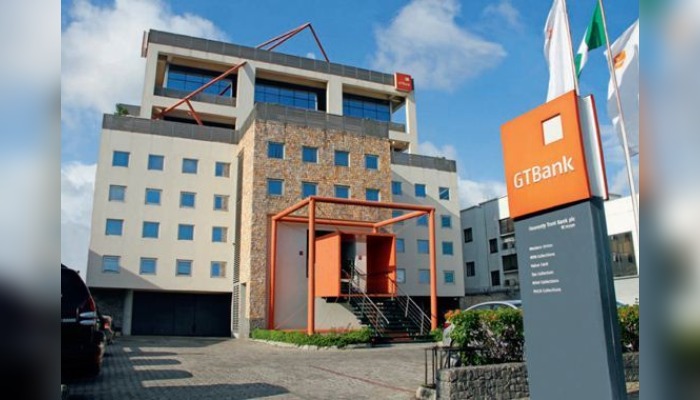
Some Nigerian banks have generated higher profit than peers, which explains why investors are increasingly attracted to their stocks.
The banks with the highest return on equity (ROE) are Stanbic IBTC Holdings Plc, Guaranty Trust Bank (GT Bank) Plc and Zenith Bank Plc.
The return on equity (ROE) is a measure of profitability paramount to investors and shareholders of bank stocks because it measures how many naira of profit a company generates with each naira of shareholders’ equity.
READ ALSO: How top banks performed in H1 2020

Stanbic IBTC Holdings, a mid-sized lender, is the most efficient bank as its ROE of 24.15 per cent as at September 2017, compares favourably with the 15.13 per cent recorded the previous year,
It is also the highest in the industry.
Guaranty Trust Bank Plc, the largest lender by market value, has a ROE of 23.38 per cent while Zenith Bank’s ROE increased to 18.12 per cent in September 2017 as against 15.15 per cent the previous year.
“Investors will place more premiums for more efficient firms. It is what you can return on assets that matter to investors,” said Ayodeji Ebo, managing director and chief executive officer of Afrivest Securities Limited.
“It also boils down to how efficient banks are. Stanbic’s non-bank subsidiaries can contribute to its business especially the pension fund business,” said Ebo.

The improved efficiency ratio explains why investors are increasingly seeing the stocks of the aforementioned lenders more attractive than their peer rivals.
READ ALSO: First Bank, UBA, earn the most revenue from e-banking in the half year 2020
Stanbic IBTC currently trades at a price-to-book (P/B) ratio of 2.4x while GT Bank and Zenith, trade at 2.1x and 1x, book value, respectively.
The Price to Book ratio or P/B ratio is a multiple that compares the current market price of a company to its book value (shareholder’s equity).
A ratio of less than one means a firm is undervalued or trading below its intrinsic value.
United Bank for Africa (UBA)’s ROE remained flat at 13 per cent while it shares trades at 0.7x book value. Access Bank’s ROE reduced to 12.14 per cent in the period under review from 13.15 per cent the previous year while its shares trade at 0.6x book value.
First Bank Holdings Nigeria (FBHN) Plc’s ROE of 8.18 per cent in the period under review, tough higher than the 7.13 per cent the previous year, is the lowest among Tier 1 lenders. Its shares trade at 0.4x book value.
Rising Non-Performing Loans (NPLs) caused by exposure to the oil and gas sector took a toll on FBHN’s assets quality and earnings.
Union Bank, Sterling, Unity Bank, Wema Bank, Fidelity, and Diamond Bank, (Small or midsized lenders), have ROEs of 3.58 per cent, 6.19 per cent, 3.12 per cent, 3.78 per cent, 7.15 per cent and 3.16 per cent, respectively.
Sterling, Unity, Union Bank, Wema, First City Monument Bank (FCMB), and Fidelity, trades at a P/B of 0.1X,0.1X, 0.4x,0.4x,0.12x, 0.26x book value.
The data shows widening gaps between the efficiency ratios and valuations of the Tier 1 lenders and the small and medium-sized banks as the latter lack the capacity to do large transactions while the drop in oil price resulted in deteriorating assets quality.
READ ALSO: Expectations high as banks set to release 2017 full-year results
Gloria Fadipe, equity research analysts with CSL Research Limited said this is because the large banks have lower funding costs, higher net interest margins, better loan book (except for FBNH recently) as they typically have more liquidity to play with.
Nevertheless, banks have seen increased earnings in recent times, thanks to improved dollar supply on the back of the introduction of the Investors’ and Exporters’ (I and E) window and increase in interest income on government securities.
The cumulative net income for the 12 lenders increased by 20.15 per cent to N498 billion in September 2017 from N414.23 billion the previous year, data gathered by BusinessDay shows.
“One of the ways to bridge the valuation gap is for the small banks to mobilize more resources through a rights issue,” said Kunle Ezun, an economist at Ecobank Plc.
BALA AUGIE



