Few sectors wear the bruises of Nigeria’s foreign exchange mismanagement over the years as visibly as aviation.
With nearly all costs denominated in dollars– from aircraft leasing to insurance and spare parts– the relentless decline of the naira has clipped the wings of growth in a country of over 200 million people.
Industry veterans and analysts interviewed by BusinessDay said Nigeria’s aviation sector has never truly taken flight. The absence of a single locally-owned carrier with a decades-long track record of sustainable growth reflects years of operating in a hostile macroeconomic environment.
Over the past two decades, repeated devaluations have hollowed out the naira’s value. From N399 to the dollar in 2021, the currency has plunged to N1,545 by 2025–a depreciation of nearly 287 percent. That collapse has driven up every cost line for operators and passengers alike.

Read also: Air India flight makes emergency landing in Thailand after bomb threat; all passengers off plane
Airfares soar despite falling fuel costs
While the cost of aviation fuel has come down in recent months, ticket prices continue to rise. Domestic one-way economy fares, which averaged N70,000 just two years ago, have more than doubled to N150,000. According to BusinessDay’s analysis, over 80 percent of airline operating costs remain dollar-linked—fuel (45 percent), labour (17 percent), maintenance materials (13 percent), and leasing (8.5 percent), among others.
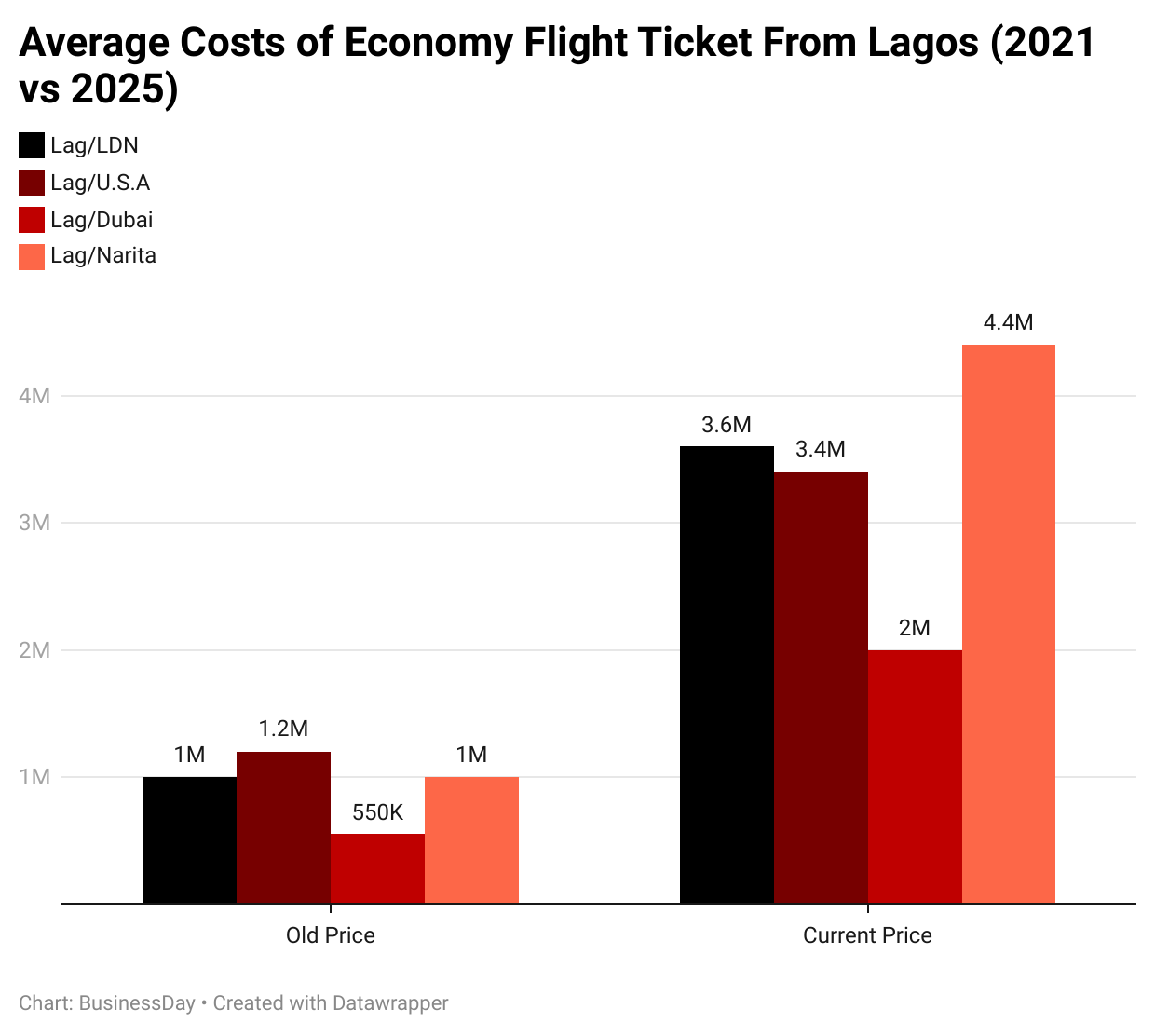
International travel is even more affected. Fares have risen by over 300 percent compared to three to four years ago. A Lagos–London economy return ticket that once cost N700,000–N1.3 million now sells for N3.2 million–N4 million. Business class tickets are as high as N14.3 million–N16 million. Fares to the US, Dubai and Narita have followed similar trajectories, in line with the naira’s sharp decline.
Despite the federal government clearing the backlog of trapped funds owed to foreign airlines in 2022, international carriers have not restored confidence in the local currency. Emirates, Delta, and United Airlines continue to insist on dollar-only transactions, sidelining naira payments entirely.
Ageing aircraft and global leasing squeeze
Nigeria’s airlines, already priced out of the new aircraft market, are increasingly reliant on aging, second-hand planes. The global aircraft leasing market, strained by post-pandemic supply chain bottlenecks, has further tightened access for Nigerian carriers. Leasing firms, now prioritising low-risk markets, have made it more difficult for Nigerian operators to compete.

“The few planes available go to the highest bidders–usually legacy carriers in more stable countries,” said Ado Sanusi, managing director of Aero Contractors.
Read also: N’Assembly proposes tougher tax rules for foreign shipping, aviation companies
Parked planes and stripped parts
Across airports, the consequences of this squeeze are visible. A recent BusinessDay visit to the Lagos airport revealed dozens of grounded planes–some without engines, others stripped for parts. More than 70 of aircraft are believed to be parked nationwide, many abandoned due to prohibitively expensive maintenance and FX shortages.
Some planes remain grounded because operators cannot afford to fly them out for C-checks, which can cost up to $1 million every 18 months. In several cases, airlines have resorted to cannibalising parked aircraft to keep other planes operational.
“The sight of grounded aircraft at Lagos’ Murtala Muhammed Airport paints a bleak picture,” said Olumide Ohunayo, an aviation analyst and director of research at Zenith Travels.
Insurance and maintenance hurdles
Aircraft insurance is yet another expense denominated in dollars. Nigerian airlines pay 8 percent–10 percent of an aircraft’s value in annual premiums—far higher than the 0.5–3 percent paid by peers in Ghana, South Africa, Europe, and the US.
To insure a B737-300, for instance, Nigerian operators pay an average of $1 million annually, compared to $200,000–$300,000 in more stable FX markets.
“Nigerian airlines earn in naira, but their biggest costs—from parts and insurance to lease payments—are priced in dollars,” said Susan Akporaiye, CEO of Topaz Travels and former NANTA president. “With the exchange rate spiralling, it’s no surprise airfares keep rising.”