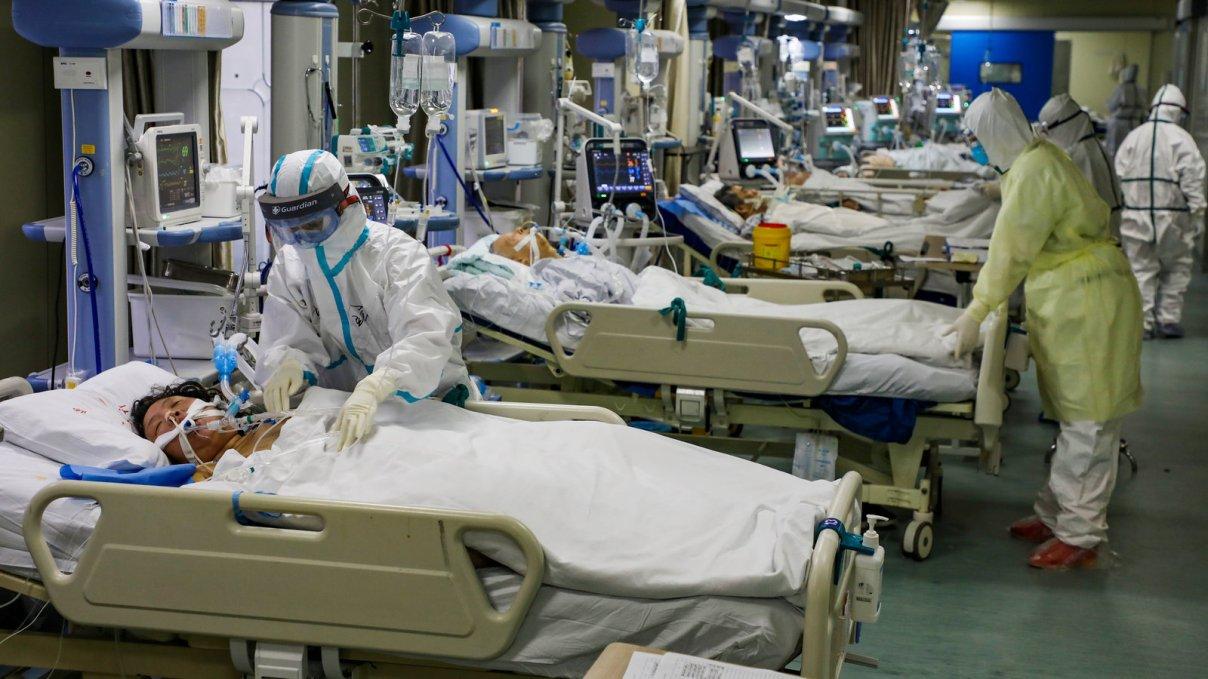
The Federal Government on Monday decried attacks on frontline workers by patients, describing them as “inhuman and unacceptable”.
Speaking at the daily briefing of the Presidential Task Force (PTF) on COVID-19 in Abuja on Monday, Boss Mustapha, chairman of the task force, said the PTF has continued to receive, rather sadly, reports about challenges facing the frontline health workers, including threat to lives and detention by patients.
This is coming against the backdrop of recent reports of ill-treatment of medical personnel fighting the deadly coronavirus.
Only recently, two medical doctors and a nurse were reportedly held hostage last Thursday by some COVID-19 patients at an isolation centre in Kwanar Dawakin, Kano State. Aminu Muhammad, a former chairman of the Nigeria Medical Association in Kano, reported that health workers were on a ward round when the incident occurred.

“Fully kitted workers with personal protective equipment were locked in a room with a COVID-19 patient for about four hours. He said they were almost suffocating before they broke the door and forced their way out of the ward,” according to Muhammad, a professor of medicine.
At the briefing on Monday, Mustapha said the COVID-19 frontline workers are actually nursing to health but have “suffered other forms of harassment” in the course of their assignment.
” Let me underscore the fact that these frontline workers constantly put their lives on the line to make sure persons infected are provided with the best care possible to enable them become healthy citizens again. It is therefore inhuman and unacceptable that patients engage in acts of locking them up and making demands that these frontline officers most of the times do not have the capacity to address,” he said.
The PTF on COVID-19, he said, “views such behaviour as reprehensible and should be deprecated”, and called on “all state governments to take this up appropriately”.
Mustapha assured that the PTF is identifying and assessing all low to medium and high burden areas with a view to assessing and modifying its strategy.

“This will involve drilling down from all tiers of government to community level. This mention serves as a notice to traditional, religious and community leaders to brace up for deeper involvement as we develop the protocols to strengthen community ownership in the national response,” he said.
He also assured that the PTF would continue to work on all options, even as he warned about the dangers inherent in lack of compliance with guidelines issued.
He reminded Nigerians that Mr. President took a painful and difficult decision to ease the restrictions by approving revised measures that will maintain a balance between the safety of Nigerians and giving them the opportunity for some level of economic activities that will sustain their means of livelihood, especially the poor and vulnerable who depend on daily means of subsistence.
“The eased restrictions must therefore not become an excuse for us to lead the lives we were used to, pre-COVID-19 days. I wish to re-iterate that the world today has completely changed from what we used to know and if we want to continue living the old ways, the cost would be enormous,” he said.
Mustapha, while reiterating that contracting COVID-19 is not a death sentence, added that “disregarding the guidelines for its avoidance, as guided by experts, is a costly self-voyage”. Unfortunately, he said, such choices cannot be made by individuals but the collective and “we are all resolute in stamping this scourge out of Nigeria”.
He reminded governors that the Catholic Bishops’ Conference has volunteered all the 425 hospitals and clinics nationwide for adaptation and use as isolation centres and urged them to approach Catholic Bishops in their states to access these facilities.
Osagie Ehanire, health minister, said the president has directed the COVID-19 team to thoroughly subject the Madagascar drug sample to scrutiny in Nigeria.
He assured that the team would investigate the alleged drug said to cure and prevent COVID-19 from Madagascar, stressing that it has requested for the sample for examination.
“Obviously it for us to give that to the research unit here to examine and see what they can do with it. We understand that it is something called atebissia annua, which also grows here but we will like to, if we get the sample, whether they are exactly identical or whether they are two different things, and see what properties it has,” Ehanire said.
“Things like this are subjected to analyses to see how they work and the use in getting a cure. Obviously all countries are interested in having a cure and we are not different. So we are looking at all possibilities, all options and all promises. We will examine them before we give it to our people,” he said.
Sani Aliyu, national coordinator of the PTF, said the team would continue the monitoring of spikes in cases of North-west and North-east.