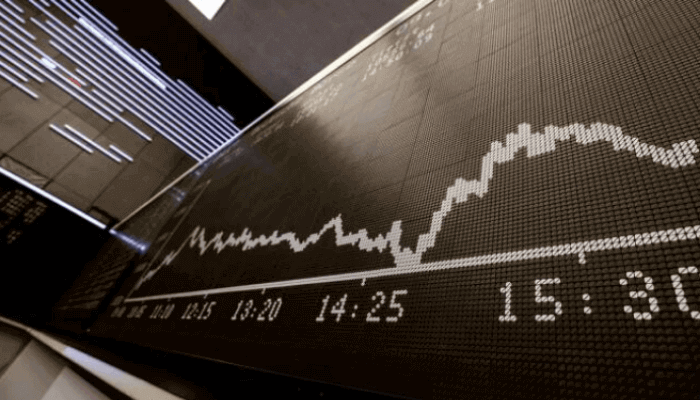
Asian markets plunged on Monday, deepening a global stocks rout triggered by US President Donald Trump’s trade war and China’s forceful response to unexpectedly high tariffs.
Japan’s benchmark Nikkei fell by more than 8% shortly after opening, while the broader Topix index last traded more than 6.5% lower after recovering from its steepest losses.
In mainland China, where markets reopened after a public holiday, the Shanghai Composite Index was last trading 6.7% lower. The blue-chip CSI300 index lost 7.5%. In Hong Kong, the benchmark Hang Seng index opened more than 9% lower. Chinese tech giants Alibaba and Tencent were each down more than 14% and 10% respectively.
South Korea’s Kospi tumbled more than 4.8% shortly after opening. Trading was halted for five minutes when a circuit breaker designed to prevent panic selling was triggered.

Asian markets are tracking the worst two-day stretch for Wall Street stocks in five years. US stock futures plunged Sunday evening after two sessions of sell-offs that wiped away over $5.4 trillion in market value.
Read also: CBN opens dollar tap as Trump tariffs test naira
US stocks fell sharply on Friday after China retaliated fiercely, imposing a 34% tariff on all US goods, raising fears of an escalating and damaging trade war fueled by continuing trade tension between the world’s two largest economies.
A commentary published Monday by the People’s Daily, the ruling Chinese Communist Party’s official mouthpiece, stressed that the country has a “strong capacity to withstand the pressure” in the face of “US tariff bullying.”
“Faced with America’s reckless tariff punches, we know exactly what we’re dealing with, and we have plenty of countermeasures at hand,” it said. “After eight years of trade war with the US, we’ve built up a wealth of experience in this struggle.”

China’s retaliation last week against the latest round of US tariffs was more sweeping than its earlier reciprocal actions and marked a significant escalation in its response, which triggered widespread market turmoil.
Ronald Temple, chief market strategist at investment bank Lazard, wrote in a Monday research note that he was expecting broad-based retaliation from other countries in the weeks and months ahead.
“As a result of these large tariff hikes, I now expect the economic damage to be more severe than would have been the case in a gradual escalation,” he said.
Taiwan’s Taiex plummeted more than 9.7% after opening on Monday. Almost all Taiwanese stocks, including TSMC and Foxconn, two of the island’s best-known export powerhouses, triggered circuit breakers, according to Taiwan’s Central News Agency. Both TSMC and Foxconn fell about 10%.
Oil prices continued to slide Monday following last week’s losses. Brent futures, the global benchmark, dropped more than 2.4%, while US West Texas Intermediate crude futures, the US benchmark, declined by 2.5%.
In Australia, the benchmark ASX 200 index fell as much 6.3% in morning trade, while New Zealand’s NZX 50 – the first indices to close in the region on Monday – ended the day 3.7% lower.
Even gold is being sold off. Traditionally considered a safer financial bet, gold has dropped by more than 4% to around $3,030 an ounce since Thursday.
US stocks are set to open sharply lower Monday, putting the S&P 500 on the precipice of a bear market — a decline of 20% from its peak and an ominous sign for investors and perhaps the broader economy.
Global investors were spooked by President Trump’s massive tariff regime, some of which went into effect on Saturday morning, and even larger tariffs are set to launch on Wednesday.