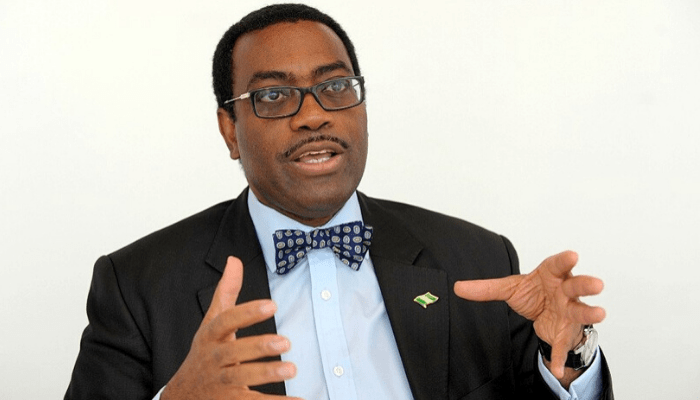
With over 30 years’ experience in agricultural innovation, Akinwumi Adesina is changing the narration of eradication of poverty through agricultural innovation and promoting good governance through the works of developing Africa’s economy.
On May 28, 2015, precisely 24 hours after his term as Minister of Agriculture ended in Nigeria, Akinwumi Adesina was the eight elected President of the African Development Bank Group (AFDB).
Akinwumi Adesina is pioneering major transformations in the agricultural field, through expanding rice production by introducing high yielding technologies, designing and implementing policies to support farmers’ access to technologies at scale, increasing the availability of credit for millions of smallholder farmers, attracting private investments for the agricultural sector, rooting out the corrupt elements in the fertilizer industry, and assisting in establishment of major agricultural policies for Africa’s green revolution.
A proactive AFDB Group, under Adesina’s adroit leadership, has also risen to the challenge and has announced a $10 billion facility support for African countries. In no small way, this has helped scale up a $3 billion COVID-19 social bond on the London Stock Exchange to help Africa deal with the economic and financial fallouts of the pandemic. Industry observers have commended AFDB President, Adesina, who under his leadership has made this support a reality.

Standard & Poor’s (S&P) Global Ratings affirmed its ‘ AAA/A-1+’ long- and short-term issuer credit ratings on AFDB, last month.
The global rating agency also stated that the outlook of the Abidjan-based multilateral institution remains stable.
Also, recently, the board of governors approved the replenishment to the African Development Fund, which underscored its important role in Africa, marked by a long track record of fulfilling its policy mandate through economic cycles, combined with robust shareholder support.
According to S& P, the AFDB under the leadership of Adesina Akinwumi will play a key role supporting the region, particularly in the context of coronavirus, as the institution recently approved an up to $10 billion relief package for 2020, of which $6.9 billion would be financed by AFDB and the remainder through its concessional lending window.
Also, Adesina has served in several high-profile positions internationally, including with the Rockefeller Foundation, and was Nigeria’s Minister of Agriculture and Rural Development from 2011 to 2015, a career stint that was widely praised for his reforms in the agricultural sector. The former minister brought the same drive to the Bank, making agriculture one of the organization’s priority areas. In 2017, he was awarded the World Food Prize.

The World Food Prize Foundation lauded Adesina’s qualitative leadership and his visionary roles over the past two decades in promoting Agriculture with the Rockefeller Foundation and the Alliance for a Green Revolution in Africa (AGRA).
During his tenure, the bank has seen its fortunes rise on several fronts, including the largest general capital increase in its history with a capital base of $208 billion.
United Kingdom-based Publish What You Fund ranked the AFDB fourth out of 47 global development institutions on its Aid Transparency Index last month.
The index placed the Bank in the highest category of transparency along with other world-class institutions such as the World Bank, the Asian Development Bank and UNDP.
In Johannesburg in 2018, the bank launched the Africa Investment Forum, a fully transactional platform, to attract investment into Africa, with participation from private sector investors, pension and sovereign wealth funds, Heads of State and government officials to discuss specific investment deals.
The Africa Investment Forum was an outstanding success by all measures. The forum delivered an
SDG targets and 90 percent of the Agenda 2063 of the African Union.
A review of achievements under Akinwummi led AFDB include, 16 million Africans connected to electricity, 70 million people with improved agricultural technologies to ensure food security, 9 million people access to finance from private sector companies, provided 55 million people opportunity to improve transportation and 31 million people with clean water and sanitation.
All, including his worst critics, agree that under Adesina’s watch, the African Development Bank has truly served Africa. The last five years have seen the Bank carry out highly impactful programs that have significantly accelerated the development of the continent.
Adesina’s efforts have not gone unnoticed. Several US universities who have honoured him includes Honorary Doctorate degrees from Franklin and Marshall College, Purdue University, Michigan State University, and University of Alberta, Canada, among many others in Africa.
He was named African of the Year by Forbes Africa, twice, in 2014 and 2019, respectively. He was named the African Person of the Year by the Africa Leadership Magazine, in an open and competitive poll across Africa, garnering 60perent of votes.
Adesina was awarded the globally prestigious Sunhak Peace Prize in 2019 for his global leadership on promoting global peace and good governance. He also donated his $500,000 laureate cash prize to establish the World Hunger Fighters Foundation, to advance his drive to end global hunger and develop the youth to become hunger fighters.
The Executive Committee of the Africa Union, consisting of all 55 African countries unanimously endorsed Adesina as the sole candidate for re-election for a second term as President.
Also, all 15 Heads of State of the Ecowas region unanimously endorsed him for re-election.
Recently, 14 former heads of state and government of Africa applauded his remarkable leadership at the Bank and endorsed him for re-election as President.