|
Getting your Trinity Audio player ready...
|
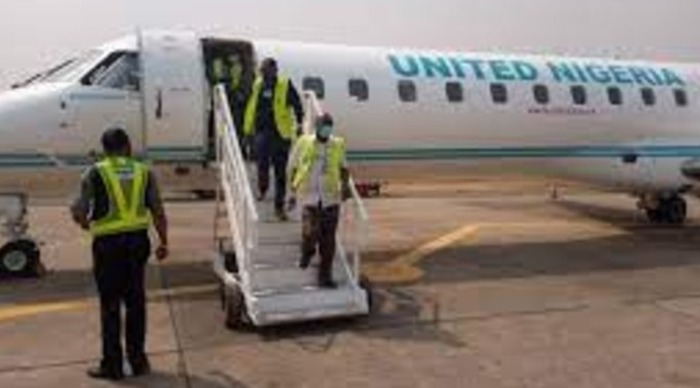
The recent altercation involving two well-known passengers aboard a United Nigeria Airlines flight in Asaba has sparked intense public conversation, with many Nigerians demanding statements from multiple aviation bodies.
While public interest is understandable, it is equally important to clarify how aviation incident management works in Nigeria so that expectations are properly aligned.
To begin with, the Nigeria Civil Aviation Authority (NCAA) is the country’s statutory aviation regulator. It is the NCAA, not the airport authorities nor the airlines, that is empowered to investigate passenger misconduct, review safety procedures, and impose sanctions where necessary.
This explains why the NCAA has rightly stepped forward to address the matter and will, after reviewing all reports, take appropriate regulatory action.

On the operational side, airlines hold the responsibility for managing onboard or pre-flight disruptions, which United Nigeria Airlines did by deboarding the involved passengers and ensuring the safety of others. Once an airline offloads disruptive passengers, the next step is standard across the aviation industry.
In Nigeria, that next step involves airport security, which includes Aviation Security (AVSEC) provided by the Federal Airports Authority of Nigeria (FAAN). Even though Asaba Airport is privately owned, FAAN’s AVSEC personnel provide internal security duties there as at all Nigerian airports.
Their role is specific: to receive such individuals after airline intervention, conduct preliminary checks, and transfer them to law-enforcement agencies. This is exactly what happened. The individuals were handed over to the police for further investigation.
Where the public discourse seems to have taken a wrong turn is in the assumption that every aviation-related incident automatically requires commentary or intervention from FAAN.
This stems from a common misconception: many Nigerians confuse airport operations with aviation regulation, and in the process, responsibilities get blurred.

It is important to distinguish between these roles.
Regulation lies with the NCAA. Operational security support lies with FAAN AVSEC. Incident-management decisions onboard lie with the airline.
When regulatory expectations are incorrectly attributed to operational agencies, it creates confusion. Clarifying this distinction is essential. This is not to absolve any party, but to ensure the public understands the proper sequence of actions and authorities involved.
In the Asaba situation, each stakeholder, comprising the airline, airport security (including FAAN AVSEC), police, and the NCAA, performed the part assigned to them within Nigeria’s aviation framework. What the public has seen so far is the structured unfolding of that process, not a gap or omission from any particular agency.
As conversations continue, Nigerians are encouraged to look to the NCAA for regulatory decisions, to the airline for operational updates, and to law enforcement for any legal outcomes.
Understanding these boundaries helps avoid misplaced accusations, misdirected demands, or expectations that do not align with how the aviation system is designed to function.
Toni Ukachukwu is an Aviation Analyst & Industry Communications Expert