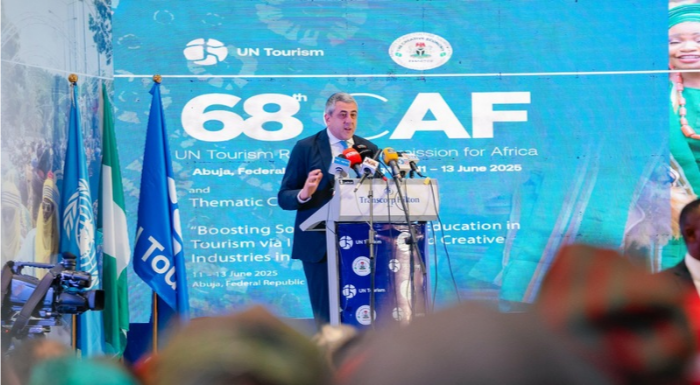
While Nigeria is being commended for the successful hosting of the 68th Meeting of the UN Tourism Regional Commission for Africa (CAF) in Abuja recently, the UN Tourism has encouraged African countries to take advantage of the opportunities created by the continent’s vibrant creative sector to boost tourism.
In speech at the Abuja meeting, ZUrab Pololikashvili, secretary general, UN Tourism, noted that the creative industries open new doors for tourism, hence the need to optimise its potential for tourism growth.
“They help visitors connect with Africa’s stories and traditions. They bring local experiences to life and build bridges between people and cultures,” the secretary general said.
He pointed out that Nigeria has a special energy in terms of the huge potential of her creative industries.

“You feel it in the music, the films, the fashion and in the people. Nollywood is now one of the largest film industries in the world. It tells African stories with African voices, creating jobs, confidence, and global influence,” Pololikashvili observed.
He is also excited that Nigerian fashion designers are on runways in New York, Paris, and beyond, while Afrobeats is playing in cars, clubs, and stadiums around the world.
However, the secretary general rightly pointed out that creativity is an Africa thing and not limited to one country.
“But this is not only Nigeria’s story,” he said.

“Across the continent in Kigali, Dakar, Nairobi, Cape Town, we see a new generation building the future. They are designing, coding, filming, imagining and the world is finally paying attention”.
For Pololikashvili, it is not only the creative industries, as Africa needs technology to boost her tourism. He argued that technology is reshaping the way people travel, hence the need to latch unto it for growth.
“Artificial Intelligence helps us understand traveller behaviour. Digital platforms help small businesses access global markets. Innovation is creating new opportunities that did not exist five years ago”.
He sees no reason why Africa cannot lead in the technology-enabled tourism space.
“The talent is here. The creativity is here. The energy is here. Let’s make sure the tools and investment follow,” he urged.
But he also recognised the need for skilled African human capital. “None of this works without people who are trained, inspired, and empowered”.
Considering the above and if Africa must take advantage of her creative industries and technology to boot tourism growth, Pololikashvili insisted that “Education must be at the heart of our strategy”. UN Tourism, according to him, supports this through its Online Academy, guidelines and training programmes.
“We must invest in schools, training centres, and partnerships with universities and businesses. And we must support youth entrepreneurship, so that ideas become jobs — and jobs become careers”.
The investment in people, according to him, is what will define the future of tourism in Africa.
Exciting and calling participants from across Africa at the Abuja meeting, Pololikashvili said,”Africa’s tourism story is still being written. And I am proud that we are writing it together”.
It would be recalled that the 6th CAF meeting is the second time Nigeria is hosting the regional commission tourism meeting in less than a decade.
The 2025 conference built on the momentum created in Lagos in 2022, when the UN Tourism in collaboration with the then Ministry of Information and Culture, headed by Lai Mohammed, explored the role of creative industries in tourism. That discussion sparked new ideas, new partnerships, and fresh ambition.
This year in Abuja, the Nigerian government and the UN Tourism took it a step further; focusing on how innovation, artificial intelligence, and education can help tourism make a deeper social impact across the region.
The 68th CAF Thematic Conference on Boosting Social Impact and Education in Tourism held from June 11-13, 2025 at Transcorp Hilton Hotel Abuja and was attended by Ministers of Tourism, diplomats, government delegates and UN Tourism affiliate members, among others.