|
Getting your Trinity Audio player ready...
|
Nigeria is the only country holding back Africa from being declared a polio-free continent, but as Africa’s most population nation marks three years without the disease, it is only a step away before it joins the rest of the world who have successfully defeated the virus.
Wednesday, August 21, 2019, marked three years since Nigeria’s last documented case of polio, which was also the last case recorded in Africa. Nigeria’s last polio case was recorded on August 2016, in war-torn Borno, the state at the heart of the Boko Haram jihadist insurgency.
According to the World Health Organisation (WHO), this three-year landmark sets in motion a comprehensive evaluation process by the Africa Regional Certification Commission to determine if the entire WHO African Region of 47 countries indeed can be declared wild polio-free.
“We are confident that very soon we will be back here trumpeting the certification that countries have, once and for all, kicked polio out of Africa,” said Matshidiso Moeti, WHO regional director for Africa.

Certification that the WHO African Region is free of wild polio is expected in early 2020.
With 201 million populations, Nigeria is on the verge of being declared polio-free, which would mean the virus has been eradicated across Africa, and as such the continent can be certified free of the virus by the World Health Organisation-backed Global Polio Eradication Initiative once the remaining samples have been analysed.
“It is a big deal for Nigeria, for Africa and for the world,” said Tunji Funsho of Rotary International, the charity that has been at the forefront of the country’s fight against the disease, saying, “No child has been paralysed by the wild polio virus in Nigeria. We have been able to reach every child with a vaccine before the virus reaches them.”
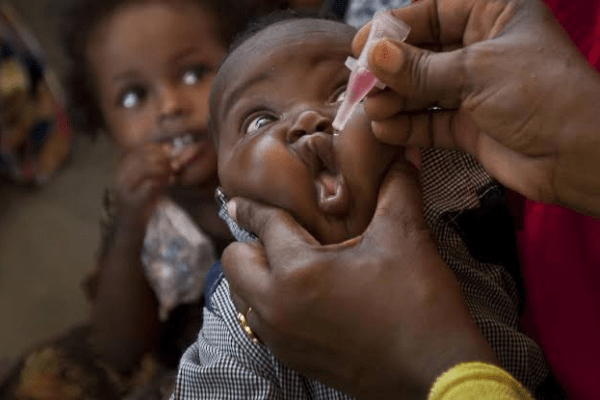
Hundreds of thousands of volunteers have repeatedly vaccinated roughly 50 million Nigerian children under the age of five in the last few years. Largely driven by the effort of the Federal Government, through the Global Polio Eradication Initiative, a joint effort between the WHO, Rotary International, the US government, UNICEF and the Bill & Melinda Gates Foundation.
Aliko Dangote, the richest man in Africa, has also contributed to the funding of the programme.
“We are here acknowledging this milestone while ensuring there is no complacency about the quantum of work that needs to be done to ensure certification, and to ensure population immunity continues to be maintained,” Faisal Shuaib, head of the Nigeria’s National Primary Health Care Development Agency, a government health agency, said.
It will take months of laborious analysis to run all of the samples but Wednesday’s milestone paves the way for Africa to be officially deemed polio-free by as early as the first half of 2020.
As at 2012, Nigeria accounted for more than half of all global polio cases, according to the WHO, with 223 victims. According to the WHO, the incidence of polio worldwide has been reduced by more than 99 per cent since 1988, when more than 350,000 children were paralyzed annually in 125 countries. If Nigeria is ultimately declared polio free, the virus will remain in only two countries; Afghanistan and Pakistan.

Meanwhile, if the evaluation process in Nigeria proves the wild virus is gone, Africa will join four of the WHO regions – the Americas, the Western Pacific, Europe and South-East Asia – in holding this distinction. It will leave only the WHO Eastern Mediterranean region still working to stop the virus.
According to Moeti, “The path to eradicating polio in Africa has been a monumental effort of multinational coordination on an unprecedented scale, providing vaccinations to hundreds of millions of children and conducting immunization campaigns in some of the most remote locations in the world, with vigilance and exhaustive surveillance to monitor outbreaks and people on the move.”
Nigerian government has organised more than a dozen supplementary immunisation campaigns with oral polio vaccine, strengthened routine immunisation, improved its polio surveillance networks and deployed innovative strategies (market vaccination, cross-border points and outreach to nomad populations) to reach more children with polio vaccines.
Also in Nigeria, polio workers painstakingly mapped the many islands of Lake Chad and travelled hours by canoe to reach hundreds of settlements for the first time. And they rolled out a new app-based electronic surveillance system called e-Surve to track the virus to its very last hiding places.
Reaching every last child with lifesaving vaccines as well as strengthening surveillance and routine immunization across the region will be essential to sustain the progress against wild polio and other strains.
Despite the progress, a number of remaining challenges – including inaccessibility due to conflict and insecurity in some areas, variations in campaign quality, massive mobile populations and, in some instances, parental refusal, have prevented health workers from reaching all children everywhere with polio vaccines in Nigeria.