|
Getting your Trinity Audio player ready...
|
The African Development Bank (AfDB) on Monday said it is expecting to increase its portfolio in Nigeria to a total of $10 billion by 2019, as it approves a $1billion loan for the country.
The bank also plans to inject a total of $4.1billion between 2016 and 2017 into different sectors of the economy to enable the government meet its fiscal responsibilities, as well for private sector financing and lending.
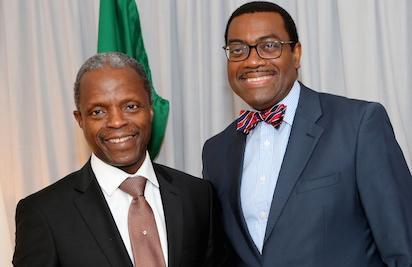
President of the Bank, Akinwunmi Adesina disclosed this at the Presidential Villa, Abuja, when he met with members of the Nigerian government’s Economic Management Team, chaired by the Vice President, Yemi Osinbajo.
“I expect that our portfolio in nigeria will not decrease it will actually grow, we expect to invest in nigeria by 2019 a total of $10 billion.
“So the bank is going to provide in total between 2016/2017 $4.1 billion to nigeria in various of power, infrastructure to agriculture and for the private sector the SMEs financing and lending.
“We have said that we are going to support the Nigerian government with the budget support to be able to deal with some of the fiscal imbalance that they have, we are looking to consider for an award of $1 billion to help to deal with that particular deficit. In addition to that, there are other challenges that the economy has which is in terms diversifying and deepening the level of diversification in critical sectors, so agriculture, solid minerals, manufacturing as well as industrial sector is very important” Adesina told journalists at the state house after the meeting.
The Nigerian government had in January this year approached the ADB to request for a $1billion loan to help fund its $15bn state deficit, deepened by increased spending as it tried to stimulate the slowing economy, which is now in a recession
Nigeria, one of Africa’s largest economies has been hit hard by the fall in crude prices as oil revenues were its mainstay.
Akinwunmi said his team discussed with the Vice President about how to invest in areas of women and youths employment in the country as well as to look for opportunities to support access to finance by supporting the Development Bank of Nigeria (DBN) with $500 million which will help to provide cheap financing for the real sector that the country wants to grow.
According to him the bank understands Nigeria’s difficult situation and was also providing $100 million to the Bank of Industry (BoI) to be able to lend to small and medium size enterprises. “We also want to finance the Bank of Agriculture to be to reform itself to be able to get more financing” he said.
He encouraged the government to continue in efforts to diversify the economy and to ensure macro-economic stability as well as fiscal stability in the country. He added that realising the most important challenge of the country which is power, the bank also plans to “invest a total of 1.400 megawatts of projects to focus on the energy sector and by 2017 we plan to invest in 1,387 megawatt of project for the sector.
“We have asked for the need for better synergies between the macro policy side and monetary policy side and also the fiscal policy side of the economy”.
Nigeria’s Minister of Finance, Kemi Adeosun, who also spoke to journalists at the State House said the EMT was relived by thesynergy in Programmes targeted by the ADB especially the $1billion budget support,
” We are looking up to them with $1 billion budget support but beyond that there are lot of loans and initiatives around agriculture, job creation or the youths, solid minerals, women empowerment and women’s access to finance, access to finance to the SMEs” she said.
She explained that the interest rate on the $1billion loan is about 1.2 per cent adding that the federal government was not over borrowing. “what we are trying to do is to ensure that this money we are borrowing we use it on the key infrastructure that will drive the economy” she said.
Nigeria’s debt profile has risen to N16.29tn, statistics released by the Debt Management Office, DMO, showed. Nigeria’s total debt liability had risen to N16.29tn as of June 30, 2016 from N12.12tn the same period one year ago.
This means that within the one-year period (July 2015 to June 2016), the country’s total debt rose by N4.17tn, or 34.41 per cent.
A breakdown of the country’s debt profile showed that external debt by the federal and state governments stood at $11.26bn or N3.19tn as of June 30, 2016.