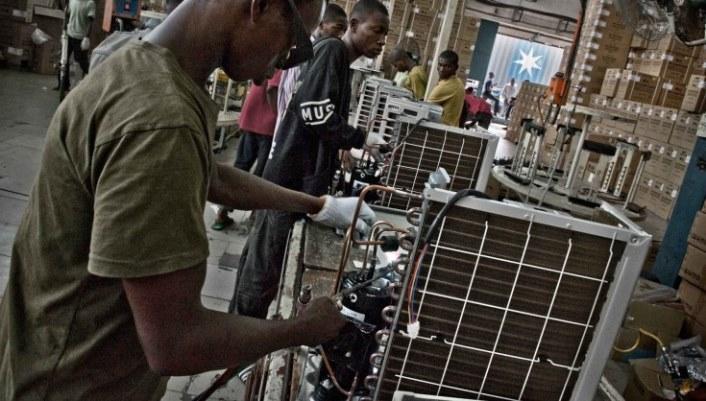
For Nigeria to compete favourably with other African countries in the face of the Africa Continental Free Trade Agreement (AfCFTA), grow the economy and move the country forward, the government at all levels must support local manufacturers.
Speaking at the 7th annual general meeting (AGM) of Kwara/Kogi States branch of Manufacturers Association of Nigeria (MAN), in Ilorin, the Kwara State capital, Segun Ajayi-Kadir, the director-general of MAN, said the association was committed to helping Nigerians, adding that “this has been our primary mandate but the bigger option is for us to collaborate to ensure that we build a country that the next generation would be proud of.”
He added that Nigeria has no choice than to industrialise, as no nation has ever developed or become wealthy without industrialisation.
“It is only by public-private partnership that the economy will grow. We urge the government and relevant agencies to pay attention support and prioritise the manufacturing sector.

“You have to put your money where your mouth is, the insecurity we are seeing in Nigeria today, it is virtually the manifestation of the neglect that we have had from the vital sectors of the economy, principally the manufacturing sector,” said Kadir.
Also, the national president of the association, Mansur Ahmed, who canvassed for a stronger synergy between the association and the government to ensure a conducive environment for industrialists, said: “Without strong support from the government; it would be difficult for us to remain in operations and function optimally.”
In his welcome address, Bioku Rahmon, MAN chairman, Kwara/ Kogi branch, said the choice of the theme of the meeting was borne out of the recent implementation of AfCFTA, now an act in Nigeria.
He expressed concern that Nigerian manufacturers despite their monumental infrastructural weakness and limitations are into competition with other African countries that are equipped with better infrastructure.
“Competing with manufacture from other African countries is no longer optional, thus, as industrialists, how do we brace up for this competition in the midst of our woeful and complicated infrastructural challenges and stand chance internationally?

“If we are to stand any chance of making headway in this competition, the horde of challenges confronting the growth of industrialists in Nigeria must be quickly addressed by the government.”
Rahmon identified a high level of insecurity in Nigeria, continuous fall in the value of the naira, rising Nigeria’s debt profile, scarcity of foreign exchange, shrinking access to loans and high-interest rates, as well as multiple taxation as obstacles bedevilling indigenous manufacturers.
He urged the federal and state governments to rescue them by providing the required infrastructure and institutional backups to enable industrialists adopt the Africa-wide competition.
“We need government support now than ever; we hope that the government will ultimately be responsive to our aforementioned requirements,” he added.
In his submission, Aderemi Madupin, a senior lecturer at the Department of Economics, Alhikmah University; said there was hope as Nigeria is now diversifying its economy.
But he described the country’s economic diversification as very weak, adding “when you talk of economic diversification and after two years you are celebrating the increase in the production of rice; it does not worth celebration.”
He, however, expressed concern over Nigeria’s high dependence on foreign finished goods and raw materials, narrow export base and inadequate power supply, policy summersault, weak economy, among other obstacles hindering development in the country.
On what should be done to ensure that Nigerian manufacturers remain in business, Madupin suggested that the oil being largely depended on should be locally refined, other resources equally tapped for rapid economic growth and self-reliant, prioritise digital transformation among other things.
“The CBN promise on single-digit interest should be implemented. I advise MAN to hold CBN accountable for that. With the AfCFTA implementation, some countries in Africa are entering into partnership with America which will not be in favour of all. Therefore, Africans must recognise they are one and manufacturers must unite,” he added.
Kamoru Abioye Yusuf, CEO KAM Holdings Limited pointed out that, as manufacturers, they are money makers not money breakers thus, industrialists must be accorded high regard.
“I want the government to see industrialists as oil in their engine, and respect us for creating jobs and stabilising the economy of the nation. No military man can go to war without bulletproof, no government agency can survive without us, we should be treated fairly.”
Arinola Lawal, the Kwara State commissioner for business, innovation and technology appreciated MAN for complementing the government’s efforts in job creation.
Represented by Salman Abibat, the director of finance and supply, the commissioner informed that the state government was taking new dimensions to transform Kwara into a vibrant economy, as she promised to address their yearnings and improve on ease-of-doing-business.