…calls for early diagnosis, treatment, community support
Anthony Chukwuka, an architect by profession, didn’t know Parkinson’s disease was creeping into his life. For nearly a decade, he drove long hours, worked late nights on construction sites, and managed multiple projects.
“I was always active, always running around,” he said. “Until one day, after a major building project, I finally slowed down, and my body couldn’t catch up.”
Chukwuka was diagnosed in 2013, but it wasn’t until 2022 that his symptoms fully showed. “I am very active and used to drive from Lagos to Warri and back the same day. I didn’t notice after a while that my lifestyle was changing. It was my wife and younger brother who noticed I was walking oddly. That’s when reality hit,” he said.
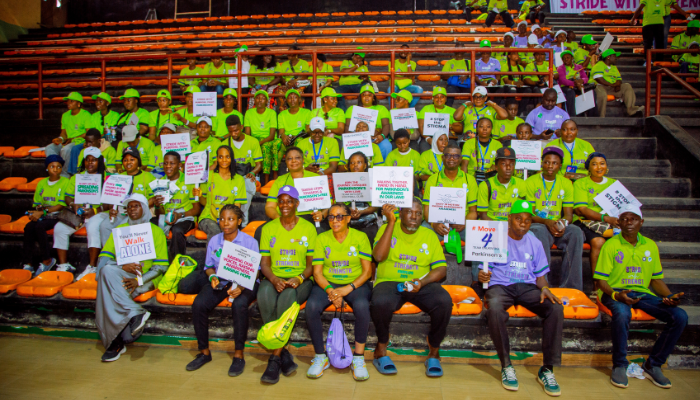
He shared his story during the fourth edition of #Move4PD, a Parkinson’s disease awareness walk hosted in Lagos by the Adewunmi Desalu Parkinson’s Foundation (ADPF). The event drew close to 900 participants, including caregivers, students, medical professionals, and patients, all walking under the theme “Stride with Strength.”

A Disease in the Shadows
Parkinson’s affects more than 10 million people worldwide, yet few Nigerians know much about it. In Nigeria, prevalence ranges from 10 to 249 per 100,000 people, according to Science Direct, but exact numbers are unknown. “This is a major concern,” Omorinsojo Desalu, Founder of the Adewunmi Desalu Parkinson’s Foundation, said.
“We don’t have statistics because people keep their sick at home,” Desalu continued. “You can walk down a street and not see a single person with Parkinson’s not because they are not there, but because we hide them.”
She started ADPF after her husband, Dr. Adewunmi Desalu, battled Parkinson’s for over a decade. “We walked that journey alone,” she recalled. “There was no information, no neurologist in private practice; it was like walking through darkness.”
“In America, every visit came with new information, a flyer, a support line, a diet tip. But in Nigeria, you do not get as much information as you need; and that was why we built ADPF,” she added. “We didn’t want other families stepping on the same landmines we did.”

Walking, Dancing, Healing
At the event, patients boxed, danced, played table tennis, and shared stories. “Every step you take helps the brain produce dopamine, the one thing we lose with Parkinson’s,” Desalu explained. “So yes, we walked slowly, but we walked with purpose.”
For many, ADPF is a lifesaver. Parkinson’s medication can cost ₦70,000 monthly, the same as Nigeria’s minimum wage. “How do you live and treat yourself with that?” asked Omorinsojo Desalu. “No one earning that amount can survive this disease without help.”
As a means of succor, ADPF provides free access to medication, physiotherapy, boxing classes, writing therapy, speech support, and counseling. “We help patients write again because Parkinson’s takes away your handwriting,” said Titi Ojo, the consultant physiotherapist with ADPF. “We also train caregivers. If they break down, who will help our patients?”
Real Lives, Real Voices
Panelist Chukwuka said ADPF changed his life. “At first, I thought it was too expensive for me,” he said. “But after filling out a form, they told me everything was free. I now do therapy, exercise, and I feel stronger.”
Dora Idahor, another patient, said, “Before I came here, I didn’t know this kind of place existed. They help physically, socially, even financially. I thought my life was over, but I now see hope.”
Similarly, Kolade Ayoade, a 49-year-old patient diagnosed when he was 40, added, “Most Nigerians don’t know what Parkinson’s is. Some think it’s witchcraft. We need to create more awareness to help people understand this is a condition and not a curse.”
Parkinson’s is not a rich man’s disease
One of the strongest misconceptions about Parkinson’s in Nigeria is that it’s a “rich man’s disease.” Desalu dismissed that, saying, “It can hit anyone. When it rains, it doesn’t ask what house you live in. We’ve had patients from all walks of life.”
She also urged the public to be more observant. “If your neighbour starts walking differently, shuffling, not smiling, not recognising faces, don’t ignore it, ask questions, and guide them to a doctor. Early diagnosis can freeze the disease before it worsens.”
Despite the progress, Omorinsojo Desalu believes there’s still a long road ahead. She said “The first time we walked, we had 150 people. Now we have about 900 registered for this event but Nigeria has 200 million people. We need more voices, more action.”
“We can’t leave it to the government alone,” the founder added. “If you have money, sponsor a patient, if you have a voice, use it. If you have time, volunteer and if you know someone with symptoms, help them find care.”