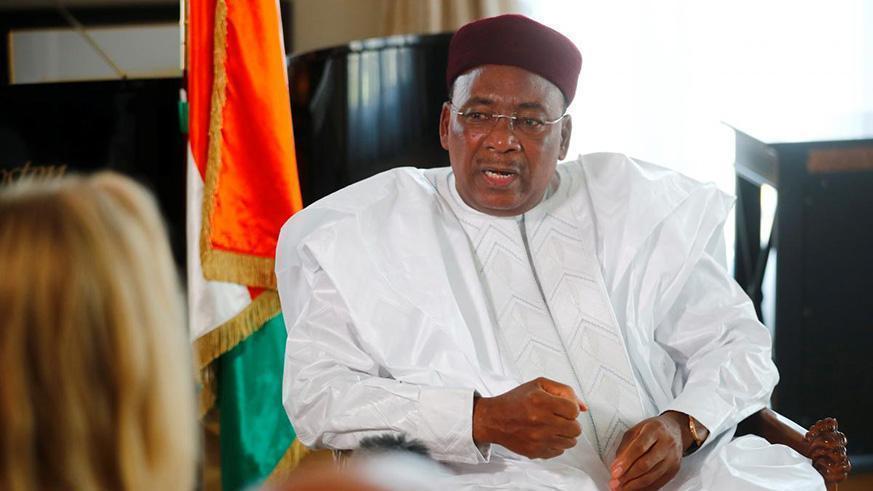
The Chairman of the Authority of Head of State and Government of the Economic Community of West African States, (ECOWAS), Niger’s President Mahamadou Issoufou, has said that achieving the proposed single currency (ECO) for the region remains his priority, adding that he will strive hard to make it a reality before the 2020 deadline.
The Nigerien President, who was elected as chair of the regional bloc at the last Summit of Heads of State and Government on 29 June 2019, in Abuja, said this during his visit to the ECOWAS Commission in Abuja to meet the institutions, which are responsible for the effective implementation of the decisions taken at the ECOWAS Summits.
He said in his address that “harmonization and strengthening of the regional macroeconomic framework, particularly with the ECOWAS single currency project, for which significant progress has recently been made, also remains a priority.”
He added that it is important to implement the roadmap for achieving the objective, which should facilitate and accelerate intra-Community trade by reducing the cost of financial transactions.

“The creation of the single currency in 2020 will be an important instrument for achieving the economic and political integration of our Region. All Member States are strongly committed to achieving macroeconomic convergence in order to ensure the viability and credibility of the future monetary zone,” he said.
For the Eco to be implemented, ten convergence criteria, set out by the West African Monetary Institute (WAMI), must be met. These criteria are divided into four primary and six secondary criteria.
The four primary criteria to be achieved by each member country are: A single-digit inflation rate at the end of each year; A fiscal deficit of no more than 4% of the GDP; A central bank deficit-financing of no more than 10% of the previous year’s tax revenues and Gross external reserves that can give import cover for a minimum of three months.
The six secondary criteria to be achieved by each member country are: Prohibition of new domestic default payments and liquidation of existing ones; Tax revenue should be equal to or greater than 20 percent of the GDP; Wage bill to tax revenue equal to or less than 35 percent; Public investment to tax revenue equal to or greater than 20 percent; A stable real exchange rate and A positive real interest rate.
It is however, instructive that the regional bloc faces a serious challenge to the objective as most of the member states are yet to meet these criteria.

But the ECOWAS chair said “while there are many challenges to achieving this, I would like, during this term of office to see significant progress in at least three areas to which I will give high priority: the consolidation of democratic institutions, regional peace and security and the economic integration of our States, particularly infrastructure programmes and the common currency.”
On democracy and good governance, he said “we must continue actions to strengthen democracy and political governance in our region, in accordance with the relevant Protocol. In this sense, I note that actions to support Member States in the organisation of transparent and credible elections, a guarantee of peace and stability, are provided for in the programme. Similarly, our actions to assist countries in difficult political situations, through mediation interventions, will also have to continue.”
On Safety and security he said “our region is currently facing security challenges related to maritime piracy, terrorism and organized crime. This situation, if it persists, is likely to undermine the progress made and the development actions of our region. Nevertheless, we remain convinced that ECOWAS will emerge victorious from the current difficulties.”
On Free Movement of Goods and Persons he said that at the trade level, efforts must be maintained to increase intra-Community trade, which still remains at an insufficient level (around 15%). “The Task Force’s recommendations must be implemented to facilitate the free movement of goods and people across the different borders of our Member States,” he said.
President of the ECOWAS Commission Jean Claude Kassi Brou, in his address, commended the Nigerien leader for his decisive contribution to the successful and timely launch of the African Continental Free Trade Area at the Summit held on 8 July in Niamey.
“Our activities support Member States in their efforts to implement their economic and social development programmes. They have helped most of them to make both economic and social progress at the national level, just as they have contributed to the consolidation of the region’s economic growth to over 3% in 2018,” he said.
He noted however, that the region faces significant challenges that require, among other things: strengthening strategies to combat insecurity and extremism; the increase of socio-economic infrastructures in order to increase the competitiveness of our Region; improving performance in the free movement of goods and people; the operational implementation of the free trade area launched in Niamey on 8 July 2019; the creation of the West African Monetary Union; the implementation of programmes for industrialization and development of resilient agriculture; and the urgent strengthening of our capacities in training and health.
“To respond to these challenges in a sustainable way, reflections and actions have already been initiated at the level of the various Departments; others are planned. We will present you with an overview in the rest of our working session,” he said.
Innocent Odoh Abuja