



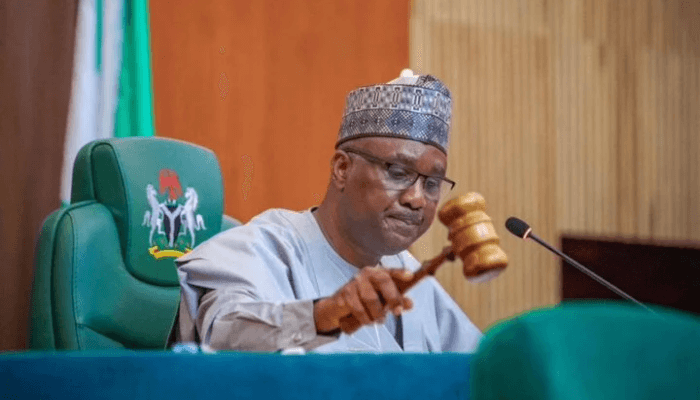
When Tajudeen Abbas, Speaker of the Hosue of Representatives took the stage 6th World Conference of Speakers of Parliaments organised by the International Parliamentary Union (IPU)/United Nations in Geneva, he made sure Nigeria’s efforts got their moment in the spotlight.
Abbas painted picture of tech-savvy lawmakers, engaged citizens, and a House plugged into the future. But back in Abuja, things aren’t quite as polished. Bills are hard to find; the website is barely updated and those sleek new terminals on lawmakers’ desks appear to be dormant.
Flanked by lawmakers from across continents, the conference featured global debate on ‘The Role of Parliaments in Shaping Our Digital Future,’ a discussion that probed how legislative houses worldwide are evolving in the age of data, algorithms, and online citizen engagement.
Read also: Firm leads campaign to tackle child negligence and digital risks in Nigeria

It was an applause-ready speech, full of the right keywords: data protection, cyber laws, inclusion, transparency. Abbas spoke of new legislation, such as the Nigeria Data Protection Act and the revised Cybercrime Bill, as tools to anchor public trust in Nigeria’s digital transition.
Abbas even pitched a big idea: a Global Parliamentary Forum on Artificial Intelligence – a global roundtable to shape the ethics and governance of AI. “Africa must not remain a passive recipient of foreign technologies or a laboratory for digital trials. We must actively shape the global digital landscape,” he said.
His message was bold: Nigeria, Africa’s most populous democracy, is not just participating in the digital age, it is actively shaping it. The 10th National Assembly, he declared, has opened its legislative doors wider than ever, bringing parliament closer to the people through technology.
The Lower Chamber has indeed made some visible moves to digitise its operations. One of the most noticeable was the rollout of electronic communication terminals to each of the chamber’s 360 members. However, the it still struggles with the basics of digital transparency. Its website, for instance, rarely reflects the real-time work of the House. Many bills under debate are nowhere to be found online, and public records are often outdated. The rows of shiny new screens glowing beside microphones, appear to be for decoration.
Yet, Abbas’s speech was anything but modest. He told the global gathering that the National Assembly’s Open Week an initiative to engage citizens online had reached over 7,000 Nigerians, mostly young people, through digital channels. It was, he said, a prime example of participatory democracy. For those who attended, the Open Week had moments of genuine engagement.

Abbas also highlighted the Reserved Seats for Women Bill — framed as part of the parliament’s digital equity efforts. While the bill pushes for greater gender representation in politics, its connection to digital governance is tenuous at best.
The ambition isn’t misplaced. Nigeria is home to one of Africa’s most vibrant tech ecosystems. Its youth population is deeply online. From digital payments to e-commerce to activism, the country thrives in virtual spaces. The irony, however remains that its own parliament is still learning how to function there.
To be fair, Nigeria is not alone in this struggle. Around the world, parliaments are famously slow-moving institutions. Tradition, bureaucracy, and resistance to change make digital transitions tricky.
In Geneva, Abbas urged fellow parliamentarians to think beyond routine oversight and embrace digital governance grounded in “equity, justice, and human dignity.” These are noble words. But they’ll only matter if backed by real access and accountability.
Read also: 13m Nigerians passwords leaked as Nation grapples with digital security crisis
As it stands, Nigeria’s digital parliament exists more on paper and podiums than in practice. There are signs of effort, yes: bills on cybercrime, laws on data, investment in infrastructure. But for the average Nigerian seeking information or interaction with lawmakers, the system still feels analogue.
Until Nigerians can track a bill online, join a live committee session, or access their representative’s voting record without sending emails or making phone calls, the promise of a digital parliament remains just that: a promise.
So, yes, Speaker Abbas made a splash on the global stage. But here at home, the real challenge isn’t dazzling diplomats, it’s delivering for citizens.





