The news rippled through Nigeria as word spread of the passing of former President Muhammadu Buhari in London. For many, it was a moment for quiet reflection, a chance to look back at eight years that profoundly shaped the lives of ordinary Nigerians. Away from the official pronouncements and political analyses, the streets and homes of Nigeria hummed with personal stories, a mosaic of experiences painted by hope, hardship, and the enduring spirit of a nation.
“Transportation costs also increased during this period, making it uncomfortable and financially burdensome for many households, especially in the early years of his administration.”
A report published by SBM Intelligence on July 15th offered a stark backdrop to these personal narratives. Data points on inflation, unemployment, and economic growth told one story, but it was the voices of everyday citizens, gathered during the public holiday, that truly brought the numbers to life.
The weight of the naira: Economic realities
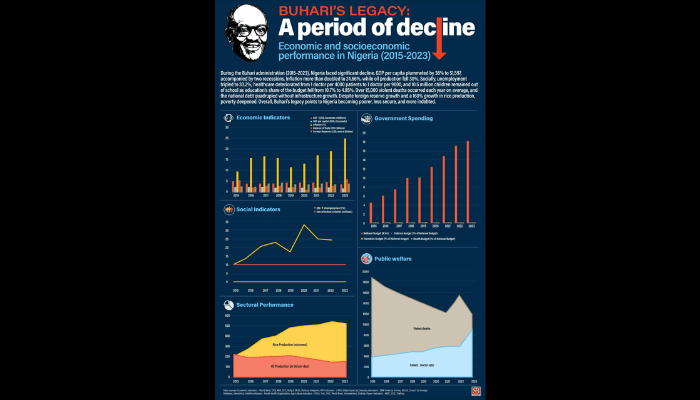
Perhaps no aspect of Buhari’s tenure touched Nigerians more directly than the economy. Inflation, a relentless beast, gnawed at purchasing power, turning once-affordable staples into luxuries. Inflation, which stood at 9.55 percent in 2015, soared to 18.85 percent by 2022 and a staggering 24.66 percent in 2023. This wasn’t just a statistic; it was a daily struggle.

At Ketu Market, Miss Vivian, her voice heavy with the memory, recalled how “inflation devastated my purchasing power. Food prices soared, and the resulting scarcity of both food and fuel contributed to higher mortality, as many people could no longer afford adequate nutrition or transportation. It was a bitter time.” She painted a vivid picture of countless Nigerians “trapped in low-paying jobs—or jobless altogether—because finding new work under President Buhari was almost impossible.”
Loveday, an engineer in Ibadan, echoed this sentiment. “During Buhari’s tenure, the cost of food began to rise gradually, alongside an increase in the exchange rate and the price of fuel. As a result, we had to spend roughly 25 percent more on food and fuel. Transportation costs also increased during this period, making it uncomfortable and financially burdensome for many households, especially in the early years of his administration.”
Abigail, a hairdresser in Onitsha, reflecting on what she called a “complete failure” of an administration, shared her family’s desperate thoughts of relocating to the East just to survive. “Basic things we could once afford became luxuries,” she lamented. “Imagine rice increasing from ₦6,400 to ₦42,000 per bag—that’s well over a 100 percent rise.” She also pointed to the fuel price hike, from ₦87 to ₦300 per litre, and the chaotic cashless policy where “people were paying ₦5,000 just to access ₦10,000 of their own money. Some even died trying to withdraw cash.”
Mr. Abiodun, in Ikeja, minced no words. “Buhari was a madman,” he declared, asserting that “the economic hardship Nigerians are facing today began under Buhari’s administration. Fuel rose from less than ₦100 to ₦300 during his time, and now it’s over ₦1,000. In Nigeria, we all know that whatever goes up never comes down.”
In Festac, Mr. Papi, too, felt the squeeze. “The price of food and fuel kept rising year after year. By the time he left office, we were spending nearly double what we used to on groceries. Fuel scarcity made transportation expensive, which in turn affected everything else.”

Even a pepper seller in Mile 12, accustomed to the ebb and flow of market prices, observed, “Things got more expensive, no doubt. Food, fuel, and even fertiliser went up. But I’ll say we still manage in the village because we grow some of what we eat. It’s people in the cities that suffered more.”
Christian’s memory of inflation was a “nightmare.” “I remember when rice jumped from ₦7,000 to ₦30,000 per bag. Fuel rose from ₦87 to over ₦300 per litre. Everything just got worse. It felt like survival was a privilege.”
Unemployment figures showed a significant rise, from 10.4 percent in 2015 to a peak of 33.2 percent in 2020 before slightly receding to 24.3 percent in 2022. “I graduated in 2018. No job. Applied everywhere. Nothing,” Christian recounted. “I had to learn digital skills online and start freelancing. Buhari’s government didn’t create meaningful employment.” Abigail, a graduate herself, confirmed, “I still couldn’t find formal employment. I had to create my own job. We’re five people in my family, and only one of us has a salaried job. The rest of us run small businesses to survive.” Mr. Papi shared a similar struggle: “I’m a graduate, and I spent almost four years doing menial jobs before I finally started a small business. Most of my friends were either unemployed or underemployed throughout his tenure.”
Crumbling pillars: Education and healthcare
Beyond the economy, the state of public services, particularly education and healthcare, remained a deep concern for many. The education budget as a percentage of the national budget hovered between 4.3 percent and 10.7 percent, while the health budget remained similarly low, between 4.1 percent and 7.6 percent. The doctor-patient ratio worsened significantly, from approximately 1:4,000 in 2015 to 1:9,000 in 2023. The figure of 10.5 million out-of-school children remained stubbornly constant throughout his tenure.
Miss Vivian observed that “public funds seemed to disappear into the pockets of power-hungry politicians who, in my view, had little interest in educating the children of ordinary citizens.” Loveday noted that “strikes by teachers and university staff continued throughout his tenure, further disrupting the system.” Christian was even more direct: “ASUU was always on strike. Public schools were broken. That 10.5 million out-of-school children figure is criminal. The money never reached where it should. I don’t think they cared.” Abigail, with biting sarcasm, added, “That number was just another opportunity to steal. The funds never reached the schools. In the North, most children are still not attending school. Buhari seemed to care more about cows than human lives. How can someone with limited education invest in education for others?” An anonymous respondent, too, was blunt: “The education sector was extremely poor during his tenure—constant strikes and underfunding. I can say for sure that the 10.5 million out-of-school children figure wasn’t addressed.”
Healthcare fared no better in the public’s eyes. Miss Vivian, an NHIS employee, “watched hospitals struggle with unpaid government bills, constant disputes over reimbursements, and cost-cutting measures that endangered patients. Skilled doctors and nurses emigrated in droves, further weakening the system.” Loveday confirmed this “brain drain,” leading to “a noticeable decline in the quality of medical services.” No significant investments were made to improve the sector.”
Abigail’s assessment was grim: “That sector completely collapsed. Many health professionals left the country during Buhari’s time. Government hospitals gambled with people’s lives. Thank God my family rarely falls sick—we mostly survive on paracetamol.” Christian’s memory was heartbreaking: “Government hospitals were a mess. No equipment, no doctors, no empathy. I once watched a woman lose her baby in a hospital corridor because no one attended to her. I will never forget it.” The anonymous respondent shared a personal tragedy: “I lost two family members at a general hospital because there was no doctor on duty to save them. Still, I don’t entirely blame the doctors—some are underpaid, and many hospitals are understaffed.” The pepper seller in Mile 12 simply stated, “Our health centre barely functioned. No drugs, no doctors. We had to travel far to get serious treatment. People died from simple illnesses because help came too late.”
The exodus: Seeking greener pastures
The frustration and despair manifested in a significant increase in net migration, as Nigerians sought opportunities abroad. Net migration figures, which were -60,000 in 2015, escalated to -86,115 in 2020 and remained significantly negative throughout the latter years of his presidency.
“Faced with such hardship, many Nigerians sought greener pastures abroad,” Miss Vivian stated. “I do not blame them; if I had the means, I would move my family as well.” Loveday observed, “The growing number of Nigerians leaving the country during this period clearly reflected widespread dissatisfaction with the economic situation. Even people with good jobs were resigning and using their savings to relocate abroad.” Abigail concluded, “Nigerians lost hope because of Buhari. I don’t blame anyone who left the country. If I had the means, I would do the same. His tenure was nothing short of disastrous.”
Mr. Papi confirmed, “I had friends with good jobs who still left the country for better opportunities because they didn’t see a future here.” The pepper seller in Mile 12 knew “several people who moved abroad. Some left with student visas, others just to find work. The economy made them leave, and many say they won’t return.” Christian’s observation was poignant: “People left because they were tired. Some sold land and property just to get out. They weren’t even poor—they just lost hope in the system.” The anonymous respondent viewed the 2020 migration numbers as a “clear sign of widespread dissatisfaction. People weren’t happy with the economy. That mass migration was driven by desperation. Honestly, at this point, we need a miracle to fix Nigeria.”
A glimmer of green: Rice production
Amidst the widespread criticism, one area often cited for improvement was rice production. Milled rice production rose from 2 million tonnes in 2015 to 5.4 million tonnes in 2022.
Loveday acknowledged, “One area where there was a noticeable improvement was rice production. The government closed the land borders at one point, which helped boost local rice production. This initiative did help to stabilise the cost of rice temporarily, and in some cases, prices dropped.” Mr. Papi agreed: “Yes, rice production increased—that was a small win.” The pepper seller in Mile 12 also noted, “We saw more support for rice farming—fertilisers, training, and improved seeds came in at some point.”
However, this positive was often tempered. Loveday added, “However, this improvement was limited to rice; overall agricultural output did not see significant progress.” Christian questioned, “Rice production may have increased, but what about affordability? Food was still expensive. Buhari’s policies were all surface-level—no deep impact on the lives of real Nigerians.” The pepper seller also pointed out, “But the cost of production also rose. It was a mix of good and bad.”
A promise unfulfilled?
The reflections on Buhari’s leadership were often direct and unvarnished. Mr. Abiodun’s fiery “May his soul rest in pieces—just like the way he scattered this country” captured the depth of some Nigerians’ frustration. The anonymous respondent, while acknowledging that Buhari “tried his best,” still highlighted the pervasive unemployment and the disastrous state of public services.
Journalist Fisayo Soyombo, a keen observer of Nigerian affairs, perhaps encapsulated the sentiment of many in his reflection: “At the end of the day, late President Muhammadu Buhari will be largely remembered as that one Nigerian president who had every single ingredient to succeed in office—especially unprecedented public goodwill—but ultimately flattered to deceive. Such a shame how poverty, unemployment, inflation, insecurity, and press freedom worsened under his watch, leading to the decimation of trust among even many of his own cult followers and the eventual shattering of what would have been an inerasable legacy. A promise unfulfilled!”
As the public holiday drew to a close, and Nigerians returned to their daily routines, the passing of Muhammadu Buhari served as a poignant moment for introspection. The numbers, coupled with the raw, heartfelt testimonies of Miss Vivian, Loveday, Abigail, Mr. Abiodun, Mr. Papi, the anonymous respondent, and Christian, paint a complex picture of a presidency that, for many, fell short of its promise. It was a period marked by economic strain, struggling public services, and a palpable sense of lost hope that drove many to seek new lives beyond Nigeria’s borders. Yet, even in the depths of disappointment, the resilience of the Nigerian people, their ability to adapt and survive, remains a testament to their enduring spirit, forever navigating the intricate dance between hope and reality.