There has been a torrent of funds flowing into emerging markets due to the continued easing stance of central banks across the United States, Europe and Asian as global synchronized economic growth losses steam.
Analysts are of the view that emerging markets offer high nominal and real yields, which looks especially attractive in the yield starved world.

As yields drop, bond prices rise, as both variables are inversely correlated.
As the global bond rally intensifies, buying up developing market long dated is proving to be a good strategy.
This is because global central banks have joined the Federal Reserve in their dovish stance, as a trade spat between the US and China is unsettling global economy.

Federal Reserve Chair, Jerome Powell is facing greater pressure to cut rates for a third straight time in respond to weakling data. Manufacturing data were disappointing, as analysts fret trade tensions and geopolitical tensions could tip the country into a recession.
Outgoing European Union Central Bank, Mario Draghi, cut interest rate for the first in eight years to the lowest level ever, as well as introducing a round of quantitative easing, as the global economy grapples with negative interest rates.
The Bank of England may cut interest rate to fend off the effect of a brexit uncertainty, and Prime Minister Boris Johnson could face a backlash from the British parliament in a no deal scenario.
“Since the beginning of the year, we have seen accommodative monetary stance in advanced economy like the United Kingdom, the United States, and Germany,” said Kayode Tinuoye, Head of Portfolio Management Limited at United Capital.
“That means a lot funds have been flowing into emerging and frontier markets,” said Tinuoye.
Read also: Unilever shows other multinationals how to achieve 100% renewable electricity
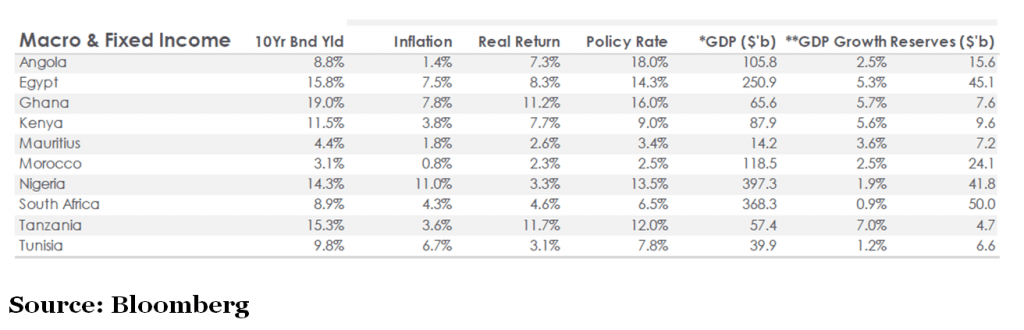
A cursory look at African economy shows it pays to be an Egyptian investor than Nigerian because the former offers a higher real return after adjusting for inflation.
That is because Egypt has a lower inflation rate that makes investment more valuable in the hands of investors as it undertook some transformation reforms that stabilized its currency.
Real rate of return is simply the return an investor receives after the rate of inflation is taken into account. If inflation rises, the real rate will fall.
Egypt has a real rate of return of 8.30 percent and inflation rate of 7.50 percent, this compares with Nigeria’s returns of 3.30 percent and inflation rate (11.0 percent). South Africa has a real rate of return of 4.60 percent and an inflation rate of 4.30 percent.
With over 50 percent of a population of 200 million living below $1.29 a day, it will take the donkey passing through them eye of the needle to salvage the vast majority of rustics from an imminent dependency.
Nigerians should tighten their belts as a possible hike in tarfiff on electricy and a possible removal of subsidies means they may never drink from a flagon poured into a golden goblet.
As G.R.R Martins puts it in his bestselling novel, Game of Thrones (GOT): Winter is coming, and our harvest could be short. But will Nigeria pay ever pay its debt like the Lannisters? That is a discussion for another day.
Smaller African countries are catching up with Nigeria. Are we a sleeping giant? Posterity will never forgive our generation if we fail to create an enabling environment for the generation unborn.