Mario Greco, chief executive of Italy’s Generali, Europe’s third-biggest insurer by premiums, speaks softly but gives every sign of being ready to do battle. It is not surprising: after turning the company round over the past three years, he still faces residual scepticism, fresh challenges and outside expectations about how corporate Italy should act.
“This is a company that is coming back,” he insists of the insurer, whose share price has nearly doubled since he took the top job three years ago. A competitive road cyclist in his free time, he sits on the edge of his chair in Generali’s Milan headquarters, his foot persistently tapping as if reaching for unseen pedals.
“Generali is coming back from nowhere because we started from a very low level,” he says. “We are changing gear. We are finishing a turnround story and we are opening a value story, which is a significant change. To people who say ‘you haven’t fixed it’, [I say] ‘look at the numbers’.”
Mr Greco, who studied international economics in the US and started his career at McKinsey, is in the vanguard of a rising generation in Italian capitalism.

His pugilistic talk is new at the top of corporate Italy — but he is not alone. His fellow CEOs at the country’s leading companies, such as Intesa Sanpaolo, Telecom Italia, Eni and Enel, were all installed after the financial crisis and the eurozone sovereign crisis triggered share price crashes. All are confronting tough turnrounds at their respective businesses after the drubbing dealt by the crises. And all are faced with the task of restoring corporate Italy’s image in the outside world, marred by a long economic stagnation and a reputation for crony capitalism.
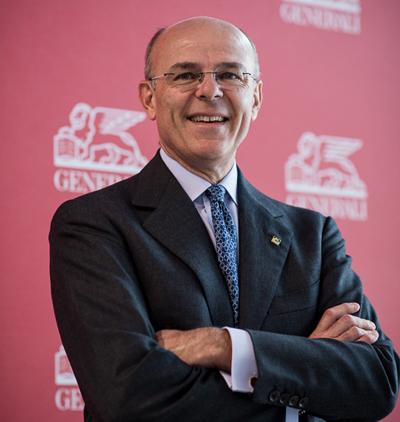
Mr Greco, 56, joined Generali from Zurich Insurance Group in the heat of the eurozone debt crisis. The board, in a typically bloody Italian board coup, had just ousted its chairman, Cesare Geronzi, and CEO, Giovanni Perissinotto, in swift succession after the insurer lost two-thirds of its value in five years.
Mr Greco’s appointment was significant because of the size of the group — Generali has €500bn in assets under management, a behemoth in a country dominated by small and midsized businesses — and its place in Italian corporate culture.
The insurer under its old guard was an example of the type of Italian crony capitalism that raises a red flag for foreign investors in the eurozone’s third-largest economy. Generali sat amid a web of cross-shareholdings, which in the good times gave it unmatched influence but in the crises became the network through which contagion spread fast.
Mr Greco has cut costs and slashed its shareholdings in companies that included Telecom Italia, selling nearly €4bn in assets to boost its capital.

“People bet I would make a capital increase three years ago — they can keep on making this bet,” he says. Mr Greco reiterates that he still has no intention to raise capital since the asset sales have boosted Generali’s economic solvency ratio, a key measure of financial strength, to 186 per cent at the end of 2014, more in line with its peers Axa and Allianz.
Mr Greco presents himself as a straight-talking numbers man, in a deliberate distinction from the avuncular manner of Italy’s older executives.
Generali aims to pay €5bn in dividends over the next four years compared with €900m last year. “We are now on a different journey to remunerate shareholders and increase the value of the company, and do that above the market average. This is completely new.”
Mr Greco may have dragged Generali’s governance and strategy into the 21st century but, like the leaders of many Italian businesses, he must now confront new problems spawned by technology and globalisation.
The International Monetary Fund warned earlier this year that the business models of European insurers are becoming unsustainable after a dramatic fall in interest rates. Mr Greco says he is prepared to deal with low bond yields “until 2018”. He is shifting Generali’s business mix to more fee-earning products to boost profits and away from life insurance, where setting up new contracts incurs heavy costs upfront. He also faces more competition arising from big data and is increasing spending on technology to better understand customer needs.
In addition, he has hired outsiders and foreigners to reflect Generali’s presence in more than 60 countries with 78,000 employees and 72m customers. He hired New Delhi-born, Cambridge and Harvard-educated Nikhil Srinivasan as chief investment officer, who is now Italy’s most prominent non-Italian executive.
His bet on new blood appears to have paid off. For 2014, Generali posted an investment return of 10 per cent on assets exceeding €400bn, which beat its peers, according to a report from research company Sanford Bernstein.
But for some analysts with the memory of eurozone crisis contagion still fresh, the focus remains on Generali’s €50bn of Italian government debt and €90bn of Italian liabilities, which remain a concern and a sign that the effects of its change may be superficial.
Mr Greco will have none of it. “The fact that we are strong in Italy, is this a sin? Is this a mistake? Is this something I have to feel regretful about? I don’t think it is,” he snaps, showing an exasperation shared by many of Italy’s executives about the perception of the country internationally. “This is one of the top 10 countries in the world by GDP. We make profits in Italy, we have high market share, Italy is growing,” he says.
Another exhalation of frustration greets a suggestion that Generali might provide credit to small and midsized businesses, since traditional bank lending has shrivelled during the downturn.
“Never, never,” he says of the popular idea among lawmakers that insurers such as Generali could disintermediate banks. “I have been very clear with everyone at a European level and a national level. We can’t help . . . It is not that we don’t want to . . . We cannot do things that we do not have the competence to do,” he says, his foot still urgently tapping out its staccato beat on the floor.
Like most of Italy’s new corporate class, Mr Greco was a supporter of 40-year-old reformist prime minister Matteo Renzi when he came to power 18 months ago. With his combative attitude, Mr Renzi was their political counterpart. Since then, business leaders’ affection has cooled as deep reforms have failed to materialise and the government growth target of 0.7 per cent this year is starting to look a stretch.
“We need much more reform as Europeans, and we need much more as Italians,” is all Mr Greco will say.
But he stresses that he wants to applaud Mr Renzi and his team for the efforts they have made to ask Italy’s corporate leaders how they can support them internationally, such as through trade missions. That this is a great step forward reflects as much as anything how broken Italy’s corporate system had become during 20 years of economic stagnation under its discredited political class of the right and left.
“The government is acting in a way where you can see that they are trying to help companies like ourselves. I feel that we are starting to have the support of the country,” Mr Greco says. “This is a simple thing but important. You feel you belong to a place.”
Culled from FT