According to the Jewish Kabbalah, when God created the world, he encrusted Himself into vessels of light which were later shattered into little bits throughout the universe. The vocation of all created beings is to gather together these shards of light back to their Creator – in essence, to perfect the world. The concept of tikkun olam is a cornerstone of Jewish spirituality and practical action in the world.
The former Bank of Israel Governor is a man after my heart. Not only is he a great economist; I suspect him to be a devotee of tikkun olam. The recent news that he has been nominated by President Barack Obama to become Vice-Chairman of the U.S. Federal Reserve has been greeted with enthusiasm by his admirers throughout the world, including yours sincerely.
Stanley Fischer was born to Jewish parents 70 years ago in the small town of Mazabuka in northern Zambia. As a teenager he won a scholarship to the London School of Economics and Political Science. He completed his doctorate at MIT and later joined the faculty at Chicago before returning to MIT. It was to be his home for most of his professional career.
A profusion of academic publications followed. A 1977 paper, “Long-Term Contracts, Rational Expectations and the Optimal Money Supply Rate”, established his name among the central figures of what became the New Keynesian Economics, among such names as Robert Lucas, Joseph Stiglitz, David Romer and Edmond Malinvaud.

Every summer the U.S. Fed organises a seminar that is attended by the glitterati of economics and central banking. A few years ago, Ben Bernanke commented that nearly everybody in attendance was in one way or the other a student of Stanley Fischer. I had the good fortune to attend lectures by economists of world repute ranging from Franco Modigliani to Raul Prebisch and Jeffrey Sachs. I never had the luck to sit at the feet of Stanley Fischer.
Having been an academic myself, I know that great scholars can often be rather poor teachers. Stanley Fischer has the unusual reputation of being a great scholar as well as a great teacher. Some of his students who went on to pursue illustrious careers of their own include outgoing Chairman Bernanke, Mario Draghi, the respected President of the European Central Bank, Lawrence Summers, former Obama Economic Adviser Christina Romer and Gregory Mankiw, one of the stars in the firmament of Harvard economics.
Stanley Fischer’s career traverses academia as well as the world of practical affairs. He did a stint as Chief Economist at the World Bank before moving next door to the IMF as First Deputy Managing Director. His time at the Fund (1994—2001) coincided with severe financial crisis in Asia, Latin America and Russia. He was one of the central figures who calmed the storms of world financial contagion and helped restore the global equilibrium. During 2002—2005, he was Vice Chairman of Citigroup, at the time the biggest banking institution in the world. In January 2005, Prime Minister Ariel Sharon, now late, appointed Fischer Governor of the Bank of Israel. He served for eight years, retiring voluntarily in June 2013 before the completion of his second term.
The philosopher Hannah Arendt believed that people are either thinkers or doers; and that it is rare to have those who are both. Stanley Fischer must be counted among that rare species.
It is a well known fact that mediocre minds tend to be uncomfortable with people of ability. Great minds, on the other hand, look out for excellence in others. They like to surround themselves with likeminded souls; nurturing teams of gifted people. Stanley Fischer is of that ilk. At the Bank of Israel (BOI), he put together a team of exceptional people, among them the wise and thoughtful Meir Sokoler. A retired Deputy Governor of the BOI, Sokoler worked with me as an Adviser when I was at the CBN.

Stanley Fischer steered the BOI through turbulent times and did so with panache and chutzpah. His highly informed judgements helped shield the economy from the worst effects of financial contagion. He took a strong stance against inflation; but he also understood that price stability must go together with growth, employment and national competitiveness. He took special interest in all sectors of the economy from high tech to agriculture and education. He engaged with farmers, cooperatives and industrial groups as well as kibbutzim.
While Europe and America were in the doldrums, Israel was making steady progress in growth and welfare. Today, Israel is among the most competitive economies in the world; second only to the United States in the number of new companies registered in the New York Stock Exchange. For these accomplishments, Stanley Fischer has won plaudits across the world. Euromoney declared him best central governor of the world in October 2010. Remarkably, the BOI has won an “A” rating from 2009 t0 2012.
In 2011 he had been touted as a possible successor to Dominique Strauss-Kahn who had to vacate his seat at the IMF under a cloud. Fischer was disqualified for the simple reason that he had reached the borderline age of sixty-five. A veteran of global financial crises, he is an inspired choice to compliment Chairman Yellen.
His success has important lessons for us. First, intellectual capital matters. Those who lead central banks must understand world economics and the complexities of 21st century digital civilisation, with its risks as well as opportunities. They must also understand government and public finance. Secondly, the mandates of central banks must go beyond the narrow targets of price stability to embrace growth, employment and macro-prudential stability. Thirdly, central banks must be reinvented as knowledge institutions whose policies derive from rigorous research and analytics – forward looking organisations where talent can thrive and flourish. Fourthly, leadership is of the utmost importance. Those who lead central banks must be people of the highest intellect and character — able to lead with vision, courage and patriotism.
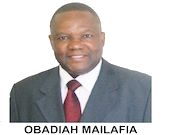
By: OBADIAH MAILAFIA