…How NDDC’s five minutes interaction convinced EFCC boss about the new intervention agency
In recent months since 2024, news hints indicate that the two financial crimes investigation agencies, the Economic and Financial Crimes Commission (EFCC) and the Independent Corrupt Practices Commission (ICPC), have made positive remarks about the Niger Delta Development Commission (NDCC).
Before now, each time any news comes from either the EFCC or the ICPC, it would be very negative, it would be about arrest or invitation based on probes. The public would only conclude that big money was missing, and it was always not far from the truth.
What has existed between government agencies and the Economic and Financial Crimes Commission (EFCC) and later the Independent Corrupt Practices Commission (ICPC) is distrust, fear, ad tension.

This way, the crimes investigation outfits see ministries, departments, and agencies (MDAs) as mere looters and rogues, while these agencies see the investigation agencies as enemies and harm-mongers.
At a point, the searchlight of the investigation agencies pointed so harshly against the NDDC that a forensic audit was commissioned by the former president, Muhammadu Buhari. And it was not in vain for the fact that N6trn was thrown up as being questionable. Thousands of projects were mentioned as being awarded and most of it not executed even where funds were fully disbursed. Most Nigerian expected many big heads to roll, but that is yet to happen to this day.
There is also the opposite case of hundreds of contractors who claim they completed their projects but were being owed; thus creating a bizarre narrative of those who work but not paid, and those who worked not, but well paid. Such a template was never going to deliver the mandate of any development agency.
What Buhari seemed to do rather than mass arrest as expected was a mandate by the EFCC and probably the ICPC to launch quiet recovery tasks. Next, he seemed to look carefully to select the headship of the NDDC after the audit. This seemed to be how Samuel Ogbuku was thrown up. He comes from a background of activism; those who campaigned against the establishment for failings in many directions.
He was a student activist in the University of Port Harcourt not too long ago, and graduated straight into activism joining those regarded as intellectual militants. Asking such a man to lead the biggest interventionist agency set up to address most of the same issues he campaigned for seemed to be a good strategy. This was at a time the NDDC was getting new managing directors every now and then, thus disrupting the Commission from completing any tangible task. Until Ogbuku (PhD) emerged.

President Bola Ahmed Tinubu seemed to agree with Buhari on this and reconfirmed him, now with a stable board headed by Chiedu Ebie, another young professional who seemed to be a man on a focused mission. He is a lawyer and is indicated as a seasoned technocrat.
This combination seems to begin to reveal the intentions of both past and present presidents on use of human resource strategy to turn around any situation.
It is within this framework that many begin to view the good remarks coming from the same investigation agencies that many MDA dread to no end.
The only visit by any CEO was only to answer preliminary queries. For once, an MDA leadership team paid a friendly visit to the EFCC to explore how best to operate in line with financial accountability framework. This sounded strange as most persons sat back to watch the new trend.
Speaking at the inauguration ceremony, the EFCC chairman assured the NDDC of the release of more recovered funds in the coming weeks.
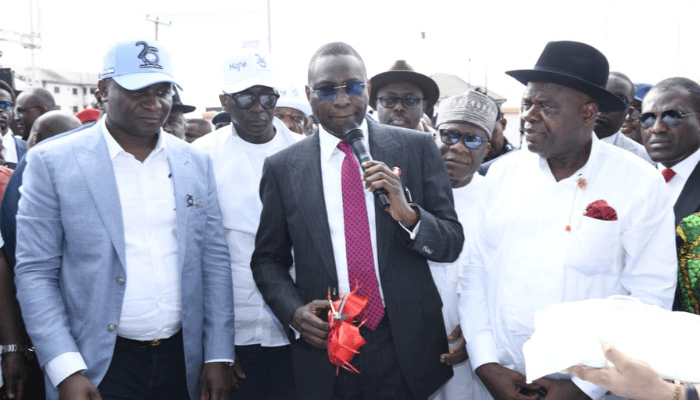
Olanikpekun Olukoyede, chairman of EFCC, was to confess at a commissioning in Bayelsa State last two weeks how the NDDC leadership also shocked him by visiting him without probe and for asking to know how to streamline operations and financial systems to meet EFCC expectations especially on transparency framework.
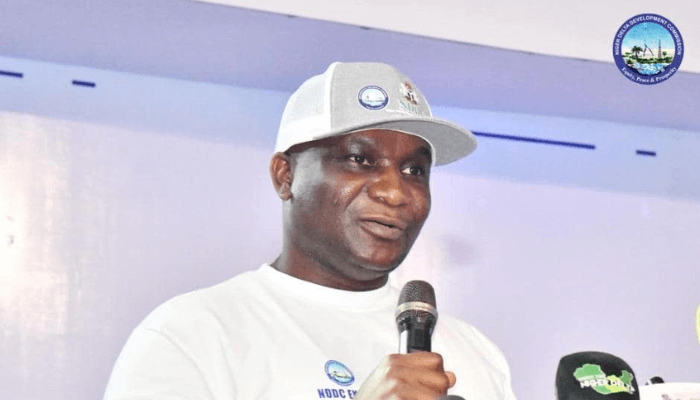
The chairman of the anti-crime agency confessed in Yenagoa that his perspective on the NDDC was turned around in 2024 when the NDDC management, led by Ogbuku, paid him a courtesy visit at the EFCC’s headquarters in Abuja.
Read also: NDDC, EFCC in strategic alliance to boost infrastructure in oil region
Olukoyede stated that he was impressed by the Commission’s “Rewind to Rebirth” initiative.
He declared: “The five minutes of interaction with the MD left me with a different perception of NDDC. Maybe, we will begin to see an NDDC that is a symbol of pride, accountability, transparency and able to deliver on its mandate.
“From his presentation, you can see that he is ready to bring a change, and that is the exact thing that we stand for in EFCC.”
This testimony seemed to be one in a lifetime because Nigerians only find the EFCC pumping dirt on the lowliness of Nigerian CEO over financial matters and looting. Rather, Olukoyede described the NDDC as a “renewed and transformed government agency.”
This new image of the Commission seems to win not only warmth but goodies to enable it work better. On this score, Olukoyede assured that the EFCC would do everything to recover all outstanding statutory contributions due to the NDDC from oil companies.
He noted: “We have made several recoveries on behalf of the NDDC, and we will not relent in this direction. We are encouraged by the fact that the NDDC is making the Renewed Hope Agenda of the Federal Government a reality in the Niger Delta region.”
The EFCC boss commended the NDDC for its institutional and policy reforms, declaring that the people of the Niger Delta will have every reason to celebrate the current leadership of the Commission. He described the NDDC as a beacon of good governance under President Bola Ahmed Tinubu.
He noted: “The Niger Delta is the goose that lays the golden egg and should not be denied the benefits of that golden egg. On our part at the EFCC, we must do everything within our power to ensure that the three per cent statutory contribution due to the NDDC is recovered and handed over to the Commission. We are going to continue supporting you.”
He said further: “Under this President, NDDC is working; good governance is being delivered. It is my delight to be part of this transformational agenda. The Renewed Hope Agenda is no longer a slogan—it is a reality. For the first time, people are identifying with what NDDC is doing.”
Olukoyede commended the NDDC, saying the Commission has refined its processes to uphold the principles of probity. This aligns with the agency’s head’s emphasis on upholding transparency and accountability in the country’s affairs.
Assuring that the EFCC would continue to assist the NDDC to achieve its mandate, he said: “We have been working with you to make recoveries; we will continue to do more.
“The collaboration is something we need to take to the next level, and with what you have put on the table I think we are ready to work with you to strengthen your systems and processes and to take the NDDC to the next level.”
The NDDC also went searching for transparency model from the ICPC which has also publicly stated that they collaborating with the NDDC to strengthen accountability and transparency. This collaboration includes establishing operational standards through a Memorandum of Understanding (MoU) to prevent corruption and enhance governance within the NDDC. The ICPC is also working with NDDC to establish an Anti-Corruption and Transparency Unit (ACTU) to sensitize staff, study processes, and develop ethical guidelines. They said: “The ICPC and NDDC are working together to create a more transparent and accountable environment within the NDDC. The collaboration involves developing a structured document, likely a Memorandum of Understanding (MoU), to outline operational standards for the NDDC. The ICPC is supporting the NDDC in establishing an Anti-Corruption and Transparency Unit (ACTU) tasked with studying and reviewing corruption-prone processes and procedures within the NDDC.
The document said the collaboration also aims to develop a code of ethics and conduct, including corruption prevention guidelines, for NDDC staff, and to implement mechanisms that prevent corruption and leakages within the organization.
The strengthened collaboration is intended to support the NDDC’s mandate of delivering development projects in the Niger Delta region, in line with constitutional provisions. The ICPC has also conducted sensitization programmes for NDDC staff on anti-corruption laws and best practices.
The National Assembly said it was aware that the NDDC was suffering from huge debts. They said: “The House is aware that the indebtedness of the IOCs to the NDDC had culminated in the drive by the Economic and Financial Crimes Commission (EFCC) to commence the debt recovery process.”
What the Ogbuku-led NDDC regime has achieved is to make the EFCC and ICPC focus only on recovering their trapped funds and not worry over the released funds sinking into any hole and getting lost again.
It has thus awakened many bodies into helping the NDDC both in budgeting and in recovery of debts and lost funds.
Read also: EFCC now satisfied, ready to release more NDDC recovered funds
Key challenge of the NDDC:
Beyond corruption that seemed to hold the Commission down for years before now, another major challenge was said to be envelope budgeting system. This is whereby little funds are allocated to every item but none would be meaningful enough to complete any of the projects in many years. So, every year, fund is allocated but not much is done. Almost every interest group including lawmakers, governors, ministers, influential people, all strive to get projects into the budget. So, apparently to satisfy each person, the funds are rationed round the projects but never enough to deliver.
The next seems to be the harsh environment of debts owed to the Commission by the federal government and oil companies in shortchanging manner. Traditional rulers of the oil states had fought this for years, naming over N3trn as outstanding. This seems to arise from confusing definition of what the NDDC Act said the FG and other funders should remit. Buhari at a point asked top government officials to look into it and if true, should create a system of refunding the money gradually. It is not clear where that landed the Commission because the masses were not told.
Tinubu came and has approved N1trn IOU to the NDDC hoping that their accumulated credits could be resolved to help knock it off.
So, without a doubt, the Niger Delta region is confronted with ecological and environmental challenges that should, perforce, attract significant funds from the Federal Government and the oil companies operating in the region.
Sadly, this has not been so, thus limiting the capacity of the NDDC to fulfill its mandate of driving the development process and transforming the Niger Delta region into one that is “economically prosperous, socially stable, ecologically regenerative and politically peaceful.”
It is rather unfortunate that, despite the spirited efforts by successive boards and managements of the NDDC to meet the expectations of the people, their efforts have not been matched with commensurate funding.
The issue of inadequate funding is resurfacing again. Indeed, it is an inconvenient truth that will remain on the front burner until it is fully addressed.
That explains why the NDDC Managing Director highlighted the issue during interactive sessions that the Commission’s board and management held with the relevant committees of the National Assembly in Abuja last year.
Ogbuku told the House of Representatives Committee on NDDC, chaired by Ibori-Suenu Erhiatake, that the Commission is owed over N2 trillion, arising from withheld funds and underpayments by both the government and the oil companies. He blamed this on non-compliance with the Act establishing the Commission.
Given the enormous impact of their activities on the environment, the oil companies are expected to be at the forefront in the critical task of urgently developing the oil basin that has suffered so much neglect in the past. It is, in fact, in their interest to develop the communities where they operate to guarantee peace, which is very necessary for them to continue with their work.
An insider in the NDDC said thankfully, both the Senate and the House of Representatives promised to assist the NDDC in recovering its outstanding funds. In their various interactions with the NDDC leadership, the lawmakers expressed concern about the disregard for existing laws governing the Commission’s funding.
The Chairman of the Senate Committee on NDDC, Asuquo Ekpenyong, expressed displeasure over the disregard for the law by the International Oil Companies (IOCs) and promised to call them to order.
The Senate Committee Chairman stated that proper funding would help NDDC to adequately address the sustainable development of the Niger Delta region, noting that the challenge of developing the region was enormous and that all relevant contributors to the NDDC must play their roles diligently.
Ekpenyong said that in discharging its oversight functions, his committee will ensure that every contributor to NDDC pays what they owe the Commission, “because we cannot afford to toy with the development of that very important region. We owe it to the country to make sure that we improve the living conditions of the people of the region.”
It is reassuring to note that both chambers of the National Assembly are concerned about the pressing funding challenges facing the NDDC and are taking steps to address the situation.
The lawmakers understand that we have a responsibility to adequately fuel the vehicle chosen to drive the development process in the Niger Delta region.
In 2023, the House of Representatives unveiled plans to investigate the activities of International Oil Companies (IOCs) operating in the Niger Delta region, as well as the recovery of over $4 billion (over N6trn) allegedly owed to the NDDC.
The resolution was passed sequel to the adoption of a motion sponsored by Hon. Donald Kimikanboh Ojogo, who frowned at the flagrant breach of the NDDC Act, 2000, which was established in response to heightened agitations and violent yearnings for special intervention in the oil-producing states.
Conclusion:
With the National Assembly turning from obstacle to solution centre by way of helping to recover trapped funds with legislative skills, and the EFCC and ICPC fiercely hunting down the trapped funds back to the owner, and above all, with the NDDC trusted now to handle the funds on transparent models, the project execution scheme of the Commission may move quicker and faster within the anniversary years and beyond.
Many however say prayers are needed to ensure that another disruption does not occur as 2027 hurtles down the lane ahead because in Nigeria, politics seems to rather disrupt, instead of advance good programmes.